

Addiss And Crofut – Eastern Ferris Wheel (1968)
Title: Eastern Ferris Wheel
Year: 1968
Format: LP
Label: Columbia
At their roots, Addiss & Crofut were folk musicians, but this hard to label record mixes elements of classical and jazz, as well as the music of Japan, Indonesia, China, Brazil, and more. Steve Addiss and Bill Crofut share the lead vocals; while Addis primarily plays 12-string guitar and Crofut plays both banjo and guitar. The unusual percussion instruments added on most of the tracks give this recording a true “world music” sound long before such a term was popular. Addiss’ “The Jimmy Song” begins with a direct quote from Bach’s Wachet Auf (Sleepers Awake).
Crofut’s “In Just Spring” is a magical setting to music of the famous poem by e.e. cummings, which he would perform to delighted audiences throughout the rest of his career. The Dave Brubeck Quartet (minus an absent Paul Desmond) guests on an unusual version of Brubeck’s “Forty Days” (from his oratorio “The Light in the Wilderness”), which also includes Palghat Raghu on mridangam.
Eclectic composer Charles Ives’ He Is There is a comic masterpiece (which contains a pastiche of brief references to bits of Americana such as “Dixie,” “Columbia the Gem of the Ocean,” “Tenting Tonight,” and “Yankee Doodle,” among others), complete with strings, piccolo, calliope, tuba, and even Crofut on French horn. This delightful LP will greatly appeal to open-minded listeners with wide-ranging tastes in music. (Ken Dryden, All Music Guide)
Track Listing
- The Jimmy Song
- In Just Spring
- Flowers Fall Away (Sakura, Sakura)
- Softly
- Down By The Meadow (Komoriuta)
- He Is There
- Willow Rustling In The Breeze (Suliram)
- Gentle Robyn (Gamban/Robyn)
- Forty Days
- High In The Mountain Pass (Alishan)
- Azulao
- Dry Riverbeds
- Spring
Harry Partch – The World Of Harry Partch (1969)
Title: The World Of Harry Partch
Year: 1969
Format: LP
Label: Columbia Masterworks
Composer, microtonal theorist, instrument-builder, writer, visual artist, satirist, philosopher, flunky, musicologist, copy editor, hobo, man of letters, publisher, iconoclast, record producer, eccentric, teacher….
Harry Partch challenged our entire musical world with, what I might term, his ‘back-to-nature’ approach to music and most especially to the Western diatonic scale and tuning system – what is termed the 12-tone equal tempered tuning system.
The 12-tone equal tempered tuning system has been around for about 300 years in the Western world but is scientifically an impure system of pitch relationships. In other words, notes have been ‘adjusted’ or put out of tune from the pure intervals of the harmonic series. This is borne out by the fact of much non-western music having different pitch relationships to the 12-tone system and, of course, much so-called ethnic music has been around since the dawn of time.
One of the most ancient scales exists in Javanese gamelan. In the Paris fair of 1898 composers such as Debussy were strongly influenced by these strange oriental scales and tuning systems. However, this wasn’t the first encounter by a westerner of such tuning systems. In 1580, for instance, Sir Francis Drake logged in his diary that the music of this land ‘was of a very strange kind, yet the sound was pleasant and delightful.’
Partch is perhaps best known for his innovative so-called 43-tone-to-the-octave scale structure. Partch realised that Western music since Gregorian chant was completely out of tune and set about devising a scale system based on the overtones of a vibrating string or column of air. He calls this system Monophony, as all the musical principles relate to ONE tone (i.e. the first eleven partials of the harmonic series).
Partch spent 12 years researching the science and musical theories which led him to this system beginning with Pythagoras (6th century BC) through Ptolemy (2nd cent. BC), Rameau (17th cent.) up to Riemann (19th/20th cent.) and concludes that Monophony reveals the falsification of the present 12-tone tempered scale and is not necessarily requisite to a practical music system, and that the basis of all musical materials lies in the understanding of the intervals that have true relationships i.e. those whose vibrations are expressed by small numbers.
“The creative person shows himself naked, and the more vigorous his creative act the more naked he appears – sometimes wholly vulnerable. yet always invulnerable in the sense of his own integrity. I am now 69 as this is being said, and I’ve been doing my own thing for more than five and a half decades. This thing began with truth, and truth does exist. For some hundreds of years, the truth of Just Intonation, which is defined in any good music dictionary, has been hidden. One could almost say maliciously. because truth always threatens the ruling hierarchy, or they think so. Nor does the spiritual, corporeal nature of man fare any better. We are reduced to specialties: a theatre of dialogue without music, and a concert of music without drama. Basic mutilations of ancient concept. My music is visual; it is corporeal, aural, and visual.
The creative man will rise above, he will transcend the mutilations. for every deeply sincere offering there is a corresponding deep and sincere hunger. Not the European chauvinism of New York, nor the mindless caterwauling of Hollywood recording studios, nor the “we-sell-music-by- the-yard,” mood-music people, can suppress either the sincere offering or the sincere hunger. True creativity is present. It is here, because man is here, in his true, deep, self. Unmutilated.”
“Harry Partch is an American visionary and stubborn individualist. . . . He has built his own musical world out of microtones, hobo speech, elastic octaves and percussion instruments made from hubcaps and nuclear cloud chambers. Recently. . . . an army of young music lovers stormed New York’s Whitney Museum to hear Harry Partch and his thirteen disciples produce a music that was totally personal and eclectic in the best sense. African polyrhythms, and ancient Greek modes, bits of Babylonia and the pulse of the American diesel engine all gathered into a richly erotic, primitive, fresh and stirring drama of sound” – Newsweek.
“The work that I have been doing these many years parallels much in the attitudes and actions of primitive man. He found sound-magic in the common materials around him. He then proceeded to make the vehicle, the instrument, as visually beautiful as he could. Finally, he involved the sound-magic and the visual beauty in his everyday words and experiences, his ritual and drama, in order to lend greater meaning to his life. This is my trinity: sound-magic, visual beauty, experience-ritual.”
“The major contribution of Monophony an intonational system is its realisation of a subtle and acoustically precise interrelationship of tonalities, all stemming or expanding from unity, 1/1. This interrelation is not capable of manifold modulations to “dominants” or to any other common scale degrees; it is not capable of parallel transpositions of intricate musical structures; it does not present any tone as any specific tonal identity.
Conversely, it is capable of both ordinary and hitherto unheard modulations to the natural limits imposed by Just Intonation and the arbitrary limit of 11; it is capable of an expanded sense of tonality, from Identities 1-3-5 to identities 1-3-5-7-9-11; it is capable of great variety in that expanded sense; it does offer twenty-eight possible tonalities, more than are inherent in Equal Temperament, and therefore a greater total of tonality identities; or assumable senses, than does Equal Temperament.” Harry Partch. (Prairie Prince Minsky)
Track Listing
- Daphne Of The Dunes
- Barstow – Eight Hitchhiker Inscriptions From A Highway Railing At Barstow, California
- Castor & Pollux – A Dance For The Twin Rhythms Of Gemini From Plectra & Percussion Dances
Disclaimer: The link below may point to content that is copyrighted. redtelephone66 only provides this link with the understanding that you are responsible for the content you download. redtelephone66 does not engage in music piracy, nor do we do host, fileshare, or otherwise trade in copyrighted works.

Kalyani Roy & Ali Ahmed Hussein – Sounds Of India (1968)
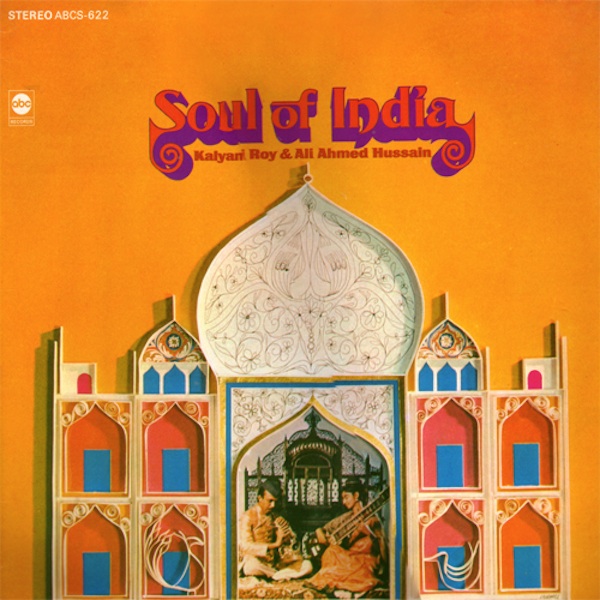
Title: Sounds Of India
Year: 1968
Format: LP
Label: ABC
Sitarist Kalyani Roy is one of the few major women instrumentalists in her genre, with a career spanning 50 years. She’s a disciple of Vilayat Khan & has had training from others, including percussion genius Jnan Prakash Ghosh. “Sounds Of India” also features Ali Ahmad Hussain, one of the veterans and maestros of shehnai– an instrument which is a very integral part of Indian Classical musical culture. (Prairie Prince Minsky)
Track Listing
- Raga: Jaunpuri: Alap; Jod; Gat; Taal:Teental
- Raga: Kedara – Alap; Gat Taal:Teental
- Dhun
Disclaimer: The link below may point to content that is copyrighted. redtelephone66 only provides this link with the understanding that you are responsible for the content you download. redtelephone66 does not engage in music piracy, nor do we do host, fileshare, or otherwise trade in copyrighted works.
Sergio Mendes & Brasil ’66 – Crystal Illusions (1969)
Artist: Sergio Mendes & Brasil ’66
Title: Crystal Illusions
Year: 1968
Format: LP
Label: A&M
The sound and band that served Sergio Mendes well on Fool on the Hill remain intact on Crystal Illusions, with few modifications. Dave Grusin is right there with a lush, haunting orchestral chart when needed; Lani Hall is thrust further into the vocal spotlight, as cool and alluring as ever in Portuguese or English.
Mendes remained on the lookout for fresh Brazilian tunes, and he came up with a coup, one of the earliest covers of a Milton Nascimento tune to reach North America, “Vera Cruz” (with Hall’s English lyrics, it became “Empty Faces”), as well as Dori Caymmi’s “Dois Dias.”
The two singles, the perky “Pretty World” and sax-streaked cover of Otis Redding’s “The Dock of the Bay,” are nice slices of Mendes pop, though they were not significant hits. And yes, Sergio Mendes & Brasil ’66 did take a large risk on the title track, a lengthy, kaleidoscopic treatment of an Edu Lobo tune that, inspired perhaps by “MacArthur Park,” shattered radio’s time barrier at seven minutes and 50 seconds.
Yet while Grusin goes into a psychedelic freakout, we get a rare chance to hear Mendes stretch out a bit on electric piano. Weird and overblown, but wonderful. (Allmusic)
Track Listing
- Dock Of The Bay
- Viola Enluarada
- Song Of No Regrets
- Salt Sea
- Empty Faces
- Pretty World
- Dois Dias
- You Stepped Out Of A Dream
- Crystal Illusions
Seemon & Marijke – Son Of America (1971)
Title: Son Of America
Year: 1971
Format: LP
Label: A&M
A.k.a. Simon Posthuma and Marijke Koger, who started designing clothes and posters in Amsterdam around 1964, where they had an ‘alternative’ boutique called Trend. On their many trips abroad they got acquainted with Eastern music and they eventually landed in London, where they designed clothes and record sleeves for the Hollies and Cream (amongst others).
With Englishman Barry Finch and ex-colleague Josje Leeger from Amsterdam they formed The Fool in 1967 (named after the Beatles number, “Fool on the Hill”). The Fool released a few singles and an LP (produced by Graham Nash) which did quite well, particularly in America, following a U.S. tour in 1969. In 1970, The Fool split up; Simon & Marijke continued recording as a duo. (Alex Gitlin)
Track Listing
- The Son Of America
- I Saw You
- Keep On Keepin’ On
- Roselie
- Vegetable Stew
- The White Watch
- It Is All There
- Twinsouls
- Room 44
- Sitting On A Hilltop – Part I
- Sitting On A Hilltop – Part II
- Everybody’s Dancing
Truth – Truth (1970)
Title: Truth
Year: 1970
Format: LP
Label: People
Truth were a Los Angeles Xian trio that very little is known, the album was recorded at Master Recording Studio in Beverly Hills in late 1969 with songs penned by Bob Doran and J. Kerr. The album follows the trend of late sixties xian rural bands from the Los Angeles area and includes some great tracks including the fabulous sitar tinged “Thoughts”, the country/folk flavored “Being Farmed”, and an interesting remake of Joe South’s “Walk A Mile In My Shoes” among others. (Max Collodie)
Track Listing
- Have You Forgotten
- Being Farmed
- Anybody Here Know How To Pray
- Wise Old Fool
- Let It Out, Let It In
- Far Out
- Walk A Mile In My Shoes
- Thoughts
- New York
- Contibutin’
- Lizzie
- Talk
Disclaimer: The link below may point to content that is copyrighted. redtelephone66 only provides this link with the understanding that you are responsible for the content you download. redtelephone66 does not engage in music piracy, nor do we do host, fileshare, or otherwise trade in copyrighted works.
Brothers And Sisters Of Los Angeles – Dylan’s Gospel (1969)
Title: Dylan’s Gospel
Year: 1969
Format: LP
Label: Ode
This combination of the revolutionary Gospel music of the late 60′s, ushered in by Edwin Hawkins, and the revolutionary music of Bob Dylan is one of the most extraordinary manifestations of the 60′s era.
This style of Gospel music was heard in the streets, and played in clubs, which helped to further redefine its purpose, as it grew into world music. Dylan’s music had captured the minds and hearts of young Americans, as well as youth throughout the world. Combining the two genres was pure 60′s genius, and is a joy to listen to over 40 years later.
The Gospel music of the late 60′s with its political, social and cultural statements had its listeners, and Dylan’s music had its listeners. This recording exposed the two groups to music very different from what they were used to, yet there was a familiar consciousness. The times, they were a changin’. (Warren Montgomery)
Track Listing
- The Times They Are A Changin’
- I Shall Be Released
- Lay Lady Lay
- Mr. Tambourine Man
- All Along The Watchtower
- The Mighty Quinn
- Chimes Of Freedom
- I’ll Be Your Baby Tonight
- My Back Pages
- Just Like A Woman
Norman Greenbaum – With Dr. West’s Medicine Show And Junk Band (1968)
Title: With Dr. West’s Medicine Show And Junk Band
Year: 1968
Format: LP
Label: Gregar
Note: This album is basically the same as the GO GO release, though the tracklist differs and omits the songs “Nora” and “You Can’t Fight City Hall” and “The Eggplant That Ate Chicago” but does include “Gondoliers (Shakespears, Overseers, Playboys, And Bums)” (Max Collodie)
Track Listing
- Gondoliers (Shakespeares, Overseers, Playboys, And Bums)
- Modern Day Fish
- The Old Fruit Peddler
- Dominaiting Baby
- Weird
- Daddy-I Know
- Patented Medicine
- A Summer Love Song
- How Lew Sin Ate
- Just Look At Her Now
Dr. West’s Medicine Show And Junk Band – The Eggplant That Ate Chicago (1967)
Title: The Eggplant That Ate Chicago
Year: 1967
Format: LP
Label: GO GO
Having played Boston’s folk circuit for several years while attending Boston University, 1966 found singer/guitarist Norman Greenbaum deciding to form his own jug band. Recruiting guitarists Jack Carrington and Bonnie Wallach as well as drummer Evan Engber, the quartet quickly attracted local attention as ‘Dr. West’s Medicine Show and Junk Band’. Playing material similar to early Lovin’ Spoonful, their stage show incorporated multi-media, including makeup, between song medicine show spiels and psychedlic light shows.
Signed by the small Go Go label (cool company logo),1967’s “The Eggplant That Ate Chicago” teamed the band with producer Tony Marner. With Greenbaum penning the virtually all their material, the album featured an oddball hybrid of jug music (the title track), mixed with outright wierdness (check out the title track and the autobiographical “Weird”) and proto-psychedlic lyrics (“How Lew Sin Aint” – aka “hallucenate”). To be honest, the album’s way different and simply hard to aptly describe.
All acoustic (with a penchant for kazoos), be forewarned that it’s not a classic rock album. Released as a single the title track b/w “You Can’t Fight City Hall Blues” (Go Go catalog number 00100) hit the top-100. The success did little to keep the band’s momentum going and by the end of the year they’d called it quits with Greenbaum subsequently reemerging as a solo act (see separate entry).
It’s equally interesting in that, even though it’s rare (we’ve seen three copies in our collecting days), it has yet to attain much recognition in collector’s circles. As such, it’s still a reasonable buy. (By the way, the track listing shown on the liner notes doesn’t match the actual playing order.) (RDTEN1)
Track Listing
- Patent Medicine
- A Summer Love Song
- How Lew Sin Ate
- Nora
- Look At Her Now
- The Eggplant That Ate Chicago
- Modern Day Fish
- The Old Fruit Peddler
- Dominating Baby
- Weird
- You Can’t Fight City Hall Blues [bonus 45 B side]
Ford Theatre – Presents “Time Changes” A New Musical (1969)
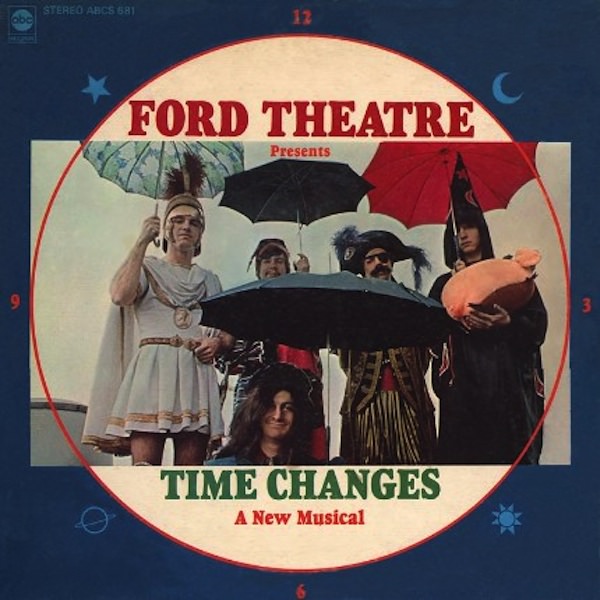
Title: Presents “Time Changes” A New Musical
Year: 1969
Format: LP
Label: ABC
Ford Theatre’s second and final album, Time Changes, was constructed around more conventionally-timed pieces, and was an early production by Bill Szymczyk, who went on to produce the Eagles. Ford Theatre guitarist Harry Palmer is the uncle of underground cult musician R. Stevie Moore. (Richie Unterberger)
Track Listing
- ACT I ( I. Introduction II. Time Changes III. Interlude One IV. That’s My Girl V. Wake Up In The Morning VI. I’ve Got The Fever VII. Crash VIII. At The Station)
- ACT II ( I. Back To Philadelphia II. Clifford’s Dilemma III. Jefferson Airplane IV. I Feel Uncertain V. Interlude Two VI. Good Thing VII. Outroduction)
Disclaimer: The link below may point to content that is copyrighted. redtelephone66 only provides this link with the understanding that you are responsible for the content you download. redtelephone66 does not engage in music piracy, nor do we do host, fileshare, or otherwise trade in copyrighted works.