

Gypsy Boots And The Nature Boys – Unpredictable! (1968)

Title: Unpredictable!
Year: 1968
Format: LP
Label: Sidewalk
Robert “Gypsy Boots” Bootzin (August 19, 1914 – August 8, 2004) was an American fitness pioneer. He is credited with laying the foundation for the acceptance by mainstream America of “alternative” lifestyles such as yoga and organic food.
Born in San Francisco as the son of Russian-Jewish immigrants, Bootzin had “dropped out” as early as 1933. He, along with 10-15 other “tribesmen,” lived off the land, slept in caves and trees, and bathed in waterfalls. His philosophy of clean living, exercise, and healthy eating as laid out in his books Barefeet and Good Things to Eat and The Gypsy in Me gained him a cult following.
His health food store “Health Hut” was one of the first of its kind in the world (if not the first), and was patronized by dozens of Hollywood celebrities in the early 1960s. The original Health Hut had an authentic “Tiki” style to it made with leaves and bamboo. It has been said many of the cast members of “Gilligan’s Island” TV series had met there and the “Tiki” theme is said to have been part of the inspiration before the TV show began.
Gypsy Boots continued to travel with the Spike Jones Musical/Comedy troup and speaking about health foods. He was a regular guest on US television talk shows in the 1960s, appearing 25 times on The Steve Allen Show, reaching 30 million viewers and increased his national fame. On the Steve Allen Show he would often play up his role as a health advocate by swinging up on stage from a vine as a “Nature Boy” to persuade Steve to drink one of “Gypsy Boots” concocted fruit health drinks. He referred to this drink as a “Smoothie”, giving credo Gypsy Boots as the originator of the popular style of blended natural fruit health drinks.
Gypsy Boots personally espoused never eating meat, drinking alcohol, or smoking tobacco. He was an early believer in the health properties of organic foodstuffs. One of these organic foods was garlic –which he later became a spokesperson for the “Kyolic” variety. He also did work for a Sonoma cheese factory. He would often have a garlic spiced cheese “Sonoma Jack” at his booth at health festivals and faires from the “Valley of the Moon”. Along with his all-natural sugar-free “Boots Bars”, Wheat Grass, Spirulina and Kyolic. As well as “honey sweet” Medjoule Dates from his orchard.
At age 84, he was still able to throw an American football around forty yards.
He released a record album, Unpredictable on Sidewalk Records in 1968.
He has authored an autobiograhy entitled The Gypsy in Me in which it also contains some of his advice and healthy recipes.
“Boots” was an avid fan of the USC Trojans football team and the Los Angeles Dodgers. He regularly attended the games of both teams and was well known by other fans for his spirited cheers, noise makers and streamers.
The 1948 Nat King Cole hit “Nature Boy” was written about Bootzin by fellow “tribesman” Eden Ahbez.
He died, reportedly at age 89, in Camarillo, California. (Prairie Prince Minsky)
Track Listing
- Fight On For The U.S.C.
- Golden Earrings
- He’s Got The Whole World In His Hands
- I Feel So Fine
- I’m Gypsy Boots
- Laugh And Sing
- Learn To Be A Drinker
- These Boots Are Made For Walking
- We’re Havin’ A Love-in
- Winchester Cathedral
Marks And Lebzelter – Rock And Other Four Letter Words (1968)
Title: Rock And Other Four Letter Words
Year: 1967
Format: LP
Label: Columbia Masterworks
Rock And Other Four Letter Words was a concept album put together by the duo of J. Marks and Shipen Lebzelter. The songs consist of various voiceovers and strange noises to create meandering soundscapes, mixed in with the occasional blaring Rock guitar obviously aimed at the Psychedelic-drug crowd of the 60s.
The best songs are Other Four Letter Words that begins with a little orchestration, and then an effects laden conversation that eventually gives way to a loud guitar Rock cut with a banging fuzz heavy rhythm and a drum break.
There’s also the slow groover It’s True with some females singing, the jazzy Rock of Trouble with female back-ups and more of that guitar work, and Poop For Sopranos And Orchestra that switches between some swinging versus with two female lead singers and more abstract and spaced-out interludes. (Motown67)
Track Listing
- Other Four Letter Words
- Essence Of It’s Own
- It’s True
- Greatest Hits – Love Your Navel
- In The Middle Of Nothing
- Baked Beans
- They’re Through
- Today
- Eine Kleine Hayakawa
- Do You Understand What I’m Trying To Say?
- Trouble
- Poop For Sopranos And Orchestra
- This Is The Word
LSD – A Documentary Report (1966)
Title: A Documentary Report
Year: 1966
Format: LP
Label: Capitol
The granddaddy of all LSD documentaries sounds even better today than when it was released. The attitude is mocking and hostile in an understated manner rather than openly confrontational, perhaps because it was made at such an early stage. Interviews with acid luminaries, regular heads and neutral observers are tied together with classy narration and musical fragments, and an unforgettable peak is reached with an actual trip recording of “Brian”, a hipster acid head who unfortunately happens to have his first bad LSD experience while being recorded (with concealed microphones). The recording is authentic-sounding and either very funny or pretty scary, depending on how hard-core you are. (Lysergia.com)
The menace of LSD on wax! Side One is called “The Trip” and it consists of people talking about their personal experiences on acid. The best being a guy who they actually tape recorded having a bad trip. There is about 5 minutes or so of this dude just freaking out, all by himself, in a dark room. Supposedly these are highlights of a bad trip that lasted 12 hours and resulted in him permanently losing his mind. Other goodies include Huxley’s widow talking about showering angry mobs with acid fumes to create peace, Ginsberg chanting with gurus, and a hippy chick talking about an especially groovy shower – and that’s just side one!
Side Two is called “The Scene”, and it deals more with the Sociological aspects of drug culture. This must have come out right when Acid was outlawed, and you can tell it is supposed to be a piece of anti-drug propaganda, but they just make it sound like such darn good fun! I’m sure this lp was responsible for pushing many curious youths the last few inches to “turning on”. (Waxidermy)
This LP was created and released in 1966 by Capitol Records as a response to the burgeoning use of LSD — lysergic acid diethylamide — among American teenagers. The rear album jacket proclaims “A documentary report on the current psychedelic drug controversy!” Almost salaciously, the contents are depicted as “Actual recordings of people under the influence of psychedelic drugs… Psychedelic music… The sound of the “Acid Test”… LSD users and pushers and the amazing story of LSD in action.”
In an ironic and fascinating twist, some of that “psychedelic music” — particularly the fast-paced tune heard at the beginning of side two — is that of Neal Cassidy and a pre-Grateful Dead combo called the Warlocks performing “Speed Limit” circa 1965. Each side of the long-player consists of a single, continuous track.
Narrated by author Lawrence Schiller, side one sets “The Scene” with information on the history of the drug, its effects, as well as sound bites of acid users — both novice and seasoned — during and after use. Likewise there are points of view from leading authorities in the medical community via Dr. Sidney Cohen, M.D. — from the Psychosomatic Services division of the Wadsworth V. A. Hospital in Los Angeles, CA. Conversely, several minutes are devoted to the warnings and proselytizations of Dr. Timothy Leary and a variety of young men and women — from equally diverse walks of life — who speak candidly about their experiences — both pro and con.
Several countercultural iconic names are dropped, most prominent among them is that of Owsley Stanley aka Bear. He is specifically mentioned for creating a synthesis which left the LSD practically free of impurities and, for a time, the safest non- pharmaceutical acid being circulated. Side two contains “The Trip” where Schiller again guides listeners through comments from primarily teens about when they began their experimentation and what (if anything) they were able to take from their use. Next up is the audio vérité eight-party acid trip. One of the participants — named “Brian” — is the primary focus of Schiller’s occasional commentary.
Despite his purported familiarity with the drug, its ability to incapacitate becomes evident and his already fragile psyche turns increasingly dark and introspective as “Brian” is heard going through an especially unpleasant manic and psychotic episode. Or, as Schiller refers to it, a “rocky journey [that] ended 12 hours after it had so innocently begun.” As to the positive uses of the compound, both Schiller and Dr. Cohen are not secretive about the treatment of cancer patients, chronic alcoholics, and even the breakthroughs in therapy for mentally-challenged children. After providing a brief update of LSD’s legal nature — circa 1966 — there are additional quotes from Laura Archera Huxley, widow and biographer for her late husband, author of The Doors of Perception, Aldous Huxley. She vehemently disagrees with the illegality of the drug, yet is quick to warn of its dangers when used irresponsibly.
Following a brief allusion to the infamous Acid Tests held by Ken Kesey and company, portions of a live Allen Ginsberg poetry reading are played prior to some interview clips in which he talks about his revelations and insights on the substance. There are also a few minutes of rambling Acid Test recordings, concluding with the profound statement that “… on the basis of the evidence… the answer to the LSD problem should be just about as obvious as the basic question: Is this trip really necessary?”
The LP’s inner-gatefold includes a “Glossary of terms used in this album” with an A to Z of hippie slang — from “Acidhead” to “Turn On,” while the back cover has an essay from concurrent Capitol Records President, Alan W. Livingston that, in part, states “At Capitol Records we live in a world of the young — a world of rock ‘n’ roll music, amid the need for a constant awareness of teenage interests of all kinds.” (Lindsay Planer, All Music Guide)
Track Listing
- The Scene
- The Trip
LSD – Promo – Open-End Interview With Dr. Sidney Cohen And Excerpts From Lp (1966)
Title: Promo – Open-End Interview With Dr. Sidney Cohen And Excerpts From Lp
Year: 1966
Format: LP
Label: Capitol
This is the companion release to the LSD documentary album. It was released to radio stations to promote the lp and contains an “open-end” interview with Doctor Sidney Cohen, M.D.. This “interview” is similar to the open-end interview album released by the Byrds to promote their “5D (Fifth Dimension)” album where DJs would play this record and have a list of questions that would be “answered” by playing back the record, an ingenious way to promote, saving the artist a lot of time and travel. This particular record also contains excerpts from the released album.
Track Listing
- Open-End Interview With Dr. Sidney Cohen/LSD [Excerpt]
- Allen Ginsberg [Excerpt]
- The “Lost Generation” [Excerpt]
- Users [Excerpt]
- Trip [Excerpt]
- Dr. Timothy Leary [Excerpt]
Malachi – Holy Music (1966)
Title: Holy Music
Year: 1966
Format: LP
Label: Verve
A very tripped-out set of meditation music issued by Verve in the late 60s, and arguably even more spacey and atmospheric than some of Tony Scott’s similar records for the label at the time! Malachi is actually John Morgan Newbern working here in a spare setting to capture the “evening vibrations” of a single night in 1966 served up through instrumentation that includes low-end percussion, acoustic guitar, and a fair bit of Jew’s harp played by Steve Cunningham (of Red Crayola fame), but drifting out slowly over the longer tracks in the set.
The album’s an early example of the extremes that 60s labels used to address the growing interest in Eastern ideals at the time and it’s much less commercial than some of the more gimmicky sessions of the decade. Titles include “Wednesday — Second”, “Wednesday — Sixth”, “Wednesday — Fourth”, “Wednesday — Fifth”, and “Wednesday — Eighth”.
John Morgan Newbern first appeared in the mid ’60s under the name, Malachi. His first major release, titled “Malachi/Holy Music” was on the M.G.M.-Verve label. John’s music has always been considered unique and is said to be one of the early influences in the birth of the New Age genre. However so, John considers his music to be more “ancient age” than “New Age”. Either way, these performances are definitely a spiritual fusion of world sounds.
Born in Baltimore, Maryland in 1944 to parents of Swiss and French ancestry, the direction of John’s life was to be towards a life in the military. A series of unusual events surrounding a visit to Kukulkan’s Pyramid in Chichen Itza, Yucatan, Mexico in 1955 would, to his parents disapproval, change that direction forever. The phenomenal presence of the ancient temple of the Maya so touched his life that the next decades would be spent in search of the root of the truth, leading to the creation of the music you find here.
The late poet, Alan Ginsburg once said of John’s music: “He listens quietly to himself and then he plays what he hears. Poe would have enjoyed his presence.” (Prairie Prince Minsky)
Track Listing
- WEDNESDAY – Second
- WEDNESDAY – Sixth
- WEDNESDAY – Fourth
- WEDNESDAY – Fifth
- WEDNESDAY – Eighth
Children Of One – Children Of One (1969)
Title: Children Of One
Year: 1969
Format: LP
Label: Real
Children Of One consisted of Lucas Mason (flute-piano), Peter Sokolow (bass clarinet), Leonard Lonergan (soprano sax), Bala Krishna (sitar), Les Grinage, (cello-dilruba), Lakshmi (tanpura), Konrad Kaufman (percussion), and Vera Sokolow, Paula Mason & Irin Poellot (chorus).
Released on the small New York based Real label in 1969, the Children Of One were pioneers in what would eventually become known as New Age Music. Most of the music on this album is based on Eastern meditative improvisation and at times classical in structure with female vocals according to reviewer Michael Parker as “wordless, somewhat operatic in style that comes off as mysterious and ritualistic instead of gratuitous or annoying” (the only exception is Konrad Kaufman’s five minute drum solo “Konrad’s Rap”). (Jack Dominilla)
Track Listing
- Getting Together
- Here And Now
- Spheres
- Angel Dance
- Eastern Cloth
- Time Turns Towards Tomorrow
- Konrads Rap
- Short Talk
- Was And Will Be
Timothy Leary – Turn On, Tune In, Drop Out (1966)

Title: Turn On, Tune In, Drop Out
Year: 1966
Format: LP
Label: ESP Disk
This unadorned spoken word recording of the 60’s icon, Timothy Leary (“the most dangerous man alive”), was recorded at the famous Millbrook, New York estate just before his famous residency was ended by repeated raids and arrests by G. Gordon Liddy.
Though the album title, Turn On, Tune In, Drop Out, became a clichéd rallying cry for a whole generation, it was presented to the public here for the first time.
In this document he presents his ideas on drugs, current events and cultural phenomena, with recollections of earlier experiences and experiments; all delivered in a straight ahead, quiet manner even though the content is downright subversive and confrontational. An absolute must for anyone interested in the 1960’s or countercultural thinking of any era. (ESP DISK)
Track Listing
- Side One
- Side Two
Baba Ram Dass (Dr. Richard Alpert) – Here We All Are (1969)
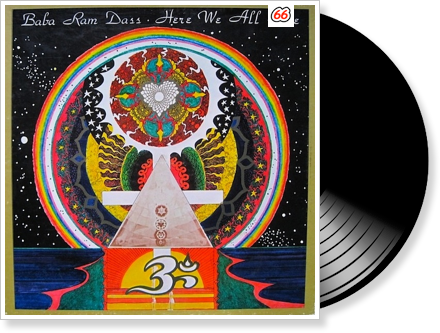
Title: Here We All Are
Year: 1969
Format: LP
Label: Yogananda
HERE WE ALL ARE is the story of the evolution of RICHARD ALPERT, from Harvard University professor and successful psychologist, to BABA RAM DASS, wandering sadhu of holy man. Describing his early days with TIMOTHY LEARY and his introduction to Psychedelics, BABA RAM DASS tells of his growing desire to stay permanently “high” and off his quest to find someone who really “knows”.
His search eventually leads to an agonizing barefoot trek through India and to his Guru, a totally conscious being living in a constant state of Sahaj Samhadi. BABA RAM DASS concludes with an explanation of one of the most exquisitely articulated systems for spiritual enlightment known to man, ths system of Ashtanga, or Raja Yoga, and shares with those on a similar journey his knowledge of how it all is in the universe.
Recorded live in the summer of 1969 in Vancouver, BC, Canada, produced by Inner Sound Productions of Yogananda Ashram Society, and manufactured by Rada Record Pressings of Burnaby, BC. 3 records, 6 sides, 2 hours and 10 minutes listening time. (Jack Dominilla)
Richard Alpert (born April 6, 1931), also known as Baba Ram Dass, is a contemporary spiritual teacher who wrote the 1971 bestseller Be Here Now. He is well known for his personal and professional association with Timothy Leary at Harvard University in the early 1960s. He is also known for his travels to India and his relationship with the Hindu guru Neem Karoli Baba.
Alpert was born to a prominent Jewish family in Newton, Massachusetts. His father, George Alpert, was one of the most influential lawyers in the Boston area and president of the New York, New Haven and Hartford Railroad, as well as one of the leading founders of Brandeis University and the Albert Einstein College of Medicine.
The youngest of three boys, Richard as a child was described as being engaging and loved by all—the family mascot. He went on to receive a Bachelor of Arts degree from Tufts University, master’s degree from Wesleyan University and doctorate (in psychology) from Stanford University.
After returning from a visiting professorship at the University of California, Berkeley, Alpert accepted a permanent position at Harvard, where he worked with the Social Relations Department, the Psychology Department, the Graduate School of Education, and the Health Service, where he was a therapist. He was also awarded research contracts with Yale and Stanford. However, perhaps most notable was the work he was doing with his close friend and associate, Dr. Timothy Leary.
Having only recently obtained his pilot’s license, Alpert flew his private plane to Cuernavaca, Mexico, where Leary first introduced him to teonanácatl, the Magic Mushrooms of Mexico. By the time Alpert made it back to America, Leary had already consulted with Aldous Huxley, who was visiting at M. I.T. Through Huxley and a number of graduate students they were able to get in touch with Sandoz, which had produced a synthetic component of ergot wheat fungus called LSD.
Alpert and Leary brought a test batch of both substances back to Harvard, where they conducted the Harvard Psilocybin Project and experimented with LSD relatively privately. Alpert was later dismissed from the university in 1963; according to Harvard President Nathan M. Pusey, Leary was dismissed for leaving Cambridge and his classes without permission or notice, and Alpert for allegedly giving psilocybin to an undergraduate. By this time, however, Alpert had already become disillusioned with academia and even described himself as feeling trapped in a meaningless game, and Leary had already left the university some weeks earlier.
The two soon relocated and continued their experiments unsupervised from a private mansion in Millbrook, New York, owned by Billy Hitchcock, an heir to the Mellon fortune. Famous poets, musicians and intellectuals of the time, such as Allen Ginsberg, Maynard Ferguson, the Grateful Dead, Marshall McLuhan and Ken Kesey, came from across the country to be part of what was going on there. Although they remained life-long friends, the two eventually began to part ways spiritually and philosophically as Leary continued to spread his mantra of “turn on, tune in, drop out,” while Alpert increasingly found his purpose in the Hindu ethic of serving others.
In 1967 Alpert traveled to India, where he met the American spiritual seeker Bhagavan Das. As he guided Alpert barefoot from temple to temple, Bhagavan Das began teaching him basic mantras and asanas, as well as how to work with beads. After a few months, Bhagavan Das led Alpert to his guru, Neem Karoli Baba, or as he is better known in the West, Maharaj-ji. Maharaj-ji soon became Alpert’s guru and gave him the name “Ram Dass,” which means “servant of God.” Under the guidance of Maharaj-ji, Ram Dass was instructed to receive teaching from Hari Dass Baba, who taught in silence using only a chalkboard.
While in India, Ram Dass also corresponded with Meher Baba; however, he remained primarily focused on the teaching of Hari Dass Baba. Among other things, Hari Dass Baba trained Ram Dass in raja yoga and ahimsa. It was these life-changing experiences in India that inspired Ram Dass to write the contemporary spiritual classic, Be Here Now, in which he teaches that everyone is a manifestation of God and that every moment is of infinite significance.
After his return to the United States in 1969, Alpert founded several organizations dedicated to expanding spiritual awareness and promoting spiritual growth, including Hanuman Foundation. Since then he has embraced a wide variety of spiritual traditions and practices, including guru kripa (grace of the guru) ; bhakti yoga focused on the Hindu spiritual deva Hanuman; meditation in various schools of Buddhism such as Theravada and Mahayana (including Tibetan and Zen) ; karma yoga; and Jewish studies.
In February 1997, he suffered a stroke which left him with expressive aphasia, however, he interprets his stroke as an act of grace and continues to travel giving lectures, as his health permits. When asked if he could sum up his life’s message Ram Dass replied, “I help people as a way to work on myself, and I work on myself to help people… To me, that’s what the emerging game is all about.” He was awarded the Peace Abbey Courage of Conscience Award in August 1991.
Ram Dass has long acknowledged his bisexuality. In the 1990s, he became more forthcoming while avoiding labels and pointing out that who we are “isn’t gay, and it’s not not-gay, and it’s not anything—it’s just awareness.” (Wikipedia)
Track Listing
- Here We All Are [Side One]
- Here We All Are [Side Two]
- Here We All Are [Side Three]
- Here We All Are [Side Four]
- Here We All Are [Side Five]
- Here We All Are [Side Six]
One Song – One Song (1974)
Artist: One Song
Title: One Song
Year: 1974
Format: LP
Label: Paula
A Houston, Texas Christian rock group led by Pete Sanchez, Jr. featuring a very talented brass and rhythm section and some nice male/female vocals and harmonies on some well crafted original songs. If xian music isn’t your bag steer clear, but if it is, you’ll enjoy this one. (Jack Dominilla)
Track Listing
- He Is Worthy
- When We All Get To Heaven
- Life Begins At Calvary
- Prodigal Son
- Jesus
- Sing And Shout
- Hallelujah, Praise The Lord
- It Just Keeps Getting Better
- Jesus Wrapped Me In His Arms
- Praise The Lord
Malachi – Holy Music (1966)
Title: Holy Music
Year: 1966
Format: LP
Label: Verve
A very tripped-out set of meditation music issued by Verve in the late 60s, and arguably even more spacey and atmospheric than some of Tony Scott’s similar records for the label at the time! Malachi is actually John Morgan Newbern working here in a spare setting to capture the “evening vibrations” of a single night in 1966 served up through instrumentation that includes low-end percussion, acoustic guitar, and a fair bit of Jew’s harp played by Steve Cunningham (of Red Crayola fame), but drifting out slowly over the longer tracks in the set.
The album’s an early example of the extremes that 60s labels used to address the growing interest in Eastern ideals at the time and it’s much less commercial than some of the more gimmicky sessions of the decade. Titles include “Wednesday — Second”, “Wednesday — Sixth”, “Wednesday — Fourth”, “Wednesday — Fifth”, and “Wednesday — Eighth”.
John Morgan Newbern first appeared in the mid ’60s under the name, Malachi. His first major release, titled “Malachi/Holy Music” was on the M.G.M.-Verve label. John’s music has always been considered unique and is said to be one of the early influences in the birth of the New Age genre. However so, John considers his music to be more “ancient age” than “New Age”. Either way, these performances are definitely a spiritual fusion of world sounds.
Born in Baltimore, Maryland in 1944 to parents of Swiss and French ancestry, the direction of John’s life was to be towards a life in the military. A series of unusual events surrounding a visit to Kukulkan’s Pyramid in Chichen Itza, Yucatan, Mexico in 1955 would, to his parents disapproval, change that direction forever. The phenomenal presence of the ancient temple of the Maya so touched his life that the next decades would be spent in search of the root of the truth, leading to the creation of the music you find here.
The late poet, Alan Ginsburg once said of John’s music: “He listens quietly to himself and then he plays what he hears. Poe would have enjoyed his presence.” (Prairie Prince Minsky)
Track Listing
- WEDNESDAY – Second
- WEDNESDAY – Sixth
- WEDNESDAY – Fourth
- WEDNESDAY – Fifth
- WEDNESDAY – Eighth