

Rosko & The John Berberian Ensemble – Music And Gibran (1968)
Title: Music And Gibran
Year: 1968
Format: LP
Label: Verve Forecast
“Poetry is most powerful to me when accompanied by music. This recording came from an album that I and one of my oldest friends bought back in 1968, entitled “Music and Gibran”, a collection of poetry by Kahlil Gibran, read by a NY disk jockey named Rosko, to Lebanese music of The John Berberian Ensemble” (Gerald Gather)
Track Listing
- The Speechless Animal
- The Story Of A Friend
- “Introduction To “”The Broken Wings”"
- Perfection
- At The Door Of The Temple
- A Glance At The Future
- Yesterday, Today And Tomorrow
Disclaimer: The link below may point to content that is copyrighted. redtelephone66 only provides this link with the understanding that you are responsible for the content you download. redtelephone66 does not engage in music piracy, nor do we do host, fileshare, or otherwise trade in copyrighted works.

The Hassles – Hour Of The Wolf (1969)
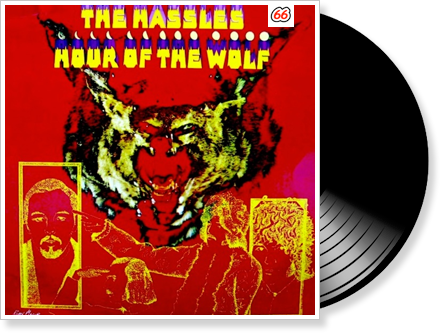
Title: Hour Of The Wolf
Year: 1969
Format: LP
Label: United Artists
Here’s the second Hassles album which is a kind of departure from the first one, the group relies on all original material here and the results are more psychedelic with a progressive touch. Chile Bowl, um i mean Billy Joel, plays some decent keyboards on this one. Ripped from vinyl (a bit noisy) this one is available on cd with the first lp and bonus cuts as “You’ve Got Me Hummin’” on the Razor & Tie label.
“Stuck in some tripped out soul void between the Rascals & Vanilla Fudge, the Hassles sold about 100 copies of their first LP & 10 copies of the second. A lot of organ bands around New York covered songs from the first LP, & their version of “Colored Rain” is nervy to the edge of brilliant. The Hassles were on the road to Art Rock with “Hour of the Wolf.” It’s a silly album (check out the wolf howls) saved by some nifty Billy Joel songs like “Cat” & “4 O’clock in the Morning.” This is the only context in which I can stomach Billy Joel although you probably disagree.But it’s still a pretty long way from “Piano Man.” (Bob Rixon, WFMU)
Track Listing
- Country Boy
- Night After Day
- Hour Of The Wolf
- 4 O’Clock In The Morning
- Cat
- Hotel St. George
- Land Of Despair
- Further Than Heaven
Disclaimer: The link below may point to content that is copyrighted. redtelephone66 only provides this link with the understanding that you are responsible for the content you download. redtelephone66 does not engage in music piracy, nor do we do host, fileshare, or otherwise trade in copyrighted works.
Malachi – Holy Music (1966)
Title: Holy Music
Year: 1966
Format: LP
Label: Verve
A very tripped-out set of meditation music issued by Verve in the late 60s, and arguably even more spacey and atmospheric than some of Tony Scott’s similar records for the label at the time! Malachi is actually John Morgan Newbern working here in a spare setting to capture the “evening vibrations” of a single night in 1966 served up through instrumentation that includes low-end percussion, acoustic guitar, and a fair bit of Jew’s harp played by Steve Cunningham (of Red Crayola fame), but drifting out slowly over the longer tracks in the set.
The album’s an early example of the extremes that 60s labels used to address the growing interest in Eastern ideals at the time and it’s much less commercial than some of the more gimmicky sessions of the decade. Titles include “Wednesday — Second”, “Wednesday — Sixth”, “Wednesday — Fourth”, “Wednesday — Fifth”, and “Wednesday — Eighth”.
John Morgan Newbern first appeared in the mid ’60s under the name, Malachi. His first major release, titled “Malachi/Holy Music” was on the M.G.M.-Verve label. John’s music has always been considered unique and is said to be one of the early influences in the birth of the New Age genre. However so, John considers his music to be more “ancient age” than “New Age”. Either way, these performances are definitely a spiritual fusion of world sounds.
Born in Baltimore, Maryland in 1944 to parents of Swiss and French ancestry, the direction of John’s life was to be towards a life in the military. A series of unusual events surrounding a visit to Kukulkan’s Pyramid in Chichen Itza, Yucatan, Mexico in 1955 would, to his parents disapproval, change that direction forever. The phenomenal presence of the ancient temple of the Maya so touched his life that the next decades would be spent in search of the root of the truth, leading to the creation of the music you find here.
The late poet, Alan Ginsburg once said of John’s music: “He listens quietly to himself and then he plays what he hears. Poe would have enjoyed his presence.” (Prairie Prince Minsky)
Track Listing
- WEDNESDAY – Second
- WEDNESDAY – Sixth
- WEDNESDAY – Fourth
- WEDNESDAY – Fifth
- WEDNESDAY – Eighth
Disclaimer: The link below may point to content that is copyrighted. redtelephone66 only provides this link with the understanding that you are responsible for the content you download. redtelephone66 does not engage in music piracy, nor do we do host, fileshare, or otherwise trade in copyrighted works.
Kali Bahlu – Cosmic Remembrance (1967)
Title: Cosmic Remembrance
Year: 1967
Format: LP
Label: World Pacific
The enigmatic Kali Bahlu was a young woman in 1967 when she released her Cosmic Remembrance LP on the then-foundering World-Pacific record label. A swirling tableau of gongs, sitars, tablas and Bahlu’s Buddhist chanting and fairy-tale ruminations, Cosmic Remembrance is an album known for its general incongruity and for testing listeners’ patience. For all of its faux-Eastern artifice and Bahlu’s voice – sometimes a feral soprano, sometimes a jarring, child-like babble – Cosmic Remembrance is nonetheless quite unique, a relic that stands apart from its era.
Also included here is Bahlu’s first recording, “Lonely Teardrops” not wholly dissimilar from the otherworldly atmosphere of her Cosmic Remembrance LP. It’s just much better. It’s also Kali Bahlu singing from some grimmer place. The ominous rumblings, Bahlu’s naked, if indecipherable, emotion, the wonderfully stark gloom: those of us drawn to sunless, wintry tundras find much to love in the remarkable “Lonely Teardrops. ” This is the reason bears hibernate. Brighter days lay ahead for Kali Bahlu, however – they could hardly get any bleaker.
Whether it was the Bahlu of “Lonely Teardrops” banging on a detuned guitar – or the beatific Bahlu rambling in sing-song tones about Lord Buddha and “clocks of never” on Cosmic Remembrance – this is clearly someone on a separate psychic plane. Often referred to as acid-influenced, that is perhaps a disservice to the peculiar experience of Kali Bahlu, whose Californian, pseudo-Buddhist cosmic consciousness just happened to synchronize with hippie sensibilities.
Kali Bahlu would later be involved in some capacity with a few hens-teeth-obscure ‘70s albums of Eastern-inspired singing and commune vibes by the Los Angeles hippie-rock group Lite Storm. Bizarrely, Bahlu was more recently spotted in Taiwanese filmmaker Mei-Juin Chen’s film “Hollywood Hotel”. (Office Naps)
Track Listing
- Cosmic Remembrance
- A Game Called Who Am I
- How Can I Tell My Guru
- A Cosmic Telephone Call From The Angel Liesle And The Buddah
- Lonely Teardrops [non lp Terra 45]
Disclaimer: The link below may point to content that is copyrighted. redtelephone66 only provides this link with the understanding that you are responsible for the content you download. redtelephone66 does not engage in music piracy, nor do we do host, fileshare, or otherwise trade in copyrighted works.
Children Of One – Children Of One (1969)
Title: Children Of One
Year: 1969
Format: LP
Label: Real
Children Of One consisted of Lucas Mason (flute-piano), Peter Sokolow (bass clarinet), Leonard Lonergan (soprano sax), Bala Krishna (sitar), Les Grinage, (cello-dilruba), Lakshmi (tanpura), Konrad Kaufman (percussion), and Vera Sokolow, Paula Mason & Irin Poellot (chorus).
Released on the small New York based Real label in 1969, the Children Of One were pioneers in what would eventually become known as New Age Music. Most of the music on this album is based on Eastern meditative improvisation and at times classical in structure with female vocals according to reviewer Michael Parker as “wordless, somewhat operatic in style that comes off as mysterious and ritualistic instead of gratuitous or annoying” (the only exception is Konrad Kaufman’s five minute drum solo “Konrad’s Rap”). (Jack Dominilla)
Track Listing
- Getting Together
- Here And Now
- Spheres
- Angel Dance
- Eastern Cloth
- Time Turns Towards Tomorrow
- Konrads Rap
- Short Talk
- Was And Will Be
Disclaimer: The link below may point to content that is copyrighted. redtelephone66 only provides this link with the understanding that you are responsible for the content you download. redtelephone66 does not engage in music piracy, nor do we do host, fileshare, or otherwise trade in copyrighted works.
Baba Ram Dass (Dr. Richard Alpert) – Here We All Are (1969)
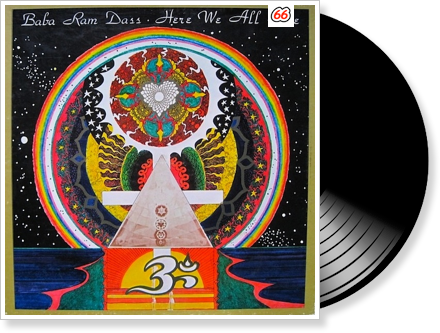
Title: Here We All Are
Year: 1969
Format: LP
Label: Yogananda
HERE WE ALL ARE is the story of the evolution of RICHARD ALPERT, from Harvard University professor and successful psychologist, to BABA RAM DASS, wandering sadhu of holy man. Describing his early days with TIMOTHY LEARY and his introduction to Psychedelics, BABA RAM DASS tells of his growing desire to stay permanently “high” and off his quest to find someone who really “knows”.
His search eventually leads to an agonizing barefoot trek through India and to his Guru, a totally conscious being living in a constant state of Sahaj Samhadi. BABA RAM DASS concludes with an explanation of one of the most exquisitely articulated systems for spiritual enlightment known to man, ths system of Ashtanga, or Raja Yoga, and shares with those on a similar journey his knowledge of how it all is in the universe.
Recorded live in the summer of 1969 in Vancouver, BC, Canada, produced by Inner Sound Productions of Yogananda Ashram Society, and manufactured by Rada Record Pressings of Burnaby, BC. 3 records, 6 sides, 2 hours and 10 minutes listening time. (Jack Dominilla)
Richard Alpert (born April 6, 1931), also known as Baba Ram Dass, is a contemporary spiritual teacher who wrote the 1971 bestseller Be Here Now. He is well known for his personal and professional association with Timothy Leary at Harvard University in the early 1960s. He is also known for his travels to India and his relationship with the Hindu guru Neem Karoli Baba.
Alpert was born to a prominent Jewish family in Newton, Massachusetts. His father, George Alpert, was one of the most influential lawyers in the Boston area and president of the New York, New Haven and Hartford Railroad, as well as one of the leading founders of Brandeis University and the Albert Einstein College of Medicine.
The youngest of three boys, Richard as a child was described as being engaging and loved by all—the family mascot. He went on to receive a Bachelor of Arts degree from Tufts University, master’s degree from Wesleyan University and doctorate (in psychology) from Stanford University.
After returning from a visiting professorship at the University of California, Berkeley, Alpert accepted a permanent position at Harvard, where he worked with the Social Relations Department, the Psychology Department, the Graduate School of Education, and the Health Service, where he was a therapist. He was also awarded research contracts with Yale and Stanford. However, perhaps most notable was the work he was doing with his close friend and associate, Dr. Timothy Leary.
Having only recently obtained his pilot’s license, Alpert flew his private plane to Cuernavaca, Mexico, where Leary first introduced him to teonanácatl, the Magic Mushrooms of Mexico. By the time Alpert made it back to America, Leary had already consulted with Aldous Huxley, who was visiting at M. I.T. Through Huxley and a number of graduate students they were able to get in touch with Sandoz, which had produced a synthetic component of ergot wheat fungus called LSD.
Alpert and Leary brought a test batch of both substances back to Harvard, where they conducted the Harvard Psilocybin Project and experimented with LSD relatively privately. Alpert was later dismissed from the university in 1963; according to Harvard President Nathan M. Pusey, Leary was dismissed for leaving Cambridge and his classes without permission or notice, and Alpert for allegedly giving psilocybin to an undergraduate. By this time, however, Alpert had already become disillusioned with academia and even described himself as feeling trapped in a meaningless game, and Leary had already left the university some weeks earlier.
The two soon relocated and continued their experiments unsupervised from a private mansion in Millbrook, New York, owned by Billy Hitchcock, an heir to the Mellon fortune. Famous poets, musicians and intellectuals of the time, such as Allen Ginsberg, Maynard Ferguson, the Grateful Dead, Marshall McLuhan and Ken Kesey, came from across the country to be part of what was going on there. Although they remained life-long friends, the two eventually began to part ways spiritually and philosophically as Leary continued to spread his mantra of “turn on, tune in, drop out,” while Alpert increasingly found his purpose in the Hindu ethic of serving others.
In 1967 Alpert traveled to India, where he met the American spiritual seeker Bhagavan Das. As he guided Alpert barefoot from temple to temple, Bhagavan Das began teaching him basic mantras and asanas, as well as how to work with beads. After a few months, Bhagavan Das led Alpert to his guru, Neem Karoli Baba, or as he is better known in the West, Maharaj-ji. Maharaj-ji soon became Alpert’s guru and gave him the name “Ram Dass,” which means “servant of God.” Under the guidance of Maharaj-ji, Ram Dass was instructed to receive teaching from Hari Dass Baba, who taught in silence using only a chalkboard.
While in India, Ram Dass also corresponded with Meher Baba; however, he remained primarily focused on the teaching of Hari Dass Baba. Among other things, Hari Dass Baba trained Ram Dass in raja yoga and ahimsa. It was these life-changing experiences in India that inspired Ram Dass to write the contemporary spiritual classic, Be Here Now, in which he teaches that everyone is a manifestation of God and that every moment is of infinite significance.
After his return to the United States in 1969, Alpert founded several organizations dedicated to expanding spiritual awareness and promoting spiritual growth, including Hanuman Foundation. Since then he has embraced a wide variety of spiritual traditions and practices, including guru kripa (grace of the guru) ; bhakti yoga focused on the Hindu spiritual deva Hanuman; meditation in various schools of Buddhism such as Theravada and Mahayana (including Tibetan and Zen) ; karma yoga; and Jewish studies.
In February 1997, he suffered a stroke which left him with expressive aphasia, however, he interprets his stroke as an act of grace and continues to travel giving lectures, as his health permits. When asked if he could sum up his life’s message Ram Dass replied, “I help people as a way to work on myself, and I work on myself to help people… To me, that’s what the emerging game is all about.” He was awarded the Peace Abbey Courage of Conscience Award in August 1991.
Ram Dass has long acknowledged his bisexuality. In the 1990s, he became more forthcoming while avoiding labels and pointing out that who we are “isn’t gay, and it’s not not-gay, and it’s not anything—it’s just awareness.” (Wikipedia)
Track Listing
- Here We All Are [Side One]
- Here We All Are [Side Two]
- Here We All Are [Side Three]
- Here We All Are [Side Four]
- Here We All Are [Side Five]
- Here We All Are [Side Six]
Disclaimer: The link below may point to content that is copyrighted. redtelephone66 only provides this link with the understanding that you are responsible for the content you download. redtelephone66 does not engage in music piracy, nor do we do host, fileshare, or otherwise trade in copyrighted works.
Bill Bissett & Th Mandan Massacre – Awake In Th Red Desert (1967)

Artist: Bill Bissett & Th Mandan Massacre
Title: Awake In Th Red Desert
Year: 1967
Format: LP
Label: See/Hear
Bill Bissett can roughly be considered the Canadian equivalent to Allen Ginsberg, an oracular poet who found a home among the psychedelic vanguard of the late ’60s with an incantatory live blend of performance art and avant-garde rock. Bissett, though, is an even more abstruse scribe who deconstructs language by stripping away conventional syntactical considerations.
It is willfully difficult but frequently rewarding as a reading experience because it is such visual work, but how well the poetry works as a recorded, musical one depends largely on how far you’re willing to go to meet the music. The answer certainly isn’t clear-cut. For those who like their music readily accessible or tuneful, the album is likely to initially inspire hair pulling and probably unsatisfied surrender in the end.
But for those who are willing to work at it, to listen in the same artful spirit with which the music was made, Awake in the Red Desert can stretch your definition of rock. It might, in fact, be the best way to grasp the poet’s muse, since you don’t have to visually decipher his grammar and spelling tricks. That, however, doesn’t necessarily make this any more accessible or easier to absorb.
The music is fragmented, noisy, spaced-out, repetitive, and Dadaistic. Occasionally either the Mandan Massacre’s playing or Bissett’s vocal experiments sound unnatural and forced. With that said, there is something vaguely hypnotic about the almost onomatopoeic chants that make up the album, and gradually it becomes apparent that Bissett has designed the undertaking as a celebration of awakening to language and its ability to open up avenues of consciousness.
The album vacillates between chaotic raga-rock heavy on the raga or on the rock side with additional Native American ceremonial hints. It utilizes musique concrète, tape loops, sound collaging, and a primitive synthesizer called the Buchla box, very much forward-looking concepts, an experiment that might have been possible only in its time but pays off more often than it doesn’t. It won’t be to the tastes of most fans of even ’60s rock music. It is much too caustic and intentionally ugly, a highly esoteric taste to be sure. But those who revel in incredibly strange music will find ideas worth holding on to. (Prairie Prince Minsky)
Track Listing
- Th Deacon Bros In Barbados
- O A B A
- An Ode To D A Levy
- My Mouths On Fire
- 2 Awake In Th Red Desert
- Arbutus Garden Apartments 6 P M
- Heard Ya Tellin
- Fires In Th Tempul
- She, Still And Curling
- Is Yr Car 2 Soft 4 Th Road
- And The Green Wind
- Yu Sing
- Now According To Paragraph C
- She’s A Very Good Cook
- Meeting At Th Transmittrs Centr
- Ium Going 2 Sleep Now / City Of Tomorrow
- Th Book Is Insyde Hr Head
Alan Watts – Om: The Sound Of Hinduism (1967)

Artist: Alan Watts
Title: Om: The Sound Of Hinduism
Year: 1967
Format: LP
Label: Warner Brothers
This one’s a little off the beaten path for us, but take this journey with us and you’ll find something beautiful. Alan Watts probably did more than any other single person to bridge the gap between Eastern and Western philosophies and religion, publishing countless books and putting out several albums, of which this was his first, released by Warner Brothers in 1967.
This record is sort of like having your friendly neighborhood British mystic over for tea; Watts was nothing if not a showman, and as he charmingly discourses on methods of meditation and Hindu beliefs over droning Indian accompaniment, the effect is simultaneously soothing and compelling, almost hypnotic.
This is not just a curio of the psychedelic ‘60s, though collectors of that ilk will definitely want to check this out; Watts was a man of great substance and that comes through loud (well, not so loud) and clear. Includes ‘Om; Tambouras for Meditation’, and ‘Readings from Hindu Scriptures. (John Swenson)
Track Listing
- Om
- Tambouras For Meditation
- Readings From Hindu Scriptures
Tree Fox – Rough Road (1978)
Artist: Tree Fox
Title: Rough Road
Year: 1978
Format: LP
Label: Fraternity
Tree Fox was one of the most popular bands in the Albany, New York area in the 1970′s. The band’s sound was a mix of The Allman Brothers, Southern Rock and The Doors. Lead Singer Larry Quinn had a look and sound similar to Jim Morrison, though he did not imitate him. “Rough Road” includes the single “15/20″ which was a national release.
The album also features the hard driving “3 Day Weekend”, the honky tonk “Oh Linda”, and “Some Woman’s Man,” a blues featuring Rich Ertelt on lead guitar and Leo Muzzy on Hammond B3 organ with Bruce O’Keefe on drums and Eliot Collins on bass. Quinn wrote all of the songs on the album and also played acoustic guitar. Tree Fox disbanded in 1980. (cdbaby)
Track Listing
- 15/20
- 3 Day Weekend
- Oh Linda!
- Some Woman’s Man
- Nothin’ Ever Stays The Same
- Where Does That Leave Me?
- Doin’ What I Wanna Do
- Wanderin’ Man
- Leavin’ In The Mornin’
- Rough Road
- 15/20 [single version]
- Wanderin’ Man [single version]
Ford Theatre – Presents “Time Changes” A New Musical (1969)
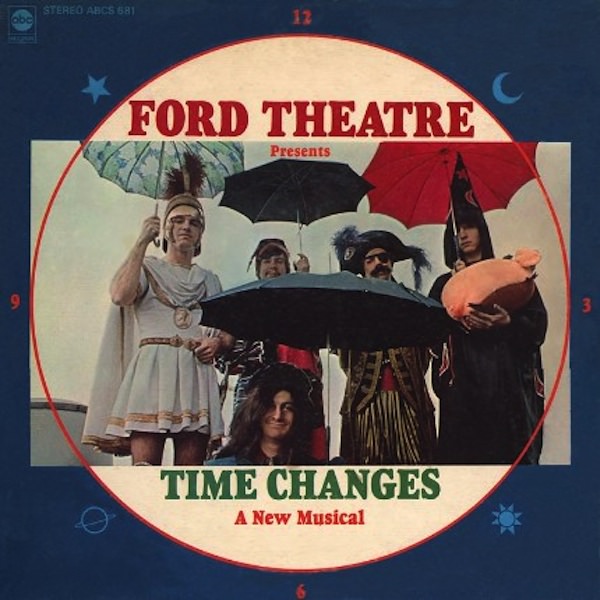
Title: Presents “Time Changes” A New Musical
Year: 1969
Format: LP
Label: ABC
Ford Theatre’s second and final album, Time Changes, was constructed around more conventionally-timed pieces, and was an early production by Bill Szymczyk, who went on to produce the Eagles. Ford Theatre guitarist Harry Palmer is the uncle of underground cult musician R. Stevie Moore. (Richie Unterberger)
Track Listing
- ACT I ( I. Introduction II. Time Changes III. Interlude One IV. That’s My Girl V. Wake Up In The Morning VI. I’ve Got The Fever VII. Crash VIII. At The Station)
- ACT II ( I. Back To Philadelphia II. Clifford’s Dilemma III. Jefferson Airplane IV. I Feel Uncertain V. Interlude Two VI. Good Thing VII. Outroduction)