

The Ides Of March – Common Bond (1971)
Title: Common Bond
Year: 1971
Format: LP
Label: Warner Brothers
The story of Common Bond actually begins with the single they recorded as a follow-up to “Vehicle,” which had gone all the way up to #2 on the national charts in spring 1970. Initially the band had hopes that “Aire of Good Feeling,” a track that wound up on the Vehicle LP, would be the next single.
But as lead guitarist, lead singer, and principal songwriter Jim Peterik remembers, “Warner Brothers did not think so. They called our management and said, would you please record another song that’s more like ‘Vehicle’? That was in the days when follow-ups sounded very similar to the prior one, a la Jackson Five or whatever. So I went to my lab, and I wrote ‘Superman.’ That kind of became the first song we recorded for the second album.
“We went to the West Coast to record ‘Superman.’ It was very exciting, because we were now at Sunset Sound, which was like us going to Mecca or something. It was just the holy grail of studios. We were just mesmerized. And sure enough, the sound that came back from those playback speakers was like nothing we had heard. It was so powerful, so punchy. And right in the middle of my vocal take, all the members of the group Chase” — another group with a horn section, who’d score a big hit single in 1974 with “Get It On” walked in.
And then we were all so amped up, because Bill Chase and the whole band were there spurring us. That really set the tone for the second record.” Despite fulfilling Warners’ request for a made-to-order follow-up, however, “Superman” didn’t reach the charts.
Though Common Bond generally stuck to the same approach as the Vehicle album, there were a few changes this time around. The band was slightly reduced in size, from a seven-piece to a six-piece, with the departure of guitarist-bass-singer Ray Herr. They were able to do sessions at RCA Recording in their home base, Chicago, with engineer Brian Christian, who in the early ’70s also worked on records by the Guess Who, Alice Cooper, and Poco. “When we heard playbacks, like [for the track] ‘Tie-Dye Princess,’ we were like totally blown away, and much more happy with the sound than we had been on the first record,” enthuses Pederik.
While the album did have some aggressive, horn-fueled soul-rock a la “Vehicle” in cuts like “Superman,” “Ogre,” and “Giddy-Up Ride Me,” there was also some quite different, gentler California-flavored harmony folk-rock, in the mold of Crosby, Stills, and Nash. Foremost among those tracks was “L.A. Goodbye,” which became their final chart single, peaking at #73. That modest position doesn’t tell the whole story, however, as the single topped the Chicago charts for five weeks — “the test of a real hit record, to me,” asserts Pederik. “Chicago used to be the test market.
If it made it in Chicago, it was a pretty good chance it would make it everywhere. Well, it didn’t happen. Apparently Warner Brothers was going through a shift in distribution, from being distributed by another major to independent distribution. The story we got [was] that ‘L.A. Goodbye’ really got lost in the shuffle between distributors.”
That doesn’t diminish his pride in his track, as Jim continues, “The studio had this Neve console. That created the sound, with the vocal harmonies, for ‘L.A. Goodbye,’ which of course is really the touchstone of that record in my mind. The vocal blend just was incredible.” Adds multi-instrumentalist and fellow Ides of March founder-member Larry Millas, “We triple-tracked the vocals. That was the secret. If you double-tracked them, they were real good. If you triple-tracked them, it was something else. We looked at each other and it was like, ‘Alright Carpenters, take that!’”
It’s something of a surprise that the same voice responsible for the gravelly blue-eyed soul of “Vehicle” could switch to a much softer tone for folk-rockish material such as “L.A. Goodbye.” But Jim Pederik was gifted with a vocal versatility enabling him to walk both sides of that line. “People think I was like a Camel smoker or something,” he observes with amusement. “I didn’t smoke at all. My voice was able to kind of split its vocal cords a little bit for that rougher sound. Within one album, I could be as clear as a bell, or as gruff as I wanted. It was just part of the way I sang. My dad used to say, ‘Jim, you’re going to ruin your voice singing that.’ I didn’t. Not yet, anyway.”
Another highlight for the band was the eleven-minute “Tie-Dye Princess,” in which the group got to blend several of the styles closest to their hearts — horn-rock, folk-rock, and elaborate, progressive song construction — into an extended piece. “Like most songs with the Ides, they start with a germ, usually a song that I bring to the table,” is the explanation Jim gives for how such lengthy tracks developed. “Then it gets Ides of March-ized in rehearsal, and it’s just what happened with the band.
We would be down in Larry’s basement, we would learn the basic song, and then we’d jam and jam and jam, and figure out ways to expand it. Sometimes the arrangements even unfolded onstage. We would try a song onstage, and then we would take a section and just interact and go, ‘Hey, that was cool. Let’s make that a part of the permanent arrangement.’ That’s how most of our arrangements developed, kind of organically, actually.”
Although the Vehicle LP had made the middle of the top hundred of the album charts, Common Bond missed the listings altogether. “The record company was not real supportive of diversity,” feels Millas. “They wanted it to be one thing. Like, ‘Be that, just do that.’ And we were doing all kinds of music on our albums. So it kind of made the marketing a little confused for them.”
Despite its lack of chart success, the Ides of March found reasons to be pleased with the music on the record. “I think what I liked most is that we could take the time and our acquired knowledge up to that point, and come up with something as satisfying as ‘L.A. Goodbye,’” states Millas. “That record is kind of a quintessential pop-folk, really well-done single, and I’m really proud of that.” Adds Peterik, “It’s probably got some of the high points, and maybe the one low point of my memory.
The high point is, like Larry said, ‘L.A. Goodbye.’ ‘Tie-Dye Princess,’ to me, that stands, [despite] a couple lyrics that I wish weren’t in there. But overall, it’s a nice piece. But when I get interviewed, people say, ‘What is the worst song you ever wrote?’ I usually say, ‘Ogre.’ It’s horrible. It’s just a bad song.”
Common Bond was the second and final Ides of March LP for Warner Brothers, the band departing for RCA soon afterward. After a couple more albums, they broke up at the end of 1973. Peterik went on to more commercial success as part of Survivor, as well as writing or co-writing hits for .38 Special. For the past 15 years, he’s also been playing with a reunited Ides of March, who, remarkably, still include all six members who played on Common Bond.
As Larry says, “We’re still the Ides of March, and we’re taking Jim’s song seeds and working on ‘em.” Picks up Jim: “And doing the same thing we always did. We’re just having a ball doing it. We always look to those times, especially those first two albums, for inspiration. Trying to take what’s good about those, and keep expanding that. I really think, no matter what the diversity is, there is an Ides of March sound.
It doesn’t have to do, necessarily, with the brass — ‘Is there brass in the song? Is there harmony?’ It’s a spirit. It’s very positive music. We don’t dwell on the negative stuff. That’s the kind of people we are, and that’s the kind of band we are. That’s kind of been the common thread.” (Richie Unterberger)
Track Listing
- Friends Of Feeling
- Ogre
- LA Goodbye
- Hymn For Her
- Mrs Grayson’s Farm
- Superman
- We Are Pillows
- Prelude To Freedom
- Freedom Sweet
- Tie-Dye Princess
Notes From The Underground – Notes From The Underground (1968)
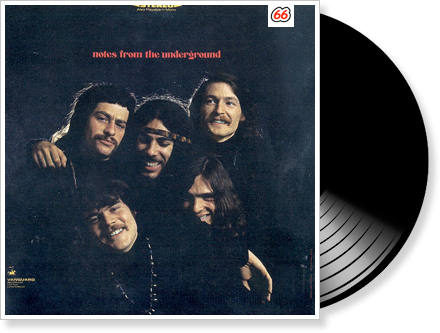
Title: Notes From The Underground
Year: 1968
Format: LP
Label: Vanguard
Berkeley, CA, psychedelic outfit Notes from the Underground formed in 1965, originally comprised of singer/multi-instrumentalist Fred Sokolow, guitarist Mark Mandell, bassist Mike O’Connor, keyboardist John Miller, and drummer Joe Luke. One of the first Bay Area rock bands of any real distinction, the group played at the first Longshoreman’s Hall concert presented by the now-legendary Family Dog collective.
They also regularly headlined the local club the Jabberwock when the house band, their chief rivals Country Joe & the Fish, were taking a night off. With the exits of Miller and Luke, Notes from the Underground recruited keyboardist Jim Work and drummer Peter Ostwald; soon after, fledgling producer and folklorist Chris Strachwitz proposed helming the Notes’ first recording session, which yielded a self-titled EP issued in 1966 on the Changes label.
The attendant publicity no doubt prompted an offer to serve as the house band at Berkeley’s New Orleans House, followed by a contract with Vanguard Records — after swapping Work for jazz-trained keyboardist Skip Rose, the Notes traveled to New York City to cut their lone LP (also self-titled), an expansive, eclectic affair highlighted by the single “Down in the Basement.” However, both O’Connor and Ostwald resigned soon after the sessions wrapped, and Vanguard — questioning the band’s continued existence — opted to cut its losses, spending no money on promotion and voiding their contract.
Sokolow and Mandell nevertheless forged ahead, assembling a patchwork lineup that included prodigal bandmate Miller as well as bassist Bing Nathan and drummer Furry Grasso. Relocating from Berkeley to Taos, NM, did little to stave off the inevitable, however, and Notes from the Underground dissolved in 1969. Sokolow and Mandell then returned to Berkeley and formed a new project, Prince Bakaradi; in 1977, the former also recorded a solo bluegrass effort titled Bluegrass Banjo Inventions. (Jason Ankeny, All Music Guide)
Track Listing
- Follow Me Down
- I Wish I Was A Punk
- Mainliner
- Down In The Basement
- What Am I Doing Here
- Where I’m At
- Cantalope Island
- Why Did You Put Me On
- Tristesse
- Who Needs Me
Two Friends – Two Friends (1972)
Title: Two Friends
Year: 1972
Format: LP
Label: Natural Resources
One of legendary producer Tom Wilson’s last productions, Two Friends, Chip Carpenter (rhythm guitar) and Bob Weiner (acoustic guitar), is a nice example of soft rock with some nice musical arrangements and harmonies.
Wilson put together some of the finest studio musicians for this effort including Michael Rubini (piano), Jim Keltner (drums), Bob Morin (drums), Ray Neopolitan (bass), Joe Osborne (bass), John Raines (drums), Ann Goodman (cello), Harry Bluestone (violin), Chip Carpenter (rhythm guitar) and Bob Weiner (acoustic guitar).
The album was recorded at one of Wilson’s favorite studios, The Record Plant in New York City with longtime cohort Barry Keene engineering. (Jack Dominilla)
Track Listing
- Long Way Hard Road
- Must Be The Wrath
- Vickie
- Falling Through My Dreams
- Set Your Sails
- Move With The Music
- Old South Bend
- Can’t Find Home
- Now That It’s Over
- Geri
- I’ll Be Free
Edgewood – Ship Of Labor (1972)
Title: Ship Of Labor
Year: 1972
Format: LP
Label: TMI
Edgewood’s roots are kind of interesting in that keyboardist David Beaver, bassist Steve Spear, guitarist Jim Tarbutton were all members of the Memphis based The Gentrys (albeit a late inning version of the group). Apparently increasingly bored within the pop confines imposed by The Gentrys, the three quit in 1970, promptly recruiting drummer Mike Bleecker (replaced by Joel Williams), multi-instrumentalist David Mayo, and guitarist Pat Taylor for Edgewood (named after the Memphis street Taylor was living on). The band spent several months writing, rehearsing and playing local clubs before signing with the small Memphis-based TMI label.
A quick word of warning – anyone expecting to hear a collection of Gentrys-styled garage/blue eyed soul moves is going to be in for a major shock when they hear 1972′s Jimm Johnson produced “Ship of Labor”. With all six band members contributing tot he album, material such as ‘Why Don’t You Listen’, ‘Unconscious Friend’ and ‘What You See’ featured a distinctive progressive edge, though the longer and more complex song structures retained a highly commercial edge that would have sounded good on FM radio.
Imagine a group like Ambrosia or perhaps Kansas with a penchant for Southern garage rock and you’ll be in the right aural neighborhood. Sure, songs like the ominous title track, ‘Burden of Lies’ and ‘Medieval People’ (when’s the last time you heard a Memphis band singing about the sins of Christian Crusaders) were a little bit quirky, but blessed with three strong vocalists in Beaver, Mayo and Taylor (they turned in some great harmony work on the title track and ‘We Both Stand To Lose’), that was a minor drawback that could easily be overlooked. Unlike anything you’d expect to hear from a Memphis band, the whole LP is worth hearing. (RDTEN1 RYM)
Track Listing
- Ain’t Had No Lovin’
- Why Don’t You Listen
- Burden Of Lies
- Ship Of Labor
- Unconscious Friend
- Medieval People
- We Both Stand To Lose
- What You See
- Silent
Sundown – Sundown (1970)
Title: Sundown
Year: 1970
Format: LP
Label: Ampex
Sundown consisted of Chuck Leavell (keyboards), Lou Mullenix (drums), Charlie Hayward (bass), Court Pickett (bass-vocals), Asa Howard (vocals), Ronnie Chambley (bass) and Bobby Cornlius (guitar-vocals).
Be forewarned, this is for Southern Rock scholars only. Well, mostly. If you did any research into Southern Rock you may have read about this album. Sundown was a local Macon band that was in the studio with Paul Hornsby producing. Recording did not go smoothly, since the band broke up a couple of times during the recording.
Paul Hornsby brought in some buddies and wound up finishing the record using names like Bill Stewart (Capricorn Rhythm Section), Charlie Hayward (later of The Charlie Daniels Band) and Chuck Leavell on piano (later of The Allman Brothers Band and Sea Level). Paul Hornsby of course also playing organ. And this was 1970.
On Redtelephone66 it was being compared to The Allman Brothers Band, but I think a better comparison would be their precursor: The Hour Glass. It’s basically old school 60′s rock, and at times a little country twang gives away its origin. All the same, this is how a lot of Southern Rock started out. So it’s quite interesting to hear what music was being made in the South at the time Southern Rock was born. So, no lost gem here. It’s nice, but that’s all. (Skydog’s Elysium)
Track Listing
- Bad Woman
- Rosalyn Was Saved
- When I Leave
- Gypsy Woman
- My Beautiful Dream
- Hide And Seek
- Did Not Take Me Long
- The Devil’s Got My Soul
- Living In And Out
- Sing Your Heart
John’s Children – Orgasm (1970)
Title: Orgasm
Year: 1970
Format: LP
Label: White Whale
Orgasm is John’s Children’s sole studio album, projected for release on March 18, 1967, and eventually released in September 1970. It was recorded (before Marc Bolan joined the band) at Advison Studios in London, England.
Originally intended as a regular studio album, it was transformed into a fake “live” album by producer Simon Napier-Bell by dubbing audience screams lifted from The Beatles’ movie A Hard Day’s Night.
According to the liner notes by Chris Donovan in the 1982 Cherry Red Records reissue of the album, its release in the United States was stopped by the Daughters of the American Revolution, who objected to the title. (Wikipedia)
Track Listing
- Killer Ben
- Jagged Time Lapse
- Smashed Blocked
- You’re A Nothing
- Not The Sort Of Girl
- Cold On Me
- Leave Me Alone
- Let Me Know
- Just What You Want
- Why Do You Lie
Harry Partch – The World Of Harry Partch (1969)
Title: The World Of Harry Partch
Year: 1969
Format: LP
Label: Columbia Masterworks
Composer, microtonal theorist, instrument-builder, writer, visual artist, satirist, philosopher, flunky, musicologist, copy editor, hobo, man of letters, publisher, iconoclast, record producer, eccentric, teacher….
Harry Partch challenged our entire musical world with, what I might term, his ‘back-to-nature’ approach to music and most especially to the Western diatonic scale and tuning system – what is termed the 12-tone equal tempered tuning system.
The 12-tone equal tempered tuning system has been around for about 300 years in the Western world but is scientifically an impure system of pitch relationships. In other words, notes have been ‘adjusted’ or put out of tune from the pure intervals of the harmonic series. This is borne out by the fact of much non-western music having different pitch relationships to the 12-tone system and, of course, much so-called ethnic music has been around since the dawn of time.
One of the most ancient scales exists in Javanese gamelan. In the Paris fair of 1898 composers such as Debussy were strongly influenced by these strange oriental scales and tuning systems. However, this wasn’t the first encounter by a westerner of such tuning systems. In 1580, for instance, Sir Francis Drake logged in his diary that the music of this land ‘was of a very strange kind, yet the sound was pleasant and delightful.’
Partch is perhaps best known for his innovative so-called 43-tone-to-the-octave scale structure. Partch realised that Western music since Gregorian chant was completely out of tune and set about devising a scale system based on the overtones of a vibrating string or column of air. He calls this system Monophony, as all the musical principles relate to ONE tone (i.e. the first eleven partials of the harmonic series).
Partch spent 12 years researching the science and musical theories which led him to this system beginning with Pythagoras (6th century BC) through Ptolemy (2nd cent. BC), Rameau (17th cent.) up to Riemann (19th/20th cent.) and concludes that Monophony reveals the falsification of the present 12-tone tempered scale and is not necessarily requisite to a practical music system, and that the basis of all musical materials lies in the understanding of the intervals that have true relationships i.e. those whose vibrations are expressed by small numbers.
“The creative person shows himself naked, and the more vigorous his creative act the more naked he appears – sometimes wholly vulnerable. yet always invulnerable in the sense of his own integrity. I am now 69 as this is being said, and I’ve been doing my own thing for more than five and a half decades. This thing began with truth, and truth does exist. For some hundreds of years, the truth of Just Intonation, which is defined in any good music dictionary, has been hidden. One could almost say maliciously. because truth always threatens the ruling hierarchy, or they think so. Nor does the spiritual, corporeal nature of man fare any better. We are reduced to specialties: a theatre of dialogue without music, and a concert of music without drama. Basic mutilations of ancient concept. My music is visual; it is corporeal, aural, and visual.
The creative man will rise above, he will transcend the mutilations. for every deeply sincere offering there is a corresponding deep and sincere hunger. Not the European chauvinism of New York, nor the mindless caterwauling of Hollywood recording studios, nor the “we-sell-music-by- the-yard,” mood-music people, can suppress either the sincere offering or the sincere hunger. True creativity is present. It is here, because man is here, in his true, deep, self. Unmutilated.”
“Harry Partch is an American visionary and stubborn individualist. . . . He has built his own musical world out of microtones, hobo speech, elastic octaves and percussion instruments made from hubcaps and nuclear cloud chambers. Recently. . . . an army of young music lovers stormed New York’s Whitney Museum to hear Harry Partch and his thirteen disciples produce a music that was totally personal and eclectic in the best sense. African polyrhythms, and ancient Greek modes, bits of Babylonia and the pulse of the American diesel engine all gathered into a richly erotic, primitive, fresh and stirring drama of sound” – Newsweek.
“The work that I have been doing these many years parallels much in the attitudes and actions of primitive man. He found sound-magic in the common materials around him. He then proceeded to make the vehicle, the instrument, as visually beautiful as he could. Finally, he involved the sound-magic and the visual beauty in his everyday words and experiences, his ritual and drama, in order to lend greater meaning to his life. This is my trinity: sound-magic, visual beauty, experience-ritual.”
“The major contribution of Monophony an intonational system is its realisation of a subtle and acoustically precise interrelationship of tonalities, all stemming or expanding from unity, 1/1. This interrelation is not capable of manifold modulations to “dominants” or to any other common scale degrees; it is not capable of parallel transpositions of intricate musical structures; it does not present any tone as any specific tonal identity.
Conversely, it is capable of both ordinary and hitherto unheard modulations to the natural limits imposed by Just Intonation and the arbitrary limit of 11; it is capable of an expanded sense of tonality, from Identities 1-3-5 to identities 1-3-5-7-9-11; it is capable of great variety in that expanded sense; it does offer twenty-eight possible tonalities, more than are inherent in Equal Temperament, and therefore a greater total of tonality identities; or assumable senses, than does Equal Temperament.” Harry Partch. (Prairie Prince Minsky)
Track Listing
- Daphne Of The Dunes
- Barstow – Eight Hitchhiker Inscriptions From A Highway Railing At Barstow, California
- Castor & Pollux – A Dance For The Twin Rhythms Of Gemini From Plectra & Percussion Dances
Disclaimer: The link below may point to content that is copyrighted. redtelephone66 only provides this link with the understanding that you are responsible for the content you download. redtelephone66 does not engage in music piracy, nor do we do host, fileshare, or otherwise trade in copyrighted works.

Lothar And The Hand People – Presenting… [Vinyl] (1968)
Title: Presenting…
Year: 1968
Format: LP
Label: Capitol
One of the weirder psychedelic groups of the late ’60s, the New York-based Lothar & the Hand People took special pride in augmenting many of their tunes with the theremin, a then-futuristic instrument most famous for its use in horror movies (as well as the Beach Boys’ “Good Vibrations”).
Playing eccentric satirical rock, good-time folk-rock, and experimental psychedelia, their material wasn’t nearly strong enough to elevate them to the rank of innovators. Although their first album is their best, they are most fondly remembered for the trance-inducing “Space Hymn,” an FM radio favorite for many years. (Richie Unterberger, All Music Guide)
Track Listing
- Machines
- This Is It
- This May Be Goodbye
- That’s Another Story
- Kids Are Little People
- Ha (Ho)
- Sex And Violence
- Bye Bye Love
- Milkweed Love
- You Won’t Be Lonely
- Woody Woodpecker
- It Comes On Anyhow
- Paul, In Love
Disclaimer: The link below may point to content that is copyrighted. redtelephone66 only provides this link with the understanding that you are responsible for the content you download. redtelephone66 does not engage in music piracy, nor do we do host, fileshare, or otherwise trade in copyrighted works.
Lothar And The Hand People – Space Hymn [Vinyl] (1969)
Title: Space Hymn
Year: 1969
Format: LP
Label: Capitol
I’m probably a little bit harder on this record than I really should be, mostly because I feel that it represents too much unrealized potential. These guys were quite unique at the time their albums were recorded, and they possessed the talent to put out something truly extraordinary. We got a whiff of this on their first one, which should have been a harbinger of better things to come.
But I feel they dropped the ball with this, their second and final album. Not that it’s not good – on the contrary, I feel 6 of the 10 tracks offered rate a B- or better. It just could have, ney, should have, excelled, and it clearly misses the mark. I think most of that has to do with their choice of material. They apparently had a liking for soft, moody ballads. And they were able to turn out some that were far better than most in this genre. But they seem to turn to this style far too often. Even the non-ballad material seems to be softer and a little more subdued than necessary.
You find yourself waiting (and waiting) for them to finally rock out, and it just never comes. In fairness, this album does contain what is clearly their best known cut in the title track; a very spacey, hypnotic, trippy piece with electronic sounds and atmosphere, the likes of which had not been heard before, and which remains their signature achievement. But a little support wouldn’t hurt, and I feel there is too little of that here. (tymeshifter RYM)
Track Listing
- Yes, I Love You
- Today Is Only Yesterday’s Tomorrow
- Midnight Ranger
- Sister Lonely
- Wedding Night For Those Who Love
- Heatwave
- Say ‘I Do!’
- What Grows On Your Head
- Sdrawkcab (Backwards)
- Space Hymn
Disclaimer: The link below may point to content that is copyrighted. redtelephone66 only provides this link with the understanding that you are responsible for the content you download. redtelephone66 does not engage in music piracy, nor do we do host, fileshare, or otherwise trade in copyrighted works.
Rockin’ Foo – Rockin’ Foo (1971)
Title: Rockin’ Foo
Year: 1971
Format: LP
Label: UNI
Just to let you know, this rip suffers from some loud (and annoying) surface noise on the opening track intro of “You Are The Music” that clears up after a few seconds. So until a better rip comes along maybe someone out there can give this one a “wash” with Soundsoap.
With the addition of a fourth member, Ron Becker, the band subsequently released a 1971 album on UNI Records.
“Rather average country-ish rocker from this California foursome. Strings and horns round out the sound. A little too mellow for my taste.” (but maybe ok for someone else’s palate, jimbo) (jimslim11 RYM)
Track Listing
- You Are The Music
- Can O’ Worms
- El Camino Real
- Julie
- All We Need Is Time
- Leave Her Alone
- On Larrabee
- Golden Scissors
- Country Tune
- Rusty Ol’ Timer