
Sandy Bull – Inventions (1965)
Title: Inventions
Year: 1965
Format: LP
Label: Vanguard
Born in New York, Sandy Bull spent the early part of his childhood in Florida with his father before returning to New York to live with his mother, the jazz harpist Daphne Hellman. His mother’s eclectic taste exposed him to a wide variety of music that eventually led to him learning the guitar and banjo, the latter from Eric Darling, who was in The Weavers. After a brief stint at college in Boston, Bull returned to New York and became involved with the Greenwich Village scene. But it was in Paris where he had his first experience of Middle-Eastern music and oud-like instruments. Having learnt to play the oud from Hamza El Din, Bull returned to the United States, signing with the folk-label Vanguard.
For his first album, Fantasias for Guitar & Banjo, Bull would take various pieces of American folk, country, blues, jazz and pop and mix them up with Eastern and western classical music. His follow-up album, Inventions, took things further and included a remarkable cover of Chuck Berry’s “Memphis”. On both recordings, Bull would either play alone or to the accompaniment of jazz drummer Billy Higgins, best known for his work with Ornette Coleman.
His ability in blending so many different styles of music was matched only by those of artists such as Davy Graham and John Fahey and his albums would provide a foretaste of the world music that would follow. The third record for Vanguard, E Pluribus Unum, would be comprised of just two tracks, one on each side. Despite his drug problems, Bull managed to record a final album for Vanguard, Demolition Derby, and in 1975 he was offered a guest spot on Bob Dylan’s Rolling Thunder tour.
No more albums appeared until the ROM release Jukebox School of Music in 1988, which introduced the piano to the list of instruments that Bull played. This album also marked the return of Billy Higgins on “Truth”. Vehicle followed in 1991. After Vehicle, which featured Aiyb Dieng, he moved to the Nashville, TN and started his Timeless Recording Society, which released Steel Tears in 1996, earning him a nomination for Best Folk album at the Nashville Music Awards.
After suffering from lung cancer for a number of years, Bull died at his home, just outside Nashville, on April 11, 2001. (RYM)
Track Listing
- Blend II
- Gavotte II (Electric)
- Gavotte II (Acoustic)
- Manha De Carnival
- Triple Ballade
- Memphis, Tennessee
Sandy Bull – E Pluribus Unum (1969)
Title: E Pluribus Unum
Year: 1969
Format: LP
Label: Vanguard
This is a tough one to review. Where I’m completely blown away by this album, I can’t help but feel like there should be more. I really dig this album; it was completely unexpected. I judge the album by the cover and this is what I get.
E Pluribus Unum is a chill out, groove album. The best part is the mix of the psychedelic feel with the folk and eastern influenced undertones; that’s the album’s bread and butter. It is currently riding the fence and tapping into many different areas of music all while keeping true to this laid-back transmutation of folk. You can see on the cover, once again, this guy looks like he’s on a different planet. Of course, if you flip the album over, he looks like a guitar salesman with his huge Oud or Lute, if you will.
His blend is somewhere in between. In any case, already you can see that he’s going in a different direction with this.
Where this is a very loose feeling album. The mix is tight. Perhaps too tight in some areas though. It does not stray too far from the main theme very often if at all. The bass does move around to my liking. It’s a twelve bar blues fashioned structure. The fuzzy electric guitar creeps in very aptly, putting a good touch over the constant, flowing oud. We can’t leave out the cowbell bringing us our downbeat. yes yes.
Excellently put, on the back on the vinyl jacket, Nat Hentoff writes an apt summation of Bull’s work. He writes, “Sandy Bull had gone beyond eclecticism and was well engaged in a continually unpredictable journey into what could be called inner musical space where diversely rooted forms and textures flowed into and out of each other, creating in the process new ways of connecting, new spirals of cross-influences, leading into unexpectedly disclosed faults of the senses where there were further doors be opened.” The cross-influences he brings up stem from an eastern realm involving Hindu, Pakistani and Arabic. The oud, in fact, was derived from Arabic meaning “the wood”.
All this aside, this becomes greatly evident on side two with “Electric Blend”. This is definitely a space out track. Bull has replaced the sitar with the oud. It creates great movement within the textures of the electric guitar and the Indian bass drum. Similar in nature are the two instruments; both are fretless. This gives the oud a stand-up bass feel at times, especially on side B, with “Electric Blend”. I find side B to be more cohesive in nature. Overall a great artifact that I am glad to have come across. I never would have expected this from Mr. Mustache and tinted glasses upon first glance. Good luck trying to get your hands on this. I don’t even know where I attained this recording.
Where I’ll admit this is a nonessential recording from, as far as I am concerned, a widely UNknown musician, it definitely holds its own in its interesting grooves. And to reflect back on there being something missing, I can’t help but feel like it isn’t daring enough. Perhaps I need to get my hands on more of Bull’s work. Where E Pluribus Unum is out there, I don’t feel as though it’s daring enough. Listening to it, and practically zoning out typing this, I find that it is for the best. This is exactly what it is, a zone out album. Bull doesn’t want us to begin to break it down as we would a 4 movement classical piece. I certainly don’t listen to it all that often, but it’s nice to know I do own it and can throw it on when I want to belly dance and shake my hips to clack of the high hat and the twang of the oud. (TheFuzz RYM)
Track Listing
- No Deposit – No Return Blues
- Electric Blend
The Orient Express – The Orient Express [Vinyl] (1969)
Title: The Orient Express
Year: 1969
Format: LP
Label: Mainstream
Possibly only in New York City’s East Village could a Belgian, Frenchman, and Iranian come together musically to create such a unique-sounding album, originally released on Mainstream in 1969. Featuring ouds, sitars, minitars, melodicas and dumbek drums, the trio successfully grafted Eastern rhythms onto a Western structure. The frantic strumming of opener, “Fruit of The Desert” establishes a driving rhythm that effectively captures the feeling traveling on the titular train that provided the band’s moniker.
Listening to Guy Duris sing his French lyrics to “Dance for Me” over an Eastern backing is just one of the many disorienting album and, like a journey on the fabled train, there are twists and turns and unexpected surprises around every corner. On the negative side, Farshid Goleshorki’s tympany and dumbek solos on “Layla” [NOT the Clapton song] and “Impulse (Forty-Two Drums)” demonstrate that persussion solos are boring and pointless, regardless of the instrument creating the racket.
The mystical aura of “Birds of India” and “Caravan of Silk” will leave more than visions of hookah-smoking caterpillas dancing in your head, while “Train to Bombay” and “For A Moment” deliver some of their most westernized arrangements they’re giddy little pop numbers that might actually have made some noise on the singles charts to help introduce the band to a wider audience. (Unfortunately, the marketing geniuses at Mainstream failed to recognize the importance of using singles to sell albums and they declined to release any from the album.)
Overall, this is a groundbreaking recording that will appeal to fans of (US) Kaleidoscope, John Berberian and The Rock East Ensemble, Magic Carpet, Oriental Sunshine, Incredible String Band, and late-period Mighty Baby (eg., Jug of Love and, particularly, their Habibiyya offshoot), and their influence resonates today in the work of Saddar Bazzar, and Eastern-flavored, acid folksters like Green Crown, In Gowan Ring, P.G. Six and Fit & Limo. (Jeff Penczak)
Track Listing
- Fruit Of The Desert
- Dance For Me
- Layla
- Birds Of India
- Train To Bombay
- Caravan Of Silk
- Azaar
- For A Moment
- Impulse (42 Drums)
- A Little Star
- Cobra Fever
The Zodiac – Cosmic Sounds [Mono] (1967)
Title: Cosmic Sounds
Year: 1967
Format: LP
Label: Elektra
The dozen signs of the Zodiac are ruminated upon during the pseudo-psychedelic Cosmic Sounds. This embarrassingly dated (ugh!!! hey man!!! that’s your opinion Lindsay!!!)”concept” album was issued in late 1967 on Elektra Records. The recording — replete with equally absurd cover art — helped usher (pardon the pun Gary) in the “age” of Aquarius.
Judging by the astrological psycho babble in these grooves, it may too have been the age of excess. But what should one expect from an album whose caveat reads “Must Be Played In The Dark”? Cosmic Sounds narrator Cyrus Faryar’s other credits include proficiencies as a bouzouki player, bassist, guitarist, and sometimes vocalist for a plethora of diverse artists, namely Dave Guard & the Whiskeyhill Singers and the Modern Folk Quartet, as well as guest spots on albums by Mama Cass Elliot, Crosby, Stills & Nash, Buffalo Springfield, Fred Neil, and even the Firesign Theatre. Faryar animates Jacques Wilson’s suitably antiquated ’60s hippie prose, depicting the various characteristics unique to the 12 respective zodiac insignias.
Backing Faryar’s narration is a loosely corralled and completely unnamed aggregate of L. A. session all-stars and Wrecking Crew regulars: Carol Kaye (bass), Hal Blaine (drums), Bud Shank (bass flute), and Emil Richards (percussion) — who often performs several different instruments during the same song. Along with some heavy-handed contributions from Moog synth guru Paul Beaver, the band churn out a series of non-descript ersatz rock melodies — the likes of which might have been as incidental fodder for an episode of Dragnet or from any of the late-’60s hippie/biker flicks such as Psych-Out or Hells Angels on Wheels.
The cinematic style comes via the talents of Juliard-trained pop composer/arranger/conductor Mort Garson — who may be best remembered for his collaborations with Doris Day, Glen Campbell, Rod McKuen, and Mel Tormé. Pretensions aside, Cosmic Sounds is a definitive timepiece and nostalgic relic reflecting the heavy marketability in the so-called “counterculture” youth movement of the late ’60s. Taken at face value, it righteously succeeds. (Lindsay Planer, All Music Guide)
Track Listing
- Aries-The Fire Fighter
- Taurus-The Voluptuary
- Gemini-The Cool Eye
- Cancer-The Moon Child
- Leo-The Lord Of Lights
- Virgo-The Perpetual Perfectionist
- Libra-The Flower Child
- Scorpio-The Passionate Hero
- Sagittarius-The Versatile Daredevil
- Capricorn-The Uncapricous Climber
- Aquarius-The Lover Of Life
- Pisces-The Peace Piper
The Astrology Album – The Astrology Album (1967)
Title: The Astrology Album
Year: 1967
Format: LP
Label: Columbia
An interesting, if inessential, psychsploitation curio from the Summer of Love. Various stars of the Columbia Records label (David Crosby, Chad Stuart, John Merrill) give interviews regarding their thoughts on astrology, interspersed with a narrator reciting information about the twelve star signs that sounds for all the world like he is reading verbatim from book on astrology he found while waiting in line at the grocery store. If the Zodiac is your bag, Mort Garson’s The Zodiac Cosmic Sounds is leagues better than this. However, two things still make this one worth owning:
The backing tracks, while regrettably buried under the narration, are fantastic period instrumentals performed by the same musicians that also appeared on Gary Usher’s fantastic album for Sagittarius, Present Tense. (jasonbear RYM)
Track Listing
- Introduction
- Aries
- Taurus
- Gemini
- Cancer
- Leo
- Virgo
- Libra
- Scorpio
- Sagittarius
- Capricorn
- Aquarius
- Pisces
Victor Lundberg – An Open Letter (1967)
Title: An Open Letter
Year: 1967
Format: LP
Label: Liberty
Lundberg was born in Grand Rapids, Michigan and was a newscaster at Grand Rapids radio station WMAX when he released “An Open Letter” in September 1967. The record, written by Lundberg and produced by Jack Tracy, imagines Lundberg talking to his teenage son — in real life, Lundberg apparently had at least one male teenager in his household at the time. Lundberg touches on hippies, the Vietnam War, and patriotism.
The voice-over, spoken over “Battle Hymn of the Republic”, memorably ends with Lundberg telling his son that, if the teen burns his draft card, then he should “burn (his) birth certificate at the same time. From that moment on, I have no son.”
“An Open Letter” became a surprise hit in Michigan, and was released nationally by Liberty Records, jumping onto the Billboard Hot 100 at #84 on November 11, 1967. Within three weeks it hit #10, making it one of the fastest-climbing records in history up to that point, and Lundberg made an appearance on the Ed Sullivan Show — apparently, the record found favour with members of the so-called Silent Majority, who supported the war.
After another week at #10, it slipped to #22 for the week ending December 16 — then vanished from the chart completely, after just six weeks in the Hot 100. (No other record has ever been ranked so high in such a short chart stay, and no other recording has dropped from as high as #22 to completely off the chart the following week.) “An Open Letter” also received a Grammy award nomination for Best Spoken Word Recording. There were also at least two “response” records: Keith Gordon’s “A Teenager’s Answer”, released on the Tower label, and “A Teenager’s Open Letter To His Father” by Robert Tamlin.
Encouraged by the single’s success, Liberty released an entire album of Lundberg’s musings, entitled An Open Letter. The album featured ten selections, many of which took a less strongly conservative line than “Teenage Son”. “My Buddy Carl” (originally the B-side of the hit single) decries racial prejudice, while “On Censorship”, takes an almost Libertarian view of “self-appointed…censorious do-gooders”. (Lundberg is sometimes identified as a leader of the Libertarian Party, but sources differ as to whether he was actually a party member.) The album failed to make the record charts, though, and Lundberg’s letters faded into obilivion. He died in 1990. (Wikipedia)
Track Listing
- Dear Neighbor
- On Censorship
- Frogs And Freedom
- To The Flower Power
- An Open Letter To My Teenage Son
- Dear Parents
- A Man’s Hands
- In The Slime In Viet Nam
- My Buddy Carl
- To The Destroyers
Miss Pat Collins – The Hip Hypnotist: Turn On! (1967)
Title: The Hip Hypnotist: Turn On!
Year: 1967
Format: LP
Label: Warner Brothers
Known as the “hip hypnotist”, Pat Collins ran a nightclub on the Sunset Strip in Los Angeles. She was a pioneer in hypnotism as entertainment, one of the first to be honest as to what hypnotism could do, as opposed to hypnotists that would claim having the ability to control people beyond their will. She also ran workshops to teach people self-hypnosis, to overcome psychological problems such as cigarette smoking. (Jack Dominilla)
Track Listing
- Turn On
- Imagination
- I Only Have Eyes For You
- I’ll See You In My Dreams
- Goin’ Out Of My Head
- You Stepped Out Of My Dream
Coven – Witchcraft Destroys Minds And Reaps Souls (1969)
Title: Witchcraft Destroys Minds And Reaps Souls
Year: 1969
Format: LP
Label: Mercury
This Chicago band obviously predated Black Sabbath as one of the first rock groups to flirt with the occult. I also wonder if Black Sabbath was influenced by this group? For one thing, Coven’s bassist was named Oz Osborne. Black Sabbath’s John Osbourne we all know better as Ozzy Osbourne make me wonder if he named himself after Oz Osborne? Plus Coven recorded a song called “Black Sabbath”, as Black Sabbath themselves did on their debut, although they are hardly the same song. But then it’s probably pure coincidence, as I can’t be sure if many copies of this album made it into the UK at the time.
But aside from that, there is nothing remotely resembling Black Sabbath musically in the music of Coven. There really is nothing heavy about their music (despite that silly Dental Hygiene Dilemma segment found on Frank Zappa’s movie 200 Motels where Jeff wanted to be heavy like Grand Funk, Black Sabbath, and Coven), and so really nothing scary about the music, but as a psychedelic album it really is a great, lost gem of psychedelia. The group consisted of vocalist Jinx Dawson, Oz Osborne, as mentioned already, drummer Steve Ross, and guitarist Chris Nielsen.
Turns out James Vincent aka Jim Donlinger of Aorta (whose self-entitled 1969 album is a great album of psychedelia, think how Chicago or the Al Kooper-led BS&T might be like if they were psychedelic leaning) provided the songwriting, plus one other Aorta member Jim Nyeholt provided keyboard work. It’s a bit strange that James Vincent is on this album as he’s a Christian and involved himself in Christian music. In 1969 comes Witchcraft Destroys Minds & Reaps Souls on the Mercury label.
What if Jefferson Airplane flirted with the occult, instead of flower power? Then you’re not far off. Another comparison is the British group Black Widow (although when Witchcraft Destroys Minds & Reaps Souls came out, Black Widow was still called Pesky Gee and concentrating mainly on covers of other people’s songs) as that group’s 1970 album Sacrifice covered similar subject matter, but Coven lacked the Jethro Tull influence. Plus Jinx Dawson does not sound much like Grace Slick, although the occasional male vocals, like on “For Unlawful Carnal Knowledge”, might remind you a bit of Paul Kantner.
Nine cuts are regular songs, that last piece, “Satanic Mass” is as you guess, a Satanic Mass, consisting mainly of chanting, although there’s a section where a young woman is being initiated, and the priest demanded her to “kiss the goat”, which I found completely hilarious, because the way he yelled that phrase in a very angry and demanding tone to her.
If you aren’t bothered by the subject matter covered on the album, are a fan of groups like Jefferson Airplane or Black Widow, you owe it to yourself to give this album a try. But for those expecting the heaviness of Black Sabbath, look elsewhere. (Benjamin Miler)
Track Listing
- Black Sabbath
- White Witch Of Rose Hall
- Coven In Charing Cross
- For Unlawful Carnal Knowledge
- Pact With Lucifer
- Choke, Thirst, Die
- Wicked Woman
- Dignitaries Of Hell
- Portrait
- Satanic Mass
The Troll – Animated Music [Vinyl] (1968)
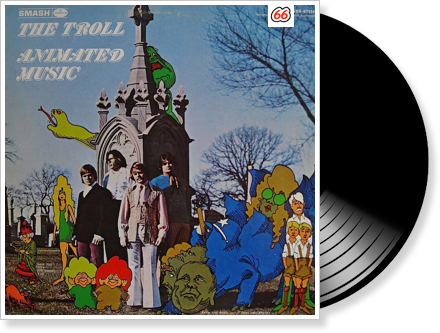
Title: Animated Music
Year: 1968
Format: LP
Label: Smash
An odd and disjointed psychedelic album and a product of the famous Dunwich Productions (see posts of Aorta, American Breed, Coven, H.P. Lovecraft etc.) from a Chicago area band that had formerly had some very minor success with garage rock and British Invasion – like stuff as The Trolls. Some of the tracks are pedestrian, but there is also some very good stuff on this. It doesn’t gell all that well- it sounds like it was put together rather haphazardly, and the music also seems like it comes from different eras.
Some of the tracks have a Beatles/ early Bee Gees flavor, others are in a hard rock vein. The best song is a cut named” Werewolf and Witchbreath, almost a cross between The Stooges, Black Sabbath around the time of their debut record, and early Fleetwood Mac at their loudest- indeed, almost like the three bands had got together and recorded a hard blues/ psychedelic/ heavy metal/ proto- punk theme for a horror flick. ” Professor Potts’ Pornographic Projector” is an amusing vaudeville sort of thing- a kind of satire on sexual mores done in a turn of the century atmosphere- kazoos, vari-speed vocals, and an 1890’s melody.” I’ve Only Myself To Blame” features some really nice Hollies like harmonies and whirling, Sgt. Pepper’s style arrangements.
It’s basically an anti-war song. Some of the rest of this album is dross, and it was one of many such albums- The Troll were popular in their immediate area, but failed to make much of an impression elsewhere. It’s an average album, the high points are high, the low points are dull instead of awful, though some of this hasn’t aged well. The drummer later became Jim Croce’s business manager, and also died in the 1973 plane crash that killed Croce. (Max Collodie)
Track Listing
- Satin City News
- Mr. Abernathy
- Fritz Und Sweeney
- Everybody’s Child
- Solitude
- I’ve Only Myself To Blame
- Professor Pott’s Pornographic Projector’Have You Seen The Queen
- Morning Of The Day
- A Winter’s Song
- Werewolf And Witchbreath
Daughters Of Albion – Daughters Of Albion (1968)
Title: Daughters Of Albion
Year: 1968
Format: LP
Label: Fontana
Inspired by the Beatles’ Sgt. Pepper’s Lonely Hearts Club Band, Daughters of Albion took a hook-laden, harmony-filled approach to late-’60s rock. Representing the combined efforts of vocalist/guitarist/songwriter Greg Dempsey and vocalist Kathy Yesse, Daughters of Albion failed to match critical expectations. Billboard described the duo as “a striking voice but uneven material.”
Featuring original songs by Dempsey, some written with Dave Luff, Daughters of Albion’s sole self-titled album was produced and arranged by Leon Russell.
After the duo’s breakup, Yesse went to record a solo album, Boogie Bands & One Night Stands, as Kathy Dalton, in 1973. Produced by Dempsey, and featuring accompaniment by Van Dyke Parks, Carl Wilson, and members of Little Feat, the album was later renamed Amazing and reissued, with one different track by Frank Zappa’s Discreet label. (Craig Harris, All Music Guide)
Track Listing
- I Love Her And She Loves My
- Still Care About You
- Yes, Our Love Is Growing
- Candle Song
- Ladyfingers
- Sweet Susan Constantine
- Hat Off, Arms Out, Ronnie
- Good To Have You
- Well Wired
- Hey, You, Wait, Stay
- Story Of Sad
- 1968 John Flip Lockup (Medley)