
On The Seventh Day… – Number One (1970)
Title: Number One
Year: 1970
Format: LP
Label: Mercury
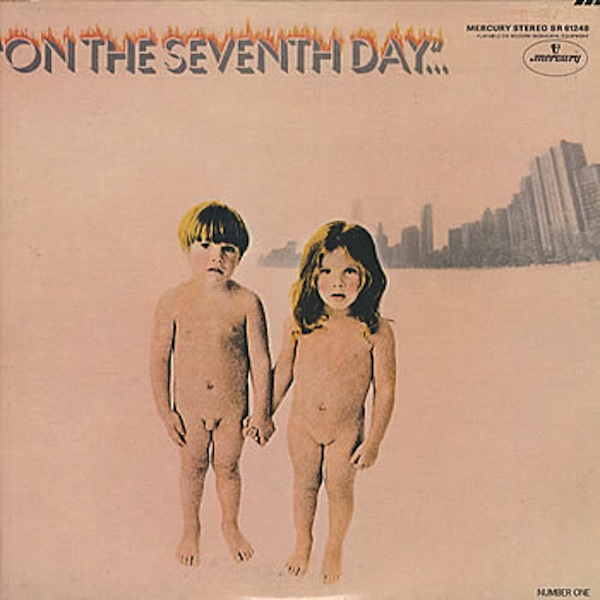
Geez, this is a weird one. As the apparent brain trust behind 1970’s “Number One” about the only thing I know about Alan Bernstein and Victor Millrose is that they enjoyed isolated mid-1960s successes as songwriters, placing a number of hits with artists such as Neil Diamond (‘Girl You’re a Woman Now’). Clearly a concept set intended as social and political commentary, the album melds together a weird blend of original song fragments, with news clips (I recognized Martin Luther King, LBJ, Robert Kennedy, Nixon, Reagan,), brief narrative sections and assorted sound effects.
The activist agenda addressed the usual array of topics, including nuclear war, poverty, race relations, war, gun control, etc. I can’t say this has aged very well, though those same problems persist three decades later. As for the original songs, they’re okay, if somewhat anonymous. Recalling something out of James Brown’s catalog, the song fragment embedded in ‘Burn the Night’ is probably the best of the lot. Overall it reminds me a little of an album by the UK band Warm Dust (“Peace for Our Time”), though the results aren’t quite as abrasive. In many ways the cover art is actually more interesting than the music.
Mercury originally released the set with a cover photo showing a pair of naked young children holding hands. Needless to say, the resulting uproar saw Mercury hastily repackage the set with a bland picture of a tree. (Acid Archives)
Track Listing
- Epilogue/There’s A Baby
- Burn The Night
- The Sound Of Drums
- They Call Me Gun
- The Song Is Mightier Than The Gun/Prologue
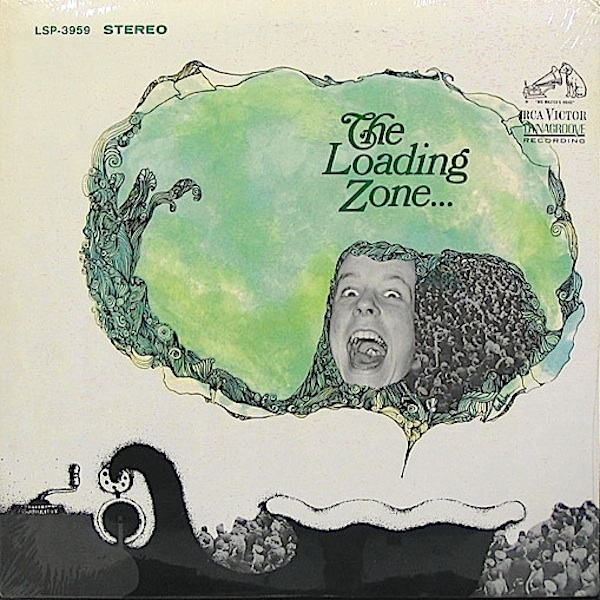
The Loading Zone – The Loading Zone (1968)
Title: The Loading Zone
Year: 1968
Format: LP
Label: RCA Victor
The Loading Zone was an American rock band of the late 1960s, formed in Oakland, California in 1966 by singer-keyboardist Paul Fauerso, following the dissolution of his jazz group The Tom Paul Trio. The original lineup was Fauerso, bassist Bob Kridle, drummer George Newcom and guitarists Pete Shapiro and Steve Dowler, both formerly of Berkeley psychedelic rock band The Marbles, who had supported Jefferson Airplane at the historic “Tribute to Dr. Strange” dance, the inaugural Family Dog promotion, held at San Francisco’s Longshoreman’s Hall in October 1965.
The Loading Zone’s first major concert was the now-legendary Trips Festival at the Longshoreman’s Hall in January 1966. Although primarily an R&B band, The Loading Zone added contemporary psychedelic influences and soon became a popular attraction on the burgeoning Bay Area music scene. The Loading Zone was based at the San Francisco venue The New Orleans House but performed numerous times at major venues including the Fillmore West.
The Loading Zone occasionally headlined but the group is better known for supporting some of the biggest acts of the period including Cream, The Who, The Byrds, Big Brother & the Holding Company, The Grateful Dead, Country Joe & The Fish, Howlin’ Wolf, Sam & Dave, Chuck Berry and Buddy Miles.
In 1968 Fauerso placed an ad in the San Francisco Chronicle seeking a new lead vocalist, which led to the recruitment of Linda Tillery, who joined just prior to the band’s signing with RCA Records. Despite their live popularity, the group lacked a strong base of original material; their self-titled debut LP was poorly received, and was criticised for its excessive production and its reliance on covers. The Loading Zone was unable to garner support from radio and eventually split in 1969.
In 1970 Fauerso and Tillery re-formed the group with guitarist Steve Busfield, bassist Mike Eggleston, and drummer George Marsh, recording their second and final LP One for All for the Umbrella label (i’ve included two tracks from that album in the file), before disbanding for good in 1971. (Wikipedia)
Track Listing
- No More Tears
- Love Feels Like Fire
- Don’t Lose Control (Of Your Soul)
- I Can’t Please You
- Shop Around
- The Bells
- Kali Yuga-Loo
- God Bless The Child
- Danger Heartbreak Dead Ahead
- Can I Dedicate
- One For All
- Think Alone
Swampgas – Swampgas (1972)
Title: Swampgas
Year: 1972
Format: LP
Label: Buddah
The Long Island, NY, band Swamp Gas recorded one album of mediocre of-its-age rock at the beginning of the early ’70s. Alternating between hard rock and folk-rock, it bore some influences from the Grateful Dead, Crosby, Stills, Nash & Young, and more aggressive bluesy early hard rock bands. The group had been discovered by Artie Kornfeld, most famous as one of the producers of the Woodstock festival, and Kornfeld and the band were co-credited as producers of the self-titled Swampgas LP.
It didn’t come out immediately, however, as Kornfeld’s label experienced financial troubles. It did eventually get released by Buddah Records, the parent company of Kornfeld’s label, but by that time the band had been broken up for about a year. Guitarist and principal songwriter Baird Hersey later recorded as part of the jazz group the Year of the Ear, with the band FX, and as a solo artist, as well as played guitar and sung with David Hykes. Singer Kim Ornitz established a successful career in film music as a sound mixer. (Richie Unterberger, All Music Guide)
Track Listing
- Potato Strut
- Don’t
- The Waiting, E Train Blue
- Trapped In The City
- Eulogy
- Frolic Child
- Pala
- Egg Shells
Gospel Oak – Gospel Oak (1970)
Title: Gospel Oak
Year: 1970
Format: LP
Label: Kapp
Matthew Kelly was a Californian who’d previously attracted attention playing blues harmonica and touring with the likes of Mel Brown, John Lee Hooker, and T-Bone Walker. The man clearly had some chops to be supporting names like that. Kelly soon found himself caught-up in San Francisco’s burgeoning rock scene. He added electric guitar to his repertoire and started playing with Chris Herold and Dave Torbert. In 1969 the three of them were hired to play in the band Horses which was fronted by sometimes actor and lead singer Don Johnson (yeap, the Miami Vice guy). Horses recorded one self-titled album before collapsing.
I found a brief online interview where Kelly actually talked about the experience: “I’m a bit embarrassed about. We actually made a record. We were backing up this Hollywood singer, a guy who was sort of a Jim Morrison type. We got flown down to Hollywood and lived there for three or four months while we were making this very commercial record, of which Jump for Joy (A Kingfish tune) was on the record with this guy Don Johnson was singing. Fortunately this record is very difficult to get. So for anybody that wants to run right out and buy it, I think they will have a very difficult time. It is just as well for it is a bit embarrassing.”
Perhaps out of personal shame Kelly’s next move found him headed for the UK. At the same time drummer Kerry Gaines, keyboardist Cliff Hall, pedal steel guitarist Gordon Huntley, lead guitarist Bob Le Gate, and singer/bassist John Rapp found themselves in England. Originally from Indiana, they somehow managed to attract the attention of Beatles publicist Tony Barrow. Barrow signed on as manager and used his connections to get the band a record deal with Kapp. The label then decided to ship the group to London where they hooked up with fellow expatriot Kelly.
The expanded lineup was the teamed with producers Mike Leander and Roger Watson for their self titled debut LP. Musically “Gospel Oak” was all over the genre map. With Rapp and Le Gate responsible for most of the material, tracks like ‘Recollections of Jessica’ and ‘Big Fat White Man’ were decent country-rock complete with nice melodies and catchy group harmonies. Showcasing Kelly’s harmonica and Le Gate’s lead guitar ‘Brown Haired Girl’, ‘Common Expressions’ and the instrumental ‘South Bleach’ offered up a harder edged blues sound, while ‘Go Talk To Rachel’ and ‘O. K. Sam’ found the group taking a stab at a more conventional and accessable rock attack. Propelled by some nifty Le Gate guitar, best of the lot was the album-closer ‘St. Anne’s Pretension’.
The album was never less than enjoyable, but by the same token it lacked anything to distinguish it from the competition. The album’s certainly likeable which makes it too bad if didn’t sport one or two slightly stronger compositions. With those ingredients these guys could have been major players. Kapp also tapped the album for a single in the form of ‘O. K. Sam’ b/w ‘Go Talk To Rachel (RDTEN1 RYM)
Track Listing
- Brown Haired Girl
- Common Expression
- Recollections Of Jessica
- South Bleach
- Big Fat White Man
- Why We Came
- Go Talk To Rachel
- O.K. Sam
- St. Anne’s Pretension
Burnt Suite – Burnt Suite (1972)
Title: Burnt Suite
Year: 1972
Format: LP
Label: BJW
Burnt Suite were from Canton, Connecticut and consisted of William Florian, Woody Andrews, and Jym Cifaldi. Released on the BJM label in 1972, Burnt Suite is a mix of soft country rock, featuring some ballads, and harder rock, with mild psych influences.
The lack of personnel, coupled with the spartan production, yields a rather thin sound over most of the LP, and a general garage sound that they may not have exactly been going for, but is very desirable to underground collectors. (timeshifter RYM)
Track Listing
- Tonight
- Sally Salamader
- Coming To An End
- Finest Things In Life
- Lightning
- Enjoyment Of The Dawn
- Got Time
- Vindati Shanti
- It’s What You Wanted
Blues Magoos – Gulf Coast Bound (1970)
Title: Gulf Coast Bound
Year: 1970
Format: LP
Label: ABC
As original member Peppy Thielhelm and original producer Bob Wyld expanded the Blues Magoos’ foray into Latin music meets mainstream blues, these May 1970 recordings take the previous years’ Never Going Back a step further. Gulf Coast Bound is an improvement, retaining John Liello’s vibes and percussion and pianist Eric Justin Kas, who is the major songwriting contributor here (strangely enough, he is listed as “Kas” on the album jacket and “Kaz” on the songwriting credits)
“Slow Down Sundown” could be the band Chicago vamping without their horn section, some strange imitation monkey-sound vocals making their way onto the platter mixed in with Daddy Ya Ya’s out-of-place tambourine as the song fades. Erik Kas does the lead vocal on the 12-minute-plus opus “Can’t Get Enough of You,” which sounds like a strange marriage between Steely Dan and Traffic.
The problem here is that the band is a notch or two below Traffic and Steely Dan, and despite the general improvement over the last disc and their initial dip into this musical bag, there is no Walter Becker or Dave Mason or Steve Winwood here, or, for that matter, a song as strong as Malo’s “Suavecito” or Steely Dan’s “Do It Again,” which resembles “Can’t Get Enough of You.” To be fair to this new Blues Magoos, they came two full years before Malo and Fagen/Becker would all hit in 1972, so this album can be viewed as pioneering work. It’s too bad ABC records didn’t keep releasing this musical journey.
Liello’s vibes add a marvelous touch, and if they were given a few more chances, maybe they could have found another hit single. The seven-minute 54-second instrumental “Magoos Blues” is lightweight John Barleycorn Must Die-era Traffic, and the new rhythm section of drummer Jim Payne and bassist Cooker Lopresti is nondescript enough to not get in the way. Of the pyschedelic/garage rock bands which changed over to another format — the Electric Prunes, H.P. Lovecraft, etc. — in what seemed like gambles to become “respectable,” this is the best of the lot. Eric Kaz takes “Tonight the Sky’s About to Cry” and it, like the rest of this album, would make for good FM radio filler in the middle of the night.
“Sea Breeze Express” follows suit, competent and pleasant music, but nothing outstanding, and, unfortunately, nothing as breathtaking as the Electric Prunes’ “Get Me to the World on Time” or the Blues Magoos’ own “We Ain’t Got Nothing Yet,” and that is the bottom line. (Joe Viglione, All Music Guide)
Track Listing
- Gulf Coast Bound
- Slow Down Sundown
- Can’t Get Enough Of You
- Magoo’s Blues
- Tonight The Sky’s About To Cry
- Sea Breeze Express
Blues Magoos – Never Goin’ Back To Georgia (1969)
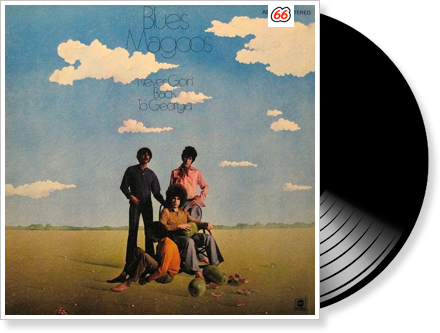
Title: Never Goin’ Back To Georgia
Year: 1969
Format: LP
Label: ABC
Neither of the two albums released after Psychedelic Lollipop, Electric Comic Book and Basic Blues Magoos, had much success. By 1968, the band was discouraged and they split up. At this point they were pretty much The Blues Magoos in name only, as Emil (Peppy) Theilhelm was the only original member.
On the strength of their name alone, the band’s management team re-signed the group to ABC Records, and, as Thielhelm had accumulated a backlog of material, suggested he front a revamped line-up. John Leillo played vibes, Eric Kaz was now on keyboards, Roger Eaton played bass and Richie Dickon became the drummer.
In 1969, the band completed the album “Never Goin’ Back To Georgia”, while the same group, except for Eaton, was augmented by session musicians for the disappointing 1970 Lp, “Gulf Coast Bound”. Neither of these sold well and after hanging on for another two years, The Blues Magoos packed it in. As for the quality, I guess there is room for debate. The first side consists mostly of strained covers that seem unsuited for Peppy’s vocal range and I am sure many a consumer was disappointed.
As I mentioned the title track had radio exposure. Filled with congas and chants it was a good enough song to encourage the masses to make a few purchases (too few as it turned out). The second side also has a convincing cover of “Broke Down Piece of Man” and the original instrumental “Georgia Breakdown” closes out the album with flare”. (otismidnight RYM)
Track Listing
- Heartbreak Hotel
- Heart Attack
- The Hunter
- Feelin’ Time (I Can Feel It)
- Gettin’ Off
- Never Goin’ Back To Georgia
- Broke Down Piece Of Man
- Nobody Knows You When You’re Down And Out
- Georgia Breakdown
Gunhill Road – Gunhill Road (1972)
Title: Gunhill Road
Year: 1972
Format: LP
Label: Kama Sutra
Gunhill Road released a couple of Lps in the 1970’s. The first release, on Mercury Records, was Gun Hill Road First Stop in 1971. The second album, Gunhill Road, was released in 1972 and produced by Kenny Rogers. It was remixed and rereleased in 1973 to great success from the track Back When My Hair Was Short.
The original recording had heavy drug references while the remix was a growing up story about everything remaining the same. The album received great reviews, and was often featured on many FM and college radio stations. The band members were Glenn Leopold, Steven Goldrich, and Gil Roman. Gunhill Road recorded 42nd Street with three different producers: Jay Leer, Kenny Rogers, and Kenny Kerner.
Back When My Hair Was Short was recorded twice. The original version released in 1972 has more edgy lyrics than the radio ready 1973 release. Back When My Hair Was Short was top 10 in more different cities at more different times than any record in 1973. (Prairie Prince Minsky)
Track Listing
- Sailing
- She Made A Man Out Of Me
- Madness
- We’re Almost Going Home
- Waiting
- 42nd Street
- Back When My Hair Was Short
- Sag Harbor
- My Antoinette
- Callin’ Atlanta
- Back When My Hair Was Short [single mono version]
The Jaggerz – We Went To Different Schools Together (1970)
Title: We Went To Different Schools Together
Year: 1970
Format: LP
Label: Kama Sutra
Best known for their 1970 smash “The Rapper,” the Jaggerz were formed in Pittsburgh during the mid-1960s by singer/guitarist Dominic Ierace, guitarist Benny Faiella, bassists Jimmy Ross and Billy Maybray, keyboardist Thom Davies and drummer Jim Pugliano.
After earning a fervent following on the local club circuit, the group ultimately signed to Kenny Gamble and Leon Huff’s label Gamble Records to issue their 1969 debut LP Introducing the Jaggerz; when the record tanked, the band signed to Kama Sutra for 1970’s We Went to Different Schools Together, falling just shy of topping the charts with “The Rapper.”
The single was the Jaggerz’ lone chart hit, however, and they were soon reduced to again hitting the local club scene. After one final LP, 1975’s Come Again, the group disbanded; frontman Ierace then changed his name to Donnie Iris and joined Wild Cherry, scoring a major disco-era hit with “Play that Funky Music” before going on to mount a solo career. (Jason Ankeny, All Music Guide)
Track Listing
- I Call My Baby Candy
- Memoirs Of The Traveler
- With A Little Help From My Friends
- Looking Glass
- The Rapper
- At My Window
- Things Gotta Get Better
- Carousel
- Don’t Make My Sky Cry
- That’s My World
The 31 Flavors – Hair (1969)
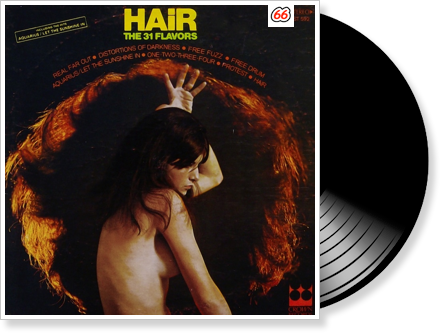
Title: Hair
Year: 1969
Format: LP
Label: Crown
For some reason, this album seems to be constantly overshadowed by the Firebirds release. However hard it may be to believe, this album is actually far heavier. The only huge difference is that it’s not nearly as consistent.
Every song here comes in pairs. The first pair, “Hair” and “Aquarius”, is complete garbage and should be avoided as much as possible. Just like the previous album, the label decided to start it off with something that won’t offend people (unoffencive as in not heavy), but it’s far worse this time around. Just like before these two songs weren’t even recorded by this band, and I’m assuming there’s two of them because there wasn’t enough material for one extra Firebirds song.
The next pair, “Free Fuzz” and “Free Drum”, is just tying up loose ends from the previous album. Although the previous album has these two tracks listed, they weren’t actually on that record, so the label put them here instead. These tracks are much better if you listen to them in succession, starting with “Free Bass” from the previous album, because they were indeed recorded in one continuous take.
The penultimate pair is “Protest” and “One-Two-Three-Four”. Finally we get to the new material that was actually recorded by The Firebirds in a completely different session than on the previous album. These two tracks are very good, but they’re really odd when you compare them to the Light My Fire songs. You can tell that the band really matured here.
The singing sounds so much better, and it actually sounds like the guy has his own style, instead of the poor Jack Bruce rip-off he did before. The lyrics are no longer corny Hendrix rip-offs. They now sound like serious song-writing attempts, and the singer’s improved style gives me an impression of sincerity.
The drummer settled down, and sounds much more professional. The bassist is the only member who didn’t necessarily clean up his style. His tone is now really heavy, in that it sounds like it’s been detuned to a really low octave. And the guitarist now plays with hardly any distortion compared with the last album (relax, only in this pair of songs).
He uses just enough to give his riffs a cool, dark feeling (and it somehow manages to be heavy), and it compliments the singing pretty well I think. He even changes to a smooth guitar tone at the end of “One-Two-Three-Four” for a nice little blues solo, which is unlike any of his sloppy blues solos from the previous album.
And although I’m not really an expert in the intricacies of guitar tuning, it really sounds like the guitarist detuned his strings along with the bassist, which I guess could be a reason that it sounds so dark, and it makes even more sense when you listen to the last pair of songs, because he reaches a low frequency of fuzz I never even thought was possible in the 60′s.
Which brings me to the the last pair, “Real Far Out” and “Distortions of Darkness”. This pair is such a masterpiece of stoned sludge, I just cannot comprehend how I’m the only person who seems to rave about it. Unlike the last pair, these are pure instrumental tracks, and the guitarist finally uses his fuzz-box, seemingly to its highest setting.
The first one is a blues workout, namely the song “Steppin’ Out” which I associate with Eric Clapton, but for all I know it’s probably originally performed by somebody else. It starts off as nice and fuzzy heavy blues, but as the song progresses the guitarist delves deeper and deeper into some sort of nightmarish acid trip, and his guitar follows him into some really sloppy sludge. It really does sound real far out.
And finally, they save the best song for last. They really could not have come up with a name as accurate as “Distortions of Darkness”. This shit is pure f**king evil. It’s actually an instrumental form of “Reflections” from the previous album, but as I mentioned earlier, the detuned bass and guitar just bring this song to what I strongly argue as the heaviest levels of the 60′s. An essential track for anybody who considers themselves a fan of proto-metal.
That first pair of tracks is so damn grotesque that ideally this album should be rated much lower than I have it, but I maintain that these aren’t even from the same band, so just delete them and add the rest of the tracks onto the end of the Firebirds album. This is a great solution, because not only do you never have to hear this excellent band being smeared with association to that shit, but you can order the “Free” songs together for a far better listening experience.
Undoubtedly among the best musicians of the decade, too bad nobody has any idea who they even are.. Oh, and it’s not Jerry Cole, so please stop spreading that misinformation if you happen to see somebody telling you that. (Andrupchik RYM)
Track Listing
- Hair
- Aquarius/Let The Sun Shine In
- Protest
- Free Fuzz
- One Two Three Four
- Real Far Out
- Free Drum
- Distortions Of Darkness