
On The Seventh Day… – Number One (1970)
Title: Number One
Year: 1970
Format: LP
Label: Mercury
Geez, this is a weird one. As the apparent brain trust behind 1970’s “Number One” about the only thing I know about Alan Bernstein and Victor Millrose is that they enjoyed isolated mid-1960s successes as songwriters, placing a number of hits with artists such as Neil Diamond (‘Girl You’re a Woman Now’). Clearly a concept set intended as social and political commentary, the album melds together a weird blend of original song fragments, with news clips (I recognized Martin Luther King, LBJ, Robert Kennedy, Nixon, Reagan,), brief narrative sections and assorted sound effects.
The activist agenda addressed the usual array of topics, including nuclear war, poverty, race relations, war, gun control, etc. I can’t say this has aged very well, though those same problems persist three decades later. As for the original songs, they’re okay, if somewhat anonymous. Recalling something out of James Brown’s catalog, the song fragment embedded in ‘Burn the Night’ is probably the best of the lot. Overall it reminds me a little of an album by the UK band Warm Dust (“Peace for Our Time”), though the results aren’t quite as abrasive. In many ways the cover art is actually more interesting than the music.
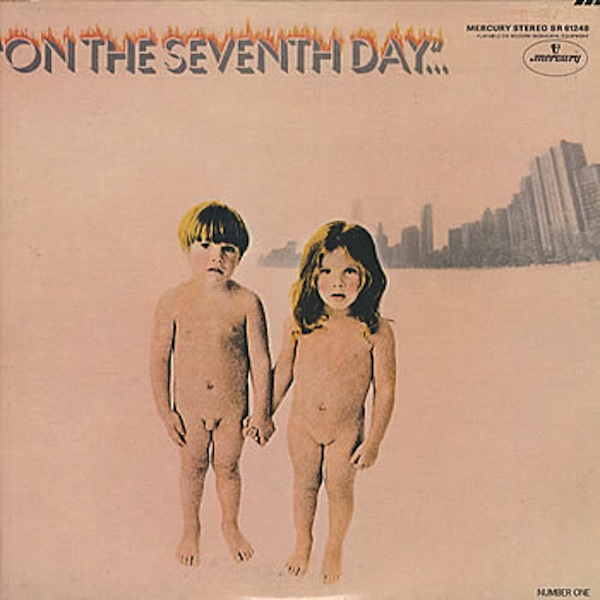
Mercury originally released the set with a cover photo showing a pair of naked young children holding hands. Needless to say, the resulting uproar saw Mercury hastily repackage the set with a bland picture of a tree. (Acid Archives)
Track Listing
- Epilogue/There’s A Baby
- Burn The Night
- The Sound Of Drums
- They Call Me Gun
- The Song Is Mightier Than The Gun/Prologue
The song you’re referring to as being by Neil Diamond isn’t by Diamond. You may be getting it confused with “Girl, You’ll Be a Woman Soon,” which Diamond wrote himself.
I think the song you mean is “This Girl is a Woman Now,” and it’s by Gary Puckett. It was written by Millrose and Bernstein.
That said, this is an interesting album, but if you’ve got any conservative leanings you won’t like it much, since it takes boilerplate 1960s leftist views towards pretty much every social issue (poverty, gun control). The album’s mixing of spoken word and music with social issues does sort of predict the coming of various early rap albums, though.
Where can I listen to They Call me Gun online?
Much appreciated Red