

Steve Karliski – Gotta Keep Movin’ (1973)
Artist: Steve Karliski
Title: Gotta Keep Movin’
Year: 1973
Format: LP
Label: Perception
Steve Karliski was the youngest son of five children born to Ukrainian immigrant parents. From a very early age he loved music and was giving recitals before the age of 10. In his teens Steve started composing songs, both lyrics and music.
In the early 1960s after attending McGill University he headed for New York with his songs and became an instant success working with other songwriters Larry Kolbar, Barry Mann, Neil Sedaka and Carole King.
After moving to Nashville his country songwriting credits and #1 hits included “Yes, Mr. Peters”, which was featured on the TV show ’60 Minutes’. “Molly” was written during the Vietnam War and was recognized in writing by Senator Bob Dole in the US. Bobby Goldsboro released it as a single.
Many artists recorded Karliski’s songs including Billy Walker, Jack Greene, Freddie Hart, Norma Jean, Tommy Cash, Faron Young, Waylon Jennings, Wayne Newton, Teresa Brewer, Hank Williams Jr., Bobby Vinton, Tony Orlando, Patti Page, Tex Ritter, Frankie Lane, Gary Puckett and the Union Gap and many others.
He also wrote the soundtrack for several movies including ‘A Time to Sing’, ‘Old Before My Time’, and ‘Money Can’t Buy Happiness’ among others.
Karliski wrote or recorded more than two hundred songs but only ever recorded on album. He met fellow Canadian Ralph Murphy during his time in New York City and signed to Murphy’s Double M Records. Karliski wrote and produced 1973’s ‘Gotta Keep Movin’ LP.
Steve Karliski passed away in 2007 in Niagara Falls, where he had been living for more than 10 years. (The Canadian Pop Encyclopedia)
Track Listing
- Gotta Keep Movin’
- Takes A Woman Like You
- Ask Me Anything
- Home Comes The Hero
- And Then Came The Bad Years
- Molly
- For Loving You
- Not The Way They Used To
- At Least One Time
- Think Of The Good Times
Compton & Batteau – In California (1970)
Artist: Compton & Batteau
Title: In California
Year: 1970
Format: LP
Label: Columbia
The 1969 Appaloosa LP was released by Columbia and after the album proved commercially stillborn the company effectively lost interests in the band. When the band collapsed violinist Robin Batteau joined his wife in California. Singer/guitarist John Parker Compton decided to join him, promptly packed up for California.
Once in California the pair began shopping demos and were promptly signed by Columbia A&R man Eddie Matthews, Produced by Abner Spector, 1970′s In California wasn’t a major change in direction from the Appaloosa album – perhaps a touch more country-rock oriented (thanks in part to support from several members of Poco who happened to be recording an album in the same studio), but featuring the same general sound – eclectic, but with some commercial touches.
Perhaps the biggest change was the emergence of Batteau. Appaloosa had pretty much been a showcase for Compton, but this time around Batteau contributed a couple of tracks to the mix (two of the best performances in my humble opinion) and handled a couple of vocals. As it turned out, his voice was far more commercial than Compton’s. (Bad Cat)
Track Listing
- Laughter Turns To Blue
- Silk On Steel
- Honeysuckle
- Elevator
- Homesick Kid
- Proposition
- Grotto Farm
- Essa Vanessa
- Zephys
- California
The Freeway – The Freeway (1971)
Artist: The Freeway
Title: The Freeway
Year: 1971
Format: LP
Label: FourMost
Yet another album from the Campus Life series of Xian Pop releases on the FourMost label (see the Soul Concern post of July 17, 2011 and the future posts of Under New Management and The Connection).
Freeway were from Michigan and consisted of Dan Erlandson (guitar-banjo-vocals), Ted Kallman (guitar-bass-vocals), Nancy Van Elk, (vocals), Connie Clendenan (trumpet-vocals), Dennis Spitters (trumpet-vocals) and Mike James (drums-vocals).
The album contains the usual secular songs that turn up on these Xian pop albums such as “People Got To Be Free”, “Let It Be” etc. with an Xian twist to the lyrics mixed in with the more Christian offerings. (J. J. Hildreth)
Track Listing
- He’s Got The Whole World In His Hands
- New 23rd
- We’ve Only Just Begun
- Oh Happy Day
- This Is My Father’s World
- People Gotta Be Free
- One Less Bell To Answer
- Let It Be
- Amazing Grace
- Aquarius
The Shades Of Blue – Happiness Is The Shades Of Blue (1966)

Artist: The Shades Of Blue
Title: Happiness Is The Shades Of Blue
Year: 1966
Format: LP
Label: Impact
The Shades of Blue were a vocal quartet from suburban Detroit who had been trying for some time to get a recording contract. Members of the group were Linda Allen, Bob Kerr, Ernie Dernai, and lead singer Nick Marinelli.
After being auditioned and turned down at the Golden World label, they kept in touch with Golden World producer John Rhys and recording artist Edwin Starr. Rhys suggested a name change from the Domingos to the Shades of Blue. Starr showed them a song he had written called “Oh How Happy,” and the group recorded it in January, 1966, at Golden World Studios. Rhys loved the recording and brought it to Harry Balk, who signed the group immediately.
Their initial single, “Oh How Happy” [Impact 1007] took only a few weeks to make #1 in Detroit, and made #12 nationally. Followups “Lonely Summer” [Impact 1014] and “Happiness” [Impact 1015] only reached the 70s in the national charts, although they fared better in hometown Detroit, making the top-30.
As far as the national charts went, the Shades of Blue were essentially one-hit wonders. The group first entered the national charts in early May, 1966, and by the end of October, they were done. They released a few more singles, but apparently, no one was listening any more outside of Detroit. They broke up in 1970, but did some reuinion concerts years later.
The album’s most soulful numbers: “With This Ring,” (not the Platters’ version), and “Way To Love You” were written by Barney “Duke” Browner, who later wrote the deep soul classic “Ain’t That Loving You (For More Reasons Than One).” A totally underappreciated production, one that you put on and let play until the end. (Bridget Bishop)
Track Listing
- Millionaire
- World In His Hands
- The Nigh
- With This Ring
- Little Orphan Boy
- Happiness
- Exception To The Rule
- A Way To Love You
- Lonely Summer
- Peace Of Mind
- Oh How Happy
The Jesus Generation – A Thief In The Night (1970)
Artist: The Jesus Generation
Title: A Thief In The Night
Year: 1970
Format: LP
Label: Gospel World
Texas private label pressing of a teen lo-fi (and inept.. in a good way) garage band.. no snarling fuzz or attitude.. this is more in the Click Kids vein (see June 26, 2011 post).
Very strange album released during the height of the Jesus Movement by Texas teen garage band. This entry is set apart by the group’s tactic of “updating” popular 60′s rock tunes with Christian lyrics.
The three Beatles reworkings are the highlights for this fan with incredibly strange lyrics and impossibly earnest deliveries devoid of any irony. Their “Amazing Grace” is done to the “House Of The Rising Sun” with some nice fuzz guitar and “Calvary” is set to The Beatles’ “Yesterday“ with cool fuzz guitar. (Show and Tell)
Track Listing
- Help
- Something
- Look For Love
- So Very Happy
- Amazing Grace
- Happy Day
- Bridge Over Troubled Water
- Calvary
- I’ve Got Confidence
- Thief In The Night
- New World
- Sweet Holy Spirit
John Berberian – The Dance Album (1978)
Artist: John Berberian
Title: The Dance Album
Year: 1978
Format: LP
Label: Olympia
Contributed by The Big “N”
A late seventies release from John Berberian (oud-violin-mandolin) also featuring legendary Armenian singer Onnik Dinkjian and traditional percussion by Johno Dolbashian (dumbeg-davool).
Also appearing on this record are vocalist Jack Baghsarian, David Attarian (accordion), Ara Dinkjian (acoustic guitar), Chris Marashlian (bass guitar) and John Vartan (doudoog-srink).
“John Berberian is considered to be one of the finest oud virtuosos in the world, and is known for a series of successful Armenian and Middle Eastern recordings. Two recordings from this series, “Expressions East” and “Oud Artistry” were record breaking in sales. “The Dance Album” was released on his own Olympia label.” (Max Collodie)
Track Listing
- Tamzara
- Mechus gyank chi menatz
- Karnan mekhag
- Medley
- Na mi naz uni
- Yeregoyan bar
- Le le yar
- Hale
Uncle Bill – Socks It To Ya (1969)

Artist: Uncle Bill
Title: Socks It To Ya
Year: 1969
Format: LP
Label: Dot
Courtesy of Egg City Radio
Circa 1969 LP by Burt Wilson performing in character as Uncle Bill, a sort of 1960’s hip updated version of W. C. Fields. Apparently he used this character on the “Laugh In” TV show. He puts his stamp on songs from the Beatles, Bob Dylan and others.
Incidentally (what makes this album interesting), backing up Wilson on this album is none other than The Peppermint Trolley Co. who were responsible for singing the “Brady Bunch” theme song for the show’s first season, they also released an album for Dot’s subsidiary label Acta Records in 1968 (see July 17, 2011 post).
The combination of Wilson’s “W. C. Fields” parody and the Trolley’s excellent accompaniment on such Pop standards as “Bottle Of Wine”, “With A Little Help From My Friends”, “The Mighty Quinn” and “Yummy, Yummy, Yummy” make this a minor pop psych classic!!! (Jacque Itzch)
Track Listing
- Uncle Bill’s Monologue
- Bottle Of Wine
- Ballad Of Bonnie And Clyde
- The Bears
- The Mighty Quinn
- Here Comes The Judge
- The Beaver Falls Open
- Little Help From My Friends
- Bass Drum Henry
- May I Take A Giant Step
- Unicorn
- Yummy, Yummy, Yummy
Willard Cantelon – LSD: Battle For The Mind (1966)
Artist: Willard Cantelon
Title: LSD: Battle For The Mind
Year: 1966
Format: LP
Label: Supreme
One of the all-time great Psych album covers: LSD Battle For The Mind. Willard Cantelon’s highly informative presentation on LSD… captured for eternity on vinyl. LSD: Battle For The Mind attempts to show the harm LSD is doing to 1960’s Society, unlike racism, sexism, war and killing all the black and brown people in the world. (huffduffer)
Track Listing
- LSD: Battle For The Mind
Marshall McLuhan – The Medium Is The Massage (1967)
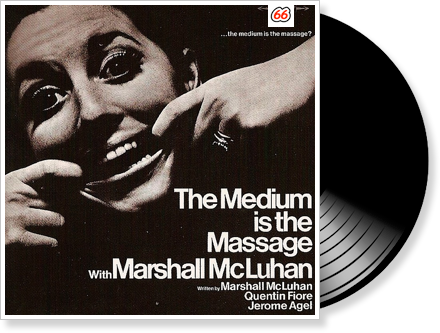
Title: The Medium Is The Massage
Year: 1967
Format: LP
Label: Columbia
In this article we will begin an examination of someone who most people do not know, but who is considered by many to be the first father and leading prophet of the electronic age, Marshall McLuhan.
A Canadian born in 1911, McLuhan became a Christian through the influence of G.K. Chesterton in 1937. He wrote his monumental work, one of twelve books and hundreds of articles, Understanding Media: The Extensions of Man, in 1964.
The subject that would occupy most of McLuhan’s career was the task of understanding the effects of technology as it related to popular culture, and how this in turn affected human beings and their relations with one another in communities.
Because he was one of the first to sound the alarm, McLuhan has gained the status of a cult hero and “high priest of pop-culture”. This status is not undeserved, and McLuhan said many things that are still pertinent today.
His thought, though voluminous, is frequently reduced to one-liners, and small sound bites, which sum up the more complicated content of his probing and rigorous examination of the media, a word that he coined. Concerning the new status of man in technological, and media-dominated society, he said:
If the work of the city is the remaking or translating of man into a more suitable form than his nomadic ancestors achieved, then might not our current translation of our entire lives into the spiritual form of information seem to make of the entire globe, and of the human family, a single consciousness?
In statements like this, McLuhan both announces the existence of a global village, another word he is credited for coining, and predicts the intensification of the world community to its present expression. All of this was done in the early 1960s at a time when television was still in its infancy, and the personal computer was almost twenty years into the future.
McLuhan is announcing what Lewis H. Lapham says is a world of people who worship the objects of their own invention in the form of fax machines and high speed computers, and accept the blessings of Coca-Cola and dresses by Donna Karan as the mark of divinity.
The fact that more people watch television than go to church is nothing new to us, but it was one of the tell-tale signs of a cultural shift in history for McLuhan; a shift which has been imperceptible to most, and devastating to all.
If anyone doubts McLuhan’s warning that “we become what we behold,” he should reflect on the consuming desire of many average teenagers to be like Michael Jordan, Madonna, or Britney Spears: a desire that has resulted in a culture of plastic surgery and drive-by shootings to obtain tennis shoes.
Objects of Desire
In our continuing examination of Marshall McLuhan, the patriarch of media criticism, we will explore the totalitarian techniques of American advertising and market research on the unsuspecting consumer. How this is accomplished, and the effects it has, were outlined in The Mechanical Bride, first published in 1951.
The book dealt with the influence of print media on the male and female psyche. The objective of advertising men, said McLuhan, is the manipulation, exploitation, and control of the individual. If this is true, then who, one might ask, was doing the controlling, and what was the desired effect?
The advertising companies were doing the controlling, and the desired effect was nothing loftier than selling products to unsuspecting customers. Making women into objects of desire by men, and then in turn selling the women the products to help them achieve the effect of desirability, accomplished the entire enterprise. The advertising men succeeded in creating a market where one did not previously exist.
The purpose here, and earlier for McLuhan, is not to vilify the advertising industry, rather it is to provide insight into how media functions. One such insight is McLuhan’s description of the contemporary mindset of a woman under the influence of advertising geniuses. He said:
To the mind of the modern girl, legs, like busts, are power points, which she has been taught to tailor, but as parts of the success kit rather than erotically or sensuously. She swings her legs from the hip . . . she knows that a “long-legged girl can go places.” As such, her legs are not intimately associated with her taste or with her unique self but are merely display objects like the grille on a car. They are date-bated power levers for the management of the male audience.
What McLuhan correctly ascertains is not the fact that women try to look attractive for men (presumably women have been doing this for a long time), but the idea of “polishing” each and every part for a kind of optimal performance.
The modern woman has been taught through advertising bombardments that every feature of her physical makeup can be enhanced for the specific purposes of gaining a husband, a promotion, or just getting a door opened.
As one might suspect, there is a male counterpart to this advertising bombardment. The overwhelming superwoman, the possessor of beauty and grace in degrees hitherto unimaginable, demands an impossibly high standard of virility from her male counterpart.
The result says McLuhan, are men who are readily captured by the gentleness and guile of women, but who are also surrounded by a barrage of body parts. The man is not won over, but slugged, and beaten down in defeat.
Technology as Extensions of the Human Body
In our continuing look at Marshal McLuhan, the man who coined the term “global village” and the phrase “the medium is the message,” we will reflect on what he had to say about the various ways human beings extend themselves, and how these extensions affect our relationships with one another. First, we must understand what McLuhan meant by the term “extension(s).”
An extension occurs when an individual or society makes or uses something in a way that extends the range of the human body and mind in a fashion that is new. The shovel we use for digging holes is a kind of extension of the hands and feet.
The spade is similar to the cupped hand, only it is stronger, less likely to break, and capable of removing more dirt per scoop than the hand. A microscope, or telescope is a way of seeing that is an extension of the eye.
Considering more complicated extensions, one might think of the automobile as an extension of the feet. It allows man to travel places in the same manner as the feet, only faster and with less effort. In addition, this extension enables one to travel in relative comfort in extreme weather conditions. Most individuals already understand the concept of extension, but many are unreflective when it comes to what McLuhan calls “amputations;” the counterpart to extensions.
Every extension of mankind, especially technological extensions, have the effect of amputating or modifying some other extension. An example of an amputation would be the loss of archery skills with the development of gunpowder and firearms. The need to be accurate with the new technology of guns made the continued practice of archery obsolete.
The extension of a technology like the automobile “amputates” the need for a highly developed walking culture, which in turn causes cities and countries to develop in different ways. The telephone extends the voice, but also amputates the art of penmanship gained through regular correspondence. These are a few examples, and almost everything we can think of is subject to similar observations.
McLuhan believed that mankind has always been fascinated and obsessed with these extensions, but too frequently we choose to ignore or minimize the amputations. For example, we praise the advantages of high speed personal travel made available by the automobile, but do not really want to be reminded of the pollution it causes.
Additionally, we do not want to be made to think about the time we spend alone in our cars isolated from other humans, or the fact that the resulting amputations from automobiles have made us more obese and generally less healthy. We have become people who regularly praise all extensions, and minimize all amputations. McLuhan believed that we do so at our own peril.
The Dangers of Over-extended Technology
We have discussed the idea of extensions and amputations caused by new technology, which is introduced into society. The automobile was previously mentioned as an extension of the foot. The car allows one to travel, just as the foot does, only faster and with less effort. The amputations which result would include loss of muscle strength in the under-utilized legs, and the reduction in the quality of air we breathe.
Something occurs when a medium like the automobile, used for transportation, becomes over-extended. The resulting amputations such as muscle atrophy, smog, and high-speed fatalities increase at a rate that challenges the benefits initially gained
Automobile fatalities, lung disease, and obesity caused by modern transportation begin to outweigh the benefits of getting to our destinations quicker and with less effort. The final movement is the reversal of the benefits. McLuhan said:
Although it may be true to say that an American is a creature of four wheels, and to point out that American youth attributes much more importance to arriving at driver’s-license age than at voting age, it is also true that the car has become an article of dress without which we feel uncertain, unclad, and incomplete in the urban compound.
To this observation might be added the fact that we train children from a very young age to stand within a few feet of high-speed vehicles without being afraid. Less than two hundred years ago a screaming locomotive or a high speed automobile would have caused a person to flee in terror for their lives.
We have slowly conditioned ourselves to not be afraid of something that is in fact extremely dangerous. Similarly, we know that speed limits of twenty miles an hour would almost certainly eliminate most car fatalities, but we also consider the advantages of getting to our destinations quicker to be worth the resulting death rate.
Proof of this casual acceptance of the disadvantages of the car could be imagined if one were to consider the fate of a political candidate who ran on a platform of reducing the national speed limit to twenty miles per hour. We know the advantages, even before implementation, but we choose to accept the disadvantages because there is a privileging of all types of technological extension, even deadly and horrific forms.
We are now prepared to consider the specific types of extensions realized by the television, mobile phone, and computer. If we take McLuhan’s lead then all of these must be simultaneously considered as extensions with both positive and negative amputations of previous technologies.
Four Questions Applied to Media
We are concluding our considerations of Marshall McLuhan’s pertinence with an examination of ideas found in his last work, The Global Village, published in 1989, twenty-five years after his monumental Understanding Media: The Extensions of Man. In his early works McLuhan focused on the rapid change in the five centuries since the development of the printing press and movable type, and the especially rapid developments of the twentieth-century.
McLuhan died in 1980 and was beginning to see the first fruits of the television generations as well as the fulfillment of some of his predictions. He was deeply concerned about man’s willful blindness to the downside of technology, yet McLuhan was not an irrational alarmist.
In his later years, and partially as a response to his critics, McLuhan developed a scientific basis for his thought around what he termed the tetrad. The tetrad allowed McLuhan to apply four laws, framed as questions, to a wide spectrum of mankind’s endeavors, and thereby give us a new tool for looking at our culture.
The first of these questions or laws is “What does it (the medium or technology) extend?” In the case of a car it would be the foot, in the case a phone it would be the voice. The second question is “What does it make obsolete?”
Again, one might answer that the car makes walking obsolete, and the phone makes smoke signals and carrier pigeons unnecessary. The third question asks, “What is retrieved?” The sense of adventure or quest is retrieved with the car, and the sense of community returns with the spread of telephone service. One might consider the rise of the cross-country vacation that accompanied the spread of automobile ownership.
The fourth question asks, “What does the technology reverse into if it is over-extended?” An over-extended automobile culture longs for the pedestrian lifestyle, and the over-extension of phone culture engenders a need for solitude.
With the radio and television we have simultaneous access to events on the entire planet. However, television culture diminishes, or amputates, many of the close ties of family life based on oral communication. The simple act of turning on a television can reduce a room of people to silence.
What is retrieved is the tribal or interrelated view of man. What it becomes or returns to is the global theater, where people are actors on a stage. One need only witness the event status of an airplane crash or weather disaster.
On McLuhan’s gravestone are the words “The Truth Shall Make You Free.” We do not have to like or even agree with everything that McLuhan said, but we should nevertheless remember that his life was dedicated to showing men the truth about the world they live in, and the hidden consequences of the technologies he develops. (Todd Kappelman)
Track Listing
- The Medium Is The Massage
Tedd Smith – Smash And Grab World (1969)
Artist: Tedd Smith
Title: Smash And Grab World
Year: 1969
Format: LP
Label: Word
This is truly a great but often overlooked psychedelic Christian album on the very unpsychdelic Word label. And an obscuro fringe record to say the least. This is Tedd Smith’s attempt to convert all the drugged out hippies into nice Christians, I presume as he was a Billy Graham sidekick. But he had an ace up his sleeve. He was going to be working from the inside.
By making an album that sounded psychedelic, he could reach the people that needed help the most. The drugged-out hippies who actually seek out strange noises, exotic instrumentation and trippy lyrics! Perhaps Tedd Smith’s little spoken word bits have been the problem for those seeking heady sounds these days as they do tend to devalue the rest of the albums mood.
The mood being an unworldly mix of avant-garde, Egyptian circus keyboards and drums, semi-fuzz spy guitar, and the beautiful folky-fragile voice of Joan Hettenhouser that swirls and pulsates into a nice 60’s sound experience. And man what a voice. Whether she’s singing about “jumping for joy” or how all the kids are “getting high on grass and acid arrows”, Hettenhouser can create an atmosphere with the best of them. It’s a crime she isn’t better known.
Evidently, she was also in a Christian Rock band called The Sons of Thunder who released four albums starting in 1968. She certainly has a sound that belongs on the Hippie Goddess compilations. Tedd’s keyboards and songwriting, if not directly influenced by psychedelics, have enough second-hand exposure to make them seem genuine.
The rest of the band was probably sneaking away now and then behind Tedd Smith’s back to engage the practices that he was preaching against. They certainly sound “experienced”. Towards the end of “Runnin’ Man”, it starts to feel like I’m dreaming and floating away and I thank Heaven for Tedd Smith’s creations.
Even if he didn’t fulfill his intended purpose, his music is definitely nice to get high too (or remember getting high). In the end, the joke’s on Tedd Smith if he thinks that he could possibly convert a wayward soul with his jams.
He seems more converted into the psychedelic culture than vice versa in my book. I guess he got his revenge with those dreadfully awful spoken word sermon poems that he threw into the album though. If you can overlook this, you’re in for a treat with this album. He ventures places that few have or ever will. (Shane Georges)
Track Listing
- Jump For Joy
- Games
- Smash And Grab World
- A Little Understanding
- Circles
- The Runnin’ Man
- Outside
- The Good I Would Be