
Revolutionary Blues Band – Revolutionary Blues Band (1970)
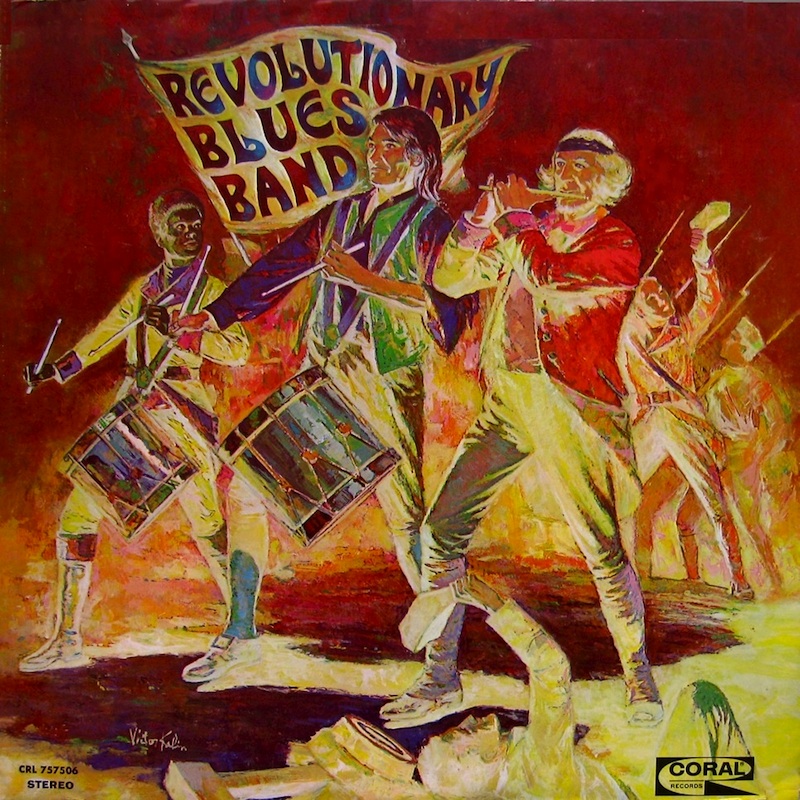
Title: Revolutionary Blues Band
Year: 1970
Format: LP
Label: Coral
The Revolutionary Blues Band were a studio band consisting of Rod Piazza (harmonica), Tom Scott (saxophone), Arthur Adams (guitar), Lightnin’ Rod Jones (vocals), and David Bennett Cohen (guitar). The album is a mix of blues and funky instrumentals, the exception being “That’s The Truth, Baby” with Lightnin’ Rod handling the vocals. The record was produced by Bob Thiele, who was known for his jazz productions and also for producing rock acts such as Eden’s Children and the Ford Theatre on ABC. (Jack Dominilla)
Track Listing
- Juicy
- Milkman, Milkman Leave Me Some Cream Today
- Lanoola Goes Limp
- That’s The Truth, Baby
- Have A Little Bit More
- Take Me Back To Tennessee
- Cutting The Mustard
- Ring My Chimes
- Funky Lady
- Dirty Town Blues
The Underground – Psychedelic Visions (1967)
Title: Psychedelic Visions
Year: 1967
Format: LP
Label: Mercury
Another in a long line of exploitation psych albums released in the 1960s to capitalize on the psychedelic craze. This one’s more in the “Garage/Punk” vain and it’s not too shabby, containing some nice remakes including a fuzz distorted version of “Tobacco Road” with an instrumental break that would make the Velvet Underground proud. (Morris James)
Track Listing
- Psychotic Reaction
- Shout
- Psychedelic Dream
- Psychotic Vibrations
- Tobacco Road
- Turn On Your Lovelight
- We Ain’t Got Nothin’ Yet
- Psychedelic Visions
- Mind Jammer
- The Warper
The Road – The Road (1970)

Title: The Road
Year: 1970
Format: LP
Label: Kama Sutra
The Road hailed from upstate New York (Buffalo to be exact) and that they released a number of 45s on UA and Kama Sutra, as well as one (maybe two) LP for the latter label between 1967 and 1970. (Actually their second album was released in 1971).
The band, featuring Phil and Jerry Hudson on vocals, Joe and Jim Hesse on bass and keyboards, Ralph Parker on guitar and Nick DeStefano on drums hit the charts (Top 40 in several markets) with their cover of the Zombies’ ‘She’s Not There’ in the early part of 1969.
Their eponymous 1969 lp was composed largely of cover tunes (including two Buffalo Springfield songs). Their version of ‘Mr. Soul’ may not be on the level of the original (one of my favorite songs by one of my two favorite 60’s bands), but it’s still a pretty respectable effort. The Road’s take on ‘Mr Soul’ is a great illustration of how much the rock landscape had changed in the two years since the Buffalo Springfield originally recorded the song, stretching the tune out with a certain era-specific vibe redolent of slightly longer hair, freer love and a somewhat, dare I say ‘Woodstock-ian’ (that’s not really a word, but I think you know what I’m trying to say) aesthetic.
There are certainly still ties – especially the lead guitar – to the original (if say Stephen Stills had taken the lead vocal instead of Neil Young), and I dig how the organ kind of percolates under the rhythm section without getting in the way. It’s a great example of the very brief period when rock was starting to loosen up just a bit, before unraveling almost irrevocably in a stinky, denim-patched fog of patchouli, weed smoke and self indulgence. (Larry Iron Leg)
Track Listing
- Follow The Road
- She’s Not There
- Love Is All
- Love-It-Is
- A Taste Of Honey
- I Can Only Give You Everything
- Dance To The Music (Shotgun)
- Never Gonna Give You Up
- Mr. Soul
- In Love
- See You There
- Rock & Roll Woman
- The Grass Looks Greener On The Other Side
Timothy Leary – Turn On, Tune In, Drop Out (1966)

Title: Turn On, Tune In, Drop Out
Year: 1966
Format: LP
Label: ESP Disk
This unadorned spoken word recording of the 60’s icon, Timothy Leary (“the most dangerous man alive”), was recorded at the famous Millbrook, New York estate just before his famous residency was ended by repeated raids and arrests by G. Gordon Liddy.
Though the album title, Turn On, Tune In, Drop Out, became a clichéd rallying cry for a whole generation, it was presented to the public here for the first time.
In this document he presents his ideas on drugs, current events and cultural phenomena, with recollections of earlier experiences and experiments; all delivered in a straight ahead, quiet manner even though the content is downright subversive and confrontational. An absolute must for anyone interested in the 1960’s or countercultural thinking of any era. (ESP DISK)
Track Listing
- Side One
- Side Two
Turn On Tune In Drop Out – O.S.T. (1967)

Title: O.S.T.
Year: 1967
Format: LP
Label: Mercury
Timothy Leary was an early advocate of LSD experimentation. Leary taught psychology at Harvard and by 1960 was doing experiments with LSD and other hallucinogens, first on prison inmates and then on himself and his friends. LSD was not illegal at the time. In 1960, Allen Ginsberg, supervised by Leary, ingested psilocybin mushrooms, (under the influence of the drug, he phoned Jack Kerouac, identifying himself as God to the telephone operator), and began to spread the word about the new powerful psychedelic drugs
When Harvard dismissed Leary in 1963, he set up the Castalia Institute in Millbrook, New York, to continue his studies. Leary’s approach to taking LSD was the opposite of Ken Kesey’sÐLeary believed in “set and setting,” a practice of taking the drug in a controlled environment, as a safeguard against bad trips. He coined the phrase “Turn On, Tune In, and Drop Out,” and formed the “League of Spiritual Discovery,” an LSD advocacy group. In the mid sixties, he began attending numerous musical events and public forums that promoted the use of LSD. Leary spent a number of years in prison for various charges related to drug possession (John Wallace)
Track Listing
- Turn On, Tune In, Drop Out
- The Trip: The Turn On
- The Trip: The Tune In
- The Trip: The Beginning Of The Voyage (Heart Chakra)
- The Trip: Root Chakra
- The Trip: All Girls Are Yours
- The Trip: Freak-Out
- The Trip: Freak-Out (Continued): Genetic Memory
- The Trip: Re-Entry (Nirvana)
- The Trip: Epilogue (Turn On, Tune In, Drop Out)
Hells Angels On Wheels – O.S.T. (1967)

Title: O.S.T.
Year: 1967
Format: LP
Label: Smash
Hells Angels on Wheels is a 1967 American cult film starring Jack Nicholson and directed by Richard Rush. The film tells the story of a gloomy gas-station attendant whose life takes an exciting turn after he decides to join the infamous Hells Angels gang. The film features several members of the actual gang as extras, including Ralph ‘Sonny’ Barger, the founder of the Oakland, California chapter of the Angels. Oh! and a cool soundtrack to boot!!! (Max Collodie)
Track Listing
- Hells Angels On Wheels [Stu Phillips]
- Flowers [Stu Phillips]
- Biker Ballet [Stu Phillips]
- Skip To My Mary J [Stu Phillips]
- Study In Motion #1 [The Poor]
- Tea Party [Stu Phillips]
- Poet [Stu Phillips]
- Poet Scores [Stu Phillips]
- Four, Five, Sex [Stu Phillips]
The Hobbits – Down To Middle Earth [Mono] (1967)

Title: Down To Middle Earth
Year: 1967
Format: LP
Label: Decca
The Hobbits were Jimmy Curtis’s project who released three records on Decca between ‘67 and ‘69 (the third as The New Hobbits), and Down to Middle Earth is their debut. It’s an amateurish and occasionally bewildering record, obviously kind of shameless psychedelic bandwagon exploitation, but the most bewildering thing about it is how completely brilliant some of it is somehow. The single “Daffodil Days” is pretty much a highlight of the sixties as far as I’m concerned–it sounds almost like a novelty record for the first few listens, with its alternating falsetto and goofily drawled vocals, airheaded verse lyrics and orchestration consisting only of “plink” and “beep”, until its thorough strangeness starts to sink in and it becomes clear that it’s near-perfect in most ways that matter.
The lyrics, it must be said, are often pretty stupid, but in a kind of adorable way, often incorporating turns of phrase that sound like grade school poetry: “Treats”, which, actually, is definitely another of the highlights of the album, centers, for example, around the chorus “Treats / Little itty-bitty treats that groove your head / Treats / Little itty-bitty treats that you can never buy for bread”. (This tendency carries over into their next album as well, as, I think, is made pretty evident by the album’s title being Men and Doors, which hardly even sounds like three words successfully put next to each other.) In spite of all of which “Treats” is great, with an unexpectedly huge and crunchy bass sound in the verses, and a chorus melody that is entirely treasurable.
None of this is to say that this is a great record, because I guess it isn’t. Most of it is good, and AMG’s bit about how “not every lost psych gem is worth its weight in gold–some are scarcely worth the vinyl they were pressed on” is garbage when said in reference to this album, but a lot of it is unremarkable. Worth picking up if you find it for significantly less than its Popsike value though. The “Daffodil Days” 45 is pretty cheap, I think. (Max Collodie)
Track Listing
- Down To Middle Earth
- I’m Just A Young Man
- Daffodil Days (The Affection Song)
- Break Away
- Treats
- Hands And Knees
- Let Me Run My Fingers Through Your Mind (Buy My Flowers)
- Out Of My Mind
- Clap Hands Til Daddy Comes Home
- Sunny Day Girl
Baba Ram Dass (Dr. Richard Alpert) – Here We All Are (1969)
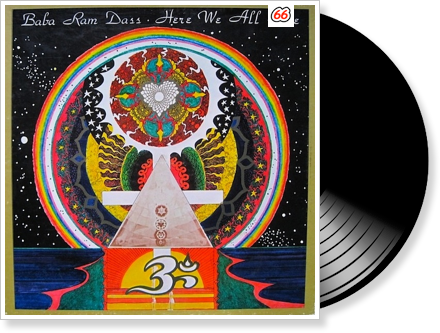
Title: Here We All Are
Year: 1969
Format: LP
Label: Yogananda
HERE WE ALL ARE is the story of the evolution of RICHARD ALPERT, from Harvard University professor and successful psychologist, to BABA RAM DASS, wandering sadhu of holy man. Describing his early days with TIMOTHY LEARY and his introduction to Psychedelics, BABA RAM DASS tells of his growing desire to stay permanently “high” and off his quest to find someone who really “knows”.
His search eventually leads to an agonizing barefoot trek through India and to his Guru, a totally conscious being living in a constant state of Sahaj Samhadi. BABA RAM DASS concludes with an explanation of one of the most exquisitely articulated systems for spiritual enlightment known to man, ths system of Ashtanga, or Raja Yoga, and shares with those on a similar journey his knowledge of how it all is in the universe.
Recorded live in the summer of 1969 in Vancouver, BC, Canada, produced by Inner Sound Productions of Yogananda Ashram Society, and manufactured by Rada Record Pressings of Burnaby, BC. 3 records, 6 sides, 2 hours and 10 minutes listening time. (Jack Dominilla)
Richard Alpert (born April 6, 1931), also known as Baba Ram Dass, is a contemporary spiritual teacher who wrote the 1971 bestseller Be Here Now. He is well known for his personal and professional association with Timothy Leary at Harvard University in the early 1960s. He is also known for his travels to India and his relationship with the Hindu guru Neem Karoli Baba.
Alpert was born to a prominent Jewish family in Newton, Massachusetts. His father, George Alpert, was one of the most influential lawyers in the Boston area and president of the New York, New Haven and Hartford Railroad, as well as one of the leading founders of Brandeis University and the Albert Einstein College of Medicine.
The youngest of three boys, Richard as a child was described as being engaging and loved by all—the family mascot. He went on to receive a Bachelor of Arts degree from Tufts University, master’s degree from Wesleyan University and doctorate (in psychology) from Stanford University.
After returning from a visiting professorship at the University of California, Berkeley, Alpert accepted a permanent position at Harvard, where he worked with the Social Relations Department, the Psychology Department, the Graduate School of Education, and the Health Service, where he was a therapist. He was also awarded research contracts with Yale and Stanford. However, perhaps most notable was the work he was doing with his close friend and associate, Dr. Timothy Leary.
Having only recently obtained his pilot’s license, Alpert flew his private plane to Cuernavaca, Mexico, where Leary first introduced him to teonanácatl, the Magic Mushrooms of Mexico. By the time Alpert made it back to America, Leary had already consulted with Aldous Huxley, who was visiting at M. I.T. Through Huxley and a number of graduate students they were able to get in touch with Sandoz, which had produced a synthetic component of ergot wheat fungus called LSD.
Alpert and Leary brought a test batch of both substances back to Harvard, where they conducted the Harvard Psilocybin Project and experimented with LSD relatively privately. Alpert was later dismissed from the university in 1963; according to Harvard President Nathan M. Pusey, Leary was dismissed for leaving Cambridge and his classes without permission or notice, and Alpert for allegedly giving psilocybin to an undergraduate. By this time, however, Alpert had already become disillusioned with academia and even described himself as feeling trapped in a meaningless game, and Leary had already left the university some weeks earlier.
The two soon relocated and continued their experiments unsupervised from a private mansion in Millbrook, New York, owned by Billy Hitchcock, an heir to the Mellon fortune. Famous poets, musicians and intellectuals of the time, such as Allen Ginsberg, Maynard Ferguson, the Grateful Dead, Marshall McLuhan and Ken Kesey, came from across the country to be part of what was going on there. Although they remained life-long friends, the two eventually began to part ways spiritually and philosophically as Leary continued to spread his mantra of “turn on, tune in, drop out,” while Alpert increasingly found his purpose in the Hindu ethic of serving others.
In 1967 Alpert traveled to India, where he met the American spiritual seeker Bhagavan Das. As he guided Alpert barefoot from temple to temple, Bhagavan Das began teaching him basic mantras and asanas, as well as how to work with beads. After a few months, Bhagavan Das led Alpert to his guru, Neem Karoli Baba, or as he is better known in the West, Maharaj-ji. Maharaj-ji soon became Alpert’s guru and gave him the name “Ram Dass,” which means “servant of God.” Under the guidance of Maharaj-ji, Ram Dass was instructed to receive teaching from Hari Dass Baba, who taught in silence using only a chalkboard.
While in India, Ram Dass also corresponded with Meher Baba; however, he remained primarily focused on the teaching of Hari Dass Baba. Among other things, Hari Dass Baba trained Ram Dass in raja yoga and ahimsa. It was these life-changing experiences in India that inspired Ram Dass to write the contemporary spiritual classic, Be Here Now, in which he teaches that everyone is a manifestation of God and that every moment is of infinite significance.
After his return to the United States in 1969, Alpert founded several organizations dedicated to expanding spiritual awareness and promoting spiritual growth, including Hanuman Foundation. Since then he has embraced a wide variety of spiritual traditions and practices, including guru kripa (grace of the guru) ; bhakti yoga focused on the Hindu spiritual deva Hanuman; meditation in various schools of Buddhism such as Theravada and Mahayana (including Tibetan and Zen) ; karma yoga; and Jewish studies.
In February 1997, he suffered a stroke which left him with expressive aphasia, however, he interprets his stroke as an act of grace and continues to travel giving lectures, as his health permits. When asked if he could sum up his life’s message Ram Dass replied, “I help people as a way to work on myself, and I work on myself to help people… To me, that’s what the emerging game is all about.” He was awarded the Peace Abbey Courage of Conscience Award in August 1991.
Ram Dass has long acknowledged his bisexuality. In the 1990s, he became more forthcoming while avoiding labels and pointing out that who we are “isn’t gay, and it’s not not-gay, and it’s not anything—it’s just awareness.” (Wikipedia)
Track Listing
- Here We All Are [Side One]
- Here We All Are [Side Two]
- Here We All Are [Side Three]
- Here We All Are [Side Four]
- Here We All Are [Side Five]
- Here We All Are [Side Six]
One Song – One Song (1974)
Artist: One Song
Title: One Song
Year: 1974
Format: LP
Label: Paula
A Houston, Texas Christian rock group led by Pete Sanchez, Jr. featuring a very talented brass and rhythm section and some nice male/female vocals and harmonies on some well crafted original songs. If xian music isn’t your bag steer clear, but if it is, you’ll enjoy this one. (Jack Dominilla)
Track Listing
- He Is Worthy
- When We All Get To Heaven
- Life Begins At Calvary
- Prodigal Son
- Jesus
- Sing And Shout
- Hallelujah, Praise The Lord
- It Just Keeps Getting Better
- Jesus Wrapped Me In His Arms
- Praise The Lord
Rebirth – Into The Light (1970)
Title: Into The Light
Year: 1970
Format: LP
Label: RCR
Dean Clemmer (lead guitar, bass, vocals), Bob Eby (vocals, bass, percussion, guitar), Jim Krabill (vocals, guitar, trumpet), Mel Lehman (percussion, piano, organ), Elaine Warfel (vocals, organ, harpsichord).
“Not a bad group of songs from a band with Christian leanings. If you like bands like Trilogy or Christian Folk (Sweet Melodies), then you’ll like this album. Light harpsichord, acoustic guitar, light drums and percussion, very mellow with average three part harmony. Lyrics are optimistic and border bubble gum”. (bfazz RYM)
Track Listing
- I Shall Be Released
- Life
- Lovely America
- The First Time
- Like A Shadow
- While I Wasn’t Watching
- Young Girls
- Hymn
- Daily Bread
- I Got Me
- Quiet Place
- Into The Light