
Gordon Alexander – Gordon’s Buster (1968)
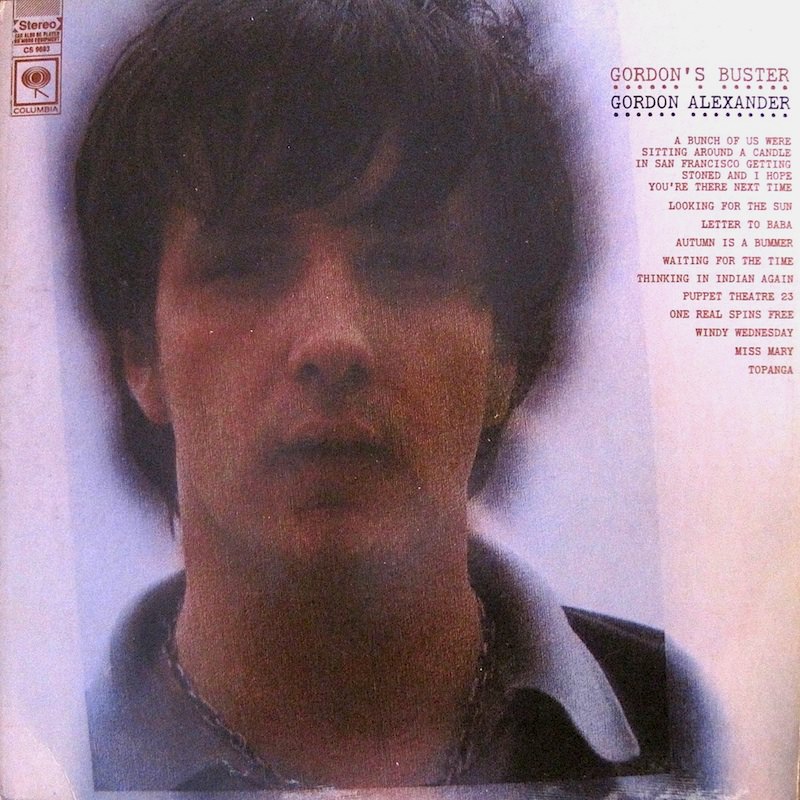
Title: Gordon’s Buster
Year: 1968
Format: LP
Label: Columbia
Columbia sure put out a lot of albums in the late 1960s that were too strange to stand much of a chance of being big sellers, yet had a little too much pop (and sounded a little too contrived) to get much of a toehold in the freaky underground. Singer/songwriter Gordon Alexander was one such act, offering songs that reflected the beatific side of the hippie experience on Gordon’s Buster, yet in a mild, faintly sunshine pop-influenced style that steered it well clear of the weirdest things coming out of California at the time. There’s a sense of the playful psych-pop of, say, Sagittarius or Chris Lucey/Bobby Jameson, yet Alexander seems earthier and a little more connected to some genuinely stoned whimsy.
The song titles alone — “Thinking in Indian,” “Letter to Baba,” “Looking for the Sun,” “Topanga,” “Puppet Theater 23″ — tell part of that story. “A Bunch of Us Were Sitting Around a Candle in San Francisco Getting Stoned and I Hope You’re There Next Time” takes the cake in that regard, though it’s not some Frank Zappa-type parody. No, it’s possibly even weirder; the lyric’s a pretty literal extension of the title, set to a breezy orchestral easy listening bossa nova-flavored pop tune that could be easily mistaken for the late-’60s TV theme of some forgotten sitcom.
Alexander’s not too distinctive a singer or crafter of melodies, however. Too, the production often seems a little half-hearted, except when those easy listening strings and horns are piled on — something to be expected, perhaps, considering the arranger was David Angel, the same guy who’s famous for doing the same thing on Love’s classic Forever Changes album. “I like to fly using my middle eye” and “I went looking for the sun in the darkness of my mind” are typical Alexander lyrical musings, but he’s no Arthur Lee when it comes to putting enigmatic imagery to song and voice.
Gratuitous washes of echo and distorted guitar come into the mix at times, yet sometimes it sounds like he’s trying to do a psychedelic take on Glen Campbell. In all it’s an eclectic period curiosity with some interesting Baroque touches, but one that lacks the vision, sincerity, or even the good tunes of the best similarly naive psych-pop from the era. (Richie Unterberger, All Music Guide)
Track Listing
- Looking For The Sun
- Letter To Baba
- Topanga
- Autumn Is A Bummer
- A Bunch Of Us Were Sitting Around A Candle In San Francisco Getting Stoned And I Hope You’re There Next Time
- Waiting For The Time
- Thinking In Indian Again
- Puppet Theatre 23
- One Real Spins Free
- Windy Wednesday
- Miss Mary
Michele – Saturn Rings (1969)
Title: Saturn Rings
Year: 1969
Format: LP
Label: ABC
Saturn Rings by Michele O’Malley, issued on ABC in 1969, is truly one of the lost psychedelic pop masterpieces. O’Malley was a member of the Ballroom, and was a session vocalist in Los Angeles, singing backup on Tommy Roe’s It’s Now Winters Day and Sagittarius’ Present Tense. West Coast popster and legendary crazy man Curt Boettcher (leader of the Ballroom) was heavily involved, with arrangements by Michael Melvoin and session players including Lowell George (pre-Little Feat), Bobby Notkoff (pre-Rockets), Elliot Ingber, Gordon Alexander, and Bobby Jameson (aka songwriter Chris Lucey). Boettcher either wrote or co-wrote seven of the album’s 11 cuts, and sings backup on the sessions as well. To say the album bombed is an understatement. It disappeared almost upon release, and O’Malley never made another one.
While the sound here is dated, there are some truly amazing moments such as “Fallen Angel,” with its beautiful sawing electric violin floating through the mix above the acoustic guitars, tabla drums, and electric bass. O’Malley’s voice just soars and glides between Western melody and Eastern modalism effortlessly. Some of the psychedelic pop arrangements have the feeling of some stranger than strange nostalgia — like a sound that is familiar, but its textures are strange and alien, such as on “Spinning, Spinning, Spinning,” with a harpsichord and either an oboe or soprano saxophone and strings. O’Malley wrote “Song to a Magic Frog” for Sagittarius, and the arrangement on this version is lush, full of elegant textures and richly layered instrumentation.
Her voice is where the real “magic” lies, however. She moves through the melody with a meld of passion and restraint and creates hooks where there are none. The truth of the matter is, that with bands like Belle & Sebastian out there, if Saturn Rings were released today it would be regarded as a quirky masterpiece. Its production and arrangement excesses for the time — which made it inaccessible to the masses — would now be heard as the work of genius. (Thom Jurek, All Music Guide)
Track Listing
- Would You Like To Go
- Blind As You Are
- Song To A Magic Frog
- Fallen Angel
- Spinning, Spinning, Spinning
- Know Yourself
- Musty Dusty
- Lament Of The Astro Cowboy
- White Linen
- Misty Mirage
- Believe You
Bob Ray – Initiation Of A Mystic (1968)
Artist: Bob Ray
Title: Initiation Of A Mystic
Year: 1968
Format: LP
Label: Soul City
Los Angeles psych-folkie Bob Ray first earned attention as a session player, contributing bass to Donovan’s now-legendary May 1966 sessions that yielded the classic “Season Of The Witch.”
The following year he teamed with singer/guitarist James Smith and drummer Terry Hand in the sunshine pop trio Thorinshield (see February 15, 2010 post), signing to Phillips to record their debut single, “The Best Of It,” produced by famed session saxophonist Steve Douglas and arranged by Perry Botkin, Jr.
A self-titled LP soon followed, but after just one more single, 1968’s “Family Of Man,” Thorinshield splintered, and Ray signed to Johnny Rivers’ Soul City label.
With Rivers assuming production duties, veteran Hal Paich handling the string arrangements, and the famed Wrecking Crew (studio virtuosos including Hal Blaine on drums, Joe Osborne on bass, and Larry Knechtel on keyboards) providing support, he cut his lone solo LP, Initiation Of A Mystic, recalling Donovan with his lush, ambitious psych-pop. Ray essentially dropped from sight soon after the record’s 1968 release. (Internet Source)
Track Listing
- (Girl With The) Cameo Ring
- Live Today
- City Of Toys
- Green Green (Big Big River)
- Smog Song
- Resurrection
- Money Tree
- Personal Movie
- Woman Of The Highlands
- Right Relations
- Islands (Poem)
The Mesmerizing Eye – Psychedelia – A Musical Light Show (1967)
Title: Psychedelia – A Musical Light Show
Year: 1967
Format: LP
Label: Smash
Exploito psych is a niche market (geez, the fact I can type something like that is a pretty strong indicator that I need to get a real life). Like most things in life, the genre has its winners and losers. The good news is that this 1967 studio enterprise is one of the winners.
Hollywood-based producers Larry Goldberg and Hank Levine were the brainchildren behind this 1967 effort. Back by an anonymous collection of studio musicians, they wrote most of “A Musical Light Show” and were credited as the producers.
Now let me warn you that even though the label lists ten tracks, this is really best described as an instrumental sound collage complete with a wide array of wacked sound effects. Tracks such as ‘Birth of a Nation’ and ‘Dear Mom, Send Money’ offer up a weird mix of conventional and psych sounds (ominous bass, fuzz guitar), those sound effects (phones, bullets, typewriters) and suitably entertaining song titles and liner notes (‘We are a raindrop floating in a ditch besides the yellow brick road.’) That says it all doesn’t it … This isn’t something your going to spin all the time, but it is goofy enough to warrant an occasional trip to the turntable and after a couple of beers its fun to play ’spot the sound effect’ with it. (Bad Cat)
Track Listing
- Birth Of A Nation
- Rain Of Terror
- Tempus Fugit
- Opus 71
- Twenty First Century Express
- May The Bird Of Paradise Fly Up Your Flute
- Requiem For Suzy Creamcheese
- The War For My Mind
- Dear Mom, Send Money
- Excersise In Frustration
Marks And Lebzelter – Rock And Other Four Letter Words (1968)
Title: Rock And Other Four Letter Words
Year: 1967
Format: LP
Label: Columbia Masterworks
Rock And Other Four Letter Words was a concept album put together by the duo of J. Marks and Shipen Lebzelter. The songs consist of various voiceovers and strange noises to create meandering soundscapes, mixed in with the occasional blaring Rock guitar obviously aimed at the Psychedelic-drug crowd of the 60s.
The best songs are Other Four Letter Words that begins with a little orchestration, and then an effects laden conversation that eventually gives way to a loud guitar Rock cut with a banging fuzz heavy rhythm and a drum break.
There’s also the slow groover It’s True with some females singing, the jazzy Rock of Trouble with female back-ups and more of that guitar work, and Poop For Sopranos And Orchestra that switches between some swinging versus with two female lead singers and more abstract and spaced-out interludes. (Motown67)
Track Listing
- Other Four Letter Words
- Essence Of It’s Own
- It’s True
- Greatest Hits – Love Your Navel
- In The Middle Of Nothing
- Baked Beans
- They’re Through
- Today
- Eine Kleine Hayakawa
- Do You Understand What I’m Trying To Say?
- Trouble
- Poop For Sopranos And Orchestra
- This Is The Word
Jameson – Color Him In [Mono] (1967)
Title: Color Him In
Year: 1967
Format: LP
Label: Verve
Produced by legendary vocal arranger Curt Boettcher, this dreamy collection of psychedelic pop is the second album by famed Hollywood hipster Bobby Jameson (his first, the classic “Songs of Protest and Anti Protest, had been credited to Chris Lucey), and appeared in the summer of ‘67.
“COLOR HIM IN” was recorded in 1966 with CURT BOETTCHER and was released on Verve Records in 1967. Curt and I met at the offices of OUR PRODUCTIONS, which had just had a hit called “AND ALONG COMES MARY”. (…) CURT BOETTCHER and I went through the songs I had written and decided on the final selections for the album “COLOR HIM IN”. The record was picked up by VERVE RECORDS, thanks to FRANK ZAPPA’S input to TOM WILSON, who produced “THE MOTHERS OF INVENTION” along with FRANK ZAPPA for VERVE RECORDS.” (Bobby Jameson)
Interesting how time has a way of changing our perspectives. In the late-’60s an artist saying something along the lines of “My music is where I have been, what I have seen, how I feel, and who I am.” may have been viewed as having vision and daring. Today you’d have to laugh at anyone dumb enough to spout such crappola … That said, this one’s steadily grown on us. The first time we listened to it we were left with the impression Robert Parker (B.) Jameson was little more than a run-of-the-mill singer/songwriter. A couple of spins have revealed the album’s considerable charm.
Actually, we should probably backtrack a little and cover what little is known about this guy. Jameson (aka Chris Lucey), actually started out as a mid-’60s folkie. Different references list as being from Arizona, Southern California, or even a transplanted Englishman. Regardless, signed by the small Surrey label, he released a little heard 1965 album – “Songs of Protest and Anti-Protest”.
Two years later, Lucey/Jameson reappeared sporting then-requisite long unwashed hair, a beard and a penchant for turtle neck sweaters and chains. Given those qualifications it probably wasn’t hard to see why Verve Records decided to sign him to a recording contract. Teaming the singer/songwriter with producers Curt Boettcher, Jim Bell and Steve Clark, 1967′s “Color Him In” also made commercial sense for a label clearly interested in trying to cash-in on the country’s sudden interest in counterculture voices. To be perfectly honest, Jameson wasn’t exactly a major musical talent. As a writer, original material such as “Windows and Doors” (loved the post-production applause) and the arch “Right By My Side” was almost funny.
As a singer, typified by the likes of “Jamie” and “Do You Believe In Yesterday” his ragged, out-of-tune voice took a little getting use to. Luckily the collection benefited from a wide array of psych touches (credit producer Boettcher), including the rollicking “Window and Doors”, “Who’s Putting Who On” (be sure to check out the out of control horns) and the not-too-subtle lyrics on “Candy Colored Dragon”. Elsewhere Jameson’s anti-establishment image occasionally seemed at odds with Association-styled pop material such as “Know Yourself”, “Jenny” and “I Love You More Than You Know”. A commercial non-entity, Verve quickly dropped Jameson; effectively killing his recording career. (RDTEN1 RYM)
Track Listing
- Jaime
- Know Yourself
- Windows And Doors
- Right By My Side
- Who’s Putting Who On
- The New Age
- Jenny
- Do You Believe In Yesterday
- I Love You More Than You Know
- Sea Dawn
- Candy Colored Dragon
- Places Times And The People
LSD – A Documentary Report (1966)
Title: A Documentary Report
Year: 1966
Format: LP
Label: Capitol
The granddaddy of all LSD documentaries sounds even better today than when it was released. The attitude is mocking and hostile in an understated manner rather than openly confrontational, perhaps because it was made at such an early stage. Interviews with acid luminaries, regular heads and neutral observers are tied together with classy narration and musical fragments, and an unforgettable peak is reached with an actual trip recording of “Brian”, a hipster acid head who unfortunately happens to have his first bad LSD experience while being recorded (with concealed microphones). The recording is authentic-sounding and either very funny or pretty scary, depending on how hard-core you are. (Lysergia.com)
The menace of LSD on wax! Side One is called “The Trip” and it consists of people talking about their personal experiences on acid. The best being a guy who they actually tape recorded having a bad trip. There is about 5 minutes or so of this dude just freaking out, all by himself, in a dark room. Supposedly these are highlights of a bad trip that lasted 12 hours and resulted in him permanently losing his mind. Other goodies include Huxley’s widow talking about showering angry mobs with acid fumes to create peace, Ginsberg chanting with gurus, and a hippy chick talking about an especially groovy shower – and that’s just side one!
Side Two is called “The Scene”, and it deals more with the Sociological aspects of drug culture. This must have come out right when Acid was outlawed, and you can tell it is supposed to be a piece of anti-drug propaganda, but they just make it sound like such darn good fun! I’m sure this lp was responsible for pushing many curious youths the last few inches to “turning on”. (Waxidermy)
This LP was created and released in 1966 by Capitol Records as a response to the burgeoning use of LSD — lysergic acid diethylamide — among American teenagers. The rear album jacket proclaims “A documentary report on the current psychedelic drug controversy!” Almost salaciously, the contents are depicted as “Actual recordings of people under the influence of psychedelic drugs… Psychedelic music… The sound of the “Acid Test”… LSD users and pushers and the amazing story of LSD in action.”
In an ironic and fascinating twist, some of that “psychedelic music” — particularly the fast-paced tune heard at the beginning of side two — is that of Neal Cassidy and a pre-Grateful Dead combo called the Warlocks performing “Speed Limit” circa 1965. Each side of the long-player consists of a single, continuous track.
Narrated by author Lawrence Schiller, side one sets “The Scene” with information on the history of the drug, its effects, as well as sound bites of acid users — both novice and seasoned — during and after use. Likewise there are points of view from leading authorities in the medical community via Dr. Sidney Cohen, M.D. — from the Psychosomatic Services division of the Wadsworth V. A. Hospital in Los Angeles, CA. Conversely, several minutes are devoted to the warnings and proselytizations of Dr. Timothy Leary and a variety of young men and women — from equally diverse walks of life — who speak candidly about their experiences — both pro and con.
Several countercultural iconic names are dropped, most prominent among them is that of Owsley Stanley aka Bear. He is specifically mentioned for creating a synthesis which left the LSD practically free of impurities and, for a time, the safest non- pharmaceutical acid being circulated. Side two contains “The Trip” where Schiller again guides listeners through comments from primarily teens about when they began their experimentation and what (if anything) they were able to take from their use. Next up is the audio vérité eight-party acid trip. One of the participants — named “Brian” — is the primary focus of Schiller’s occasional commentary.
Despite his purported familiarity with the drug, its ability to incapacitate becomes evident and his already fragile psyche turns increasingly dark and introspective as “Brian” is heard going through an especially unpleasant manic and psychotic episode. Or, as Schiller refers to it, a “rocky journey [that] ended 12 hours after it had so innocently begun.” As to the positive uses of the compound, both Schiller and Dr. Cohen are not secretive about the treatment of cancer patients, chronic alcoholics, and even the breakthroughs in therapy for mentally-challenged children. After providing a brief update of LSD’s legal nature — circa 1966 — there are additional quotes from Laura Archera Huxley, widow and biographer for her late husband, author of The Doors of Perception, Aldous Huxley. She vehemently disagrees with the illegality of the drug, yet is quick to warn of its dangers when used irresponsibly.
Following a brief allusion to the infamous Acid Tests held by Ken Kesey and company, portions of a live Allen Ginsberg poetry reading are played prior to some interview clips in which he talks about his revelations and insights on the substance. There are also a few minutes of rambling Acid Test recordings, concluding with the profound statement that “… on the basis of the evidence… the answer to the LSD problem should be just about as obvious as the basic question: Is this trip really necessary?”
The LP’s inner-gatefold includes a “Glossary of terms used in this album” with an A to Z of hippie slang — from “Acidhead” to “Turn On,” while the back cover has an essay from concurrent Capitol Records President, Alan W. Livingston that, in part, states “At Capitol Records we live in a world of the young — a world of rock ‘n’ roll music, amid the need for a constant awareness of teenage interests of all kinds.” (Lindsay Planer, All Music Guide)
Track Listing
- The Scene
- The Trip
LSD – Promo – Open-End Interview With Dr. Sidney Cohen And Excerpts From Lp (1966)
Title: Promo – Open-End Interview With Dr. Sidney Cohen And Excerpts From Lp
Year: 1966
Format: LP
Label: Capitol
This is the companion release to the LSD documentary album. It was released to radio stations to promote the lp and contains an “open-end” interview with Doctor Sidney Cohen, M.D.. This “interview” is similar to the open-end interview album released by the Byrds to promote their “5D (Fifth Dimension)” album where DJs would play this record and have a list of questions that would be “answered” by playing back the record, an ingenious way to promote, saving the artist a lot of time and travel. This particular record also contains excerpts from the released album.
Track Listing
- Open-End Interview With Dr. Sidney Cohen/LSD [Excerpt]
- Allen Ginsberg [Excerpt]
- The “Lost Generation” [Excerpt]
- Users [Excerpt]
- Trip [Excerpt]
- Dr. Timothy Leary [Excerpt]
Green Lyte Sunday – Green Lyte Sunday (1970)
Title: Green Lyte Sunday
Year: 1970
Format: LP
Label: RCA Victor
Green Lyte Sunday was one of Dayton Ohio’s most popular and enduring bands. The band was formed from the demise of the Mark V, with members Mike Losekamp (back from his stint with the NYC band Cyrkle) on keyboards and lead vocals, Jim Wyatt on bass, and Jason Hollinger on guitar. Susan Darby was the featured lead singer, she had been with the Mark V and the Knights in the mid 60s. Rick Kalb played drums and “Fly” Barlow on wind instruments.
This was the lineup in 1970, we’re not sure about all the personnel before and after. The band recorded a 45 for King, and then an LP for RCA in 1970. RCA obviously invested some money in the band, with a gatefold cover and printed lyrics. The LP seemed to sell some copies as used ones turn up pretty regularly.
As the 70s rolled on Green Lyte Sunday started to emphasize more of the jazz influences that were latent on the LP. As far as we know, the band didn’t release any more records, but was a fixture in the local music scene until the late 1970s. (Buckeyebeat)
Track Listing
- Happy, Happy
- If You Want To Be Free
- Emmie
- Glen Helen
- Woman’s Blues
- Lenore
- Chelsea Morning
- High Up In The Sky
- What Makes Him Happy
- My Own Time
Sapphire Thinkers – From Within (1969)
Title: From Within
Year: 1969
Format: LP
Label: Hobbit
The Sapphire Thinkers consisted of Bill Richmond (vocals, keyboards, guitar), Peggy Richmond (vocals, flute), Tim Lee (backing vocals), Stephen Richmond (drums, percussion, vocals), Chuck Spehek (guitar).
Very nice west coast sunshine psych out of LA with all the right ingredients — organ, fuzz, flute, male/female vocals, cool harmonies, etc. Recorded by Sandy Lehmann-Haupt, an original Merry Prankster and sound man on the Pranksters’ bus. Quality from start to finish. And yes, those are mushrooms on the cover. (Waxidermy)
Track Listing
- Melancholy Baby
- I Feel A Bit Strange
- Get Along Boy
- Blues On You
- From Within
- I Got To You
- Not Another Night
- Let Her Come In
- Please Understand
- Blind With A Borrowed Light
- There’s A Woman
- Doin’ Alright