

Abbie Hoffman – Wake Up, America! (1969)
Artist: Abbie Hoffman
Title: Wake Up, America!
Year: 1969
Format: LP
Label: Big Toe
Interesting as all out, this is a collection of various talks and songs. Abbie can’t sing, they’re just kind of goofy rants against the establishment. Best part is early on when Abbie (who must have been on a radio show) takes calls from folks who, well, DON’T like him, to put it mildly. “You said before they beat you?… Well they should have killed you, I swear!” Fascinating stuff, but goofy as all out. Man, this guy scared the hell out of a lot of folks. (barlights RYM)
Track Listing
- Our National Anthem
- Malachi’s Bar & Grill
- Texas Tweezers
- The Drug Company
- Ave Maria Jesus
- Jerry Rubin
- Flush Cool Water For Nixon
- Chicago
- Washington At Valley Forge
- Religion Of Sorts/Out Of Doors
- God Bless America
- The Only Dope Worth Shooting
Honk – Honk (1974)
Artist: Honk
Title: Honk
Year: 1974
Format: LP
Label: Epic
Here’s the second self-titled album by Honk released on Epic Records in 1974. For more info see the September 7, 2010 post of their first self-titled release from the previous year.
Track Listing
- Move Me Home
- All My Time Is Free
- Hesitation
- You Better Do Something
- Gimme That Wine
- Dog At Your Door
- Where Is Love
- Oh Daddy Blues
- Mademoiselle
- There Is A River
Arizona – Arizona (1976)
Artist: Arizona
Title: Arizona
Year: 1976
Format: LP
Label: RCA
Contributed by Moxnix
Arizona were a seven piece band from Tucson, Arizona and consisted of Mary Dobbins (vocals), Ken Ashby (vocals-acoustic guitar), Willie Knowles (vocals-acoustic guitar), Doug Holzwarth (keyboards), Bob Huff (vocals-electric guitar), Pat Murphy (bass-vocals) and Pete Kuch (drums-percussion).
A nice southern California style rock album, a mixture of acoustic and electric guitars with a couple of funky rockers thrown in. The 7 piece band(6 guys and a lady) even throw in a cover of “Suite Judy Blue Eyes”. (jimslim RYM)
Track Listing
- Dance If You Wanna Dance
- Sweet Fantasy
- So Hard Livin’ Without You
- Take It Slow
- Suite: Judy Blue Eyes
- Have A Good Time
- Tonight, I Really Need A Friend
- Johnny O
- One More Night
- Don’t It Feel Good
- Mary’s Waltz
Fred Weinberg – The Weinberg Method Of Non-Synthetic Electronic Rock (1970)
Artist: Fred Weinberg
Title: The Weinberg Method Of Non-Synthetic Electronic Rock
Year: 1970
Format: LP
Label: Anvil
When electronic music was fresh and eccentric, musicians and non-musicians were inspired by sound as never before. Hearing music became a potentially scientific endeavor, complete with laboratories full of equipment, bizarre experiments, and rational explanations of why an oboe possessed a unique timbre. Sound was at once available for deconstruction and reconstruction, and for many the sonic environment became worthy of attention.
Gradually, electronic music shifted from the halls of academia and the garages of inventors to popular music—from Stevie Wonder to disco producer Giorgio Moroder to the Who. But the integration was not an entirely smooth one. Exhibit A is Fred Weinberg’s 1970 obscurity The Weinberg Method of Non-Synthetic Electronic Rock.
Judging by the title of the record, one senses that Weinberg felt a powerful need to disassociate his music from artificiality. For Weinberg, electronic music was fine, but synthetic music was repulsive. With this album, recently re-issued by Normal Records, Weinberg integrated recordings of his real-world sonic environment into a mixture of synthesizers and tape manipulations
If Weinberg’s purpose was to engineer an album simultaneously exploiting the possibilities of electronic-scientific music and producing the visceral excess of late-60’s psychedelia, then The Weinberg Method succeeded, if a bit clumsily.
Some of the tracks on the record merit description as worthy predecessors to Faust and the Yellow Magic Orchestra, or comparison to contemporaries like the pre-Kraftwerk outfit The Organisation or Raymond Scott. These gems include “Animosity, ” a twisted and repetitive rock song with oddly treated vocals and bits of purposeful electronic manipulation.
While it’s too short to be the masterpiece that is Faust’s “It’s a Rainy Day, Sunshine Girl, ” it was certainly on the same track. Other songs, like “Muck de Foog, ” reach an even stranger plateau, producing a hectic clash between slowed-down fragments and unstable synthesizer melodies. In contrast, “Theme for Julie” is powerfully simple, and has a grand melody. “Speedo” is a cover of a doo-wop song which includes a neat Jew’s harp breakdown.
Weinberg sought to make electronic music something more than an experiment alone. However, not every track remains compelling; “Aum Mau Mau” sounds like it could be in an Outback Steakhouse commercial or something. But this album was so stylistically varied that some of the songs were bound to fail. By and large The Weinberg Method is an interesting and listenable chapter in the history of electronic music.
The debate about reliance on electronics raged through the 70’s, as evidenced by the mass hatred of “fake music” like disco, and in the 80’s and 90’s in the resentment against rap, and even today with electronic musicians being derided as talentless button-pushers. This debate has a long history, and The Weinberg Method, largely unknown as it is, has a crucial place in it.
Here was an album which predated much of the integration of electronics into functional or popular music, carrying with it an explicitly stated desire to be “non-synthetic. ” For Fred Weinberg, novel electronic instrumentation was inextricably wedded to a deeper understanding of sound and an overt accessibility. (Ben Tausig)
Track Listing
- Big Fat Woman
- Ode To Billy Joe
- A Childs Life
- Cowboy Gregg
- Money Talks
- Muck The Foog
- Animosity
- A Theme For Joanie
- Heavy Breathing
- The Keen Machine
- 1958 Revisited
- Sanctuary
- Gumball
- Supersonic
- Aum Mau Mau
- Ah, Ha!
- El Condor Pasa
- Speedo
Swamp Dogg – Total Destruction To Your Mind (1970)
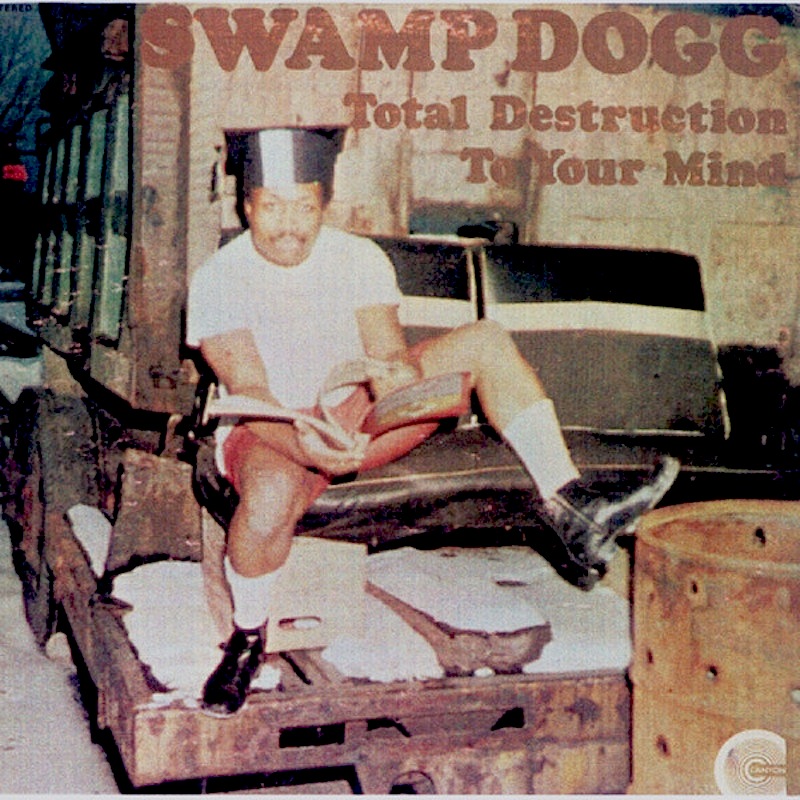
Artist: Swamp Dogg
Title: Total Destruction To Your Mind
Year: 1970
Format: LP
Label: Canyon
One of the best underground/unsung soul albums I know of. Prior to Total Destruction To Your Mind, Swamp Dogg had been recording music and releasing 45s since the 50s, under the name Jerry Williams (or Little Jerry Williams)
Frustrated by the lack of commercial success, Williams changed his name and persona and in 1970, unleashed Total Destruction To Your Mind on an unsuspecting world. While those early Calico 45s are a fine musical legacy, the above album saw Swamp Dogg hit on something totally new: a very original brew of R&B, funk and rock n roll that still sounds fresh today. Without doubt he delivered a true soul classic.
Total Destruction To Your Mind was originally released by Canyon Records. Swamp Dogg’s eccentric nature, blunt lyrics, and gruff vocals make it stand out from the commercial soul of the day. His style is really individual and authentic, which makes drawing comparisons so difficult.
Think of a more eccentric Curtis Mayfield or a less lysergic Sly Stone with the occasional Stax horn arrangement – but even this description does the man no favors. The title cut is a classic, probably one of Dogg’s best known numbers. This track opens the LP and is best described as psychedelic soul rock, featuring wah wah, loud horns, funky guitar riffs, piano, and cryptic lyrics.
Also of note are the fine contributions from guitarist Jesse Carr and drummer Johnny Sandlin; they provide structure and sanity on this great chuggin’ funk rock gem. “Redneck” (written by Joe South) and the excellent “Sal-A-Faster” are similar funk numbers that feature great beats, classic horn arrangements, and controversial lyrics.
Other goodies are the Bob Dylan influenced “Synthetic World, ” notable for its cerebral organ and the soulful, psychedelic worldplay of “Dust Your Head Color Red”. The album closes most unusually with “Mama’s Baby, Daddy’s Maybe”, a great blues number that took me by surprise. Swamp Dogg wrote nine of the twelve songs featured on this LP.
Regarding the three covers; there are two great Joe South numbers which Swamp Dogg interprets brilliantly and then there’s ”The World Beyond, ” a killer soul ballad with nostalgic lyrics written by Bobby Goldsboro. (The Rising Storm)
Track Listing
- Total Destruction To Your Mind
- Synthetic World
- Dust Your Head Color Red
- Redneck
- If I Die Tomorrow (I’ve Lived Tonight)
- I Was Born Blue
- Sal-A-Faster
- The World Beyond
- These Are Not My People
- Everything You’ll Ever Need
- The Baby Is Mine
- Mama’s Baby, Daddy’s Maybe
Beaver & Krause – All Good Men (1972)
Title: All Good Men
Year: 1972
Format: LP
Label: Warner Brothers
This record belongs to an odd and largely ignored sub-genre I refer to as “experimental easy listening”. Like Third Stream music, it was pretty much doomed from the start because it’s basically a syncretistic effort to graft together two fundamentally antagonistic musical sensibilities. But it is interesting to hear the attempt.
Except for the final track, there is very little on this record that is recognizably synthesizer music … the idea was perhaps to demonstrate that the synthesizer could reproduce the sound of conventional instruments. Like the other Beaver and Krause records, a sense of identity seems elusive; it sounds like a random selection of pieces by different, unrelated artists.
The cuts I find most interesting are “Sweet William”, which sounds like it could have come off an early Fairport Convention album, and “Legend Days Are Over”, in which spoken reminiscences by (I assume) a Native American are set to music …
I assume that the spoken part was “found” rather than recorded specifically for the purpose of this record; if so, this may be one of the earliest examples (in “popular” music at least) of this technique that would come into wider use in the post-punk era. Several other songs feature rather amateurish-sounding vocals, which I don’t care for but others might find engaging. (fatpidgeon RYM)
Track Listing
- A Real Slow Drag
- Legend Days Are Over
- Loves Of Col. Evol
- Sweet William
- Bluebird Canyon Stomp
- Looking Back Now
- Prelude
- Child Of The Morning Sun
- Between The Sun And The Rain
- All Good Men
- Waltz Me Around Again Willie/Real Slow Drag
Alan Watts – Why Not Now: Dhyana, The Art Of Meditation (1969)

Artist: Alan Watts
Title: Why Not Now: Dhyana, The Art Of Meditation
Year: 1969
Format: LP
Label: Together
This title from author and lecturer Alan Watts contains two volumes delving into the basics of meditation as well as its usefulness and application in everyday modern life. In much the same way as he had introduced the philosophies and precepts of Hinduism on his 1967 Warner Bros. long-player Om: Sound of Hinduism (see May 31, 2010 post), Why Not Now: Dhyana, The Art of Meditation (1969) is designed to present practical fundamentals of the Zen art in a Western-friendly mentality.
The English-born Watts first established himself stateside in the late ’30s, and during his tenure at Northwestern University during World War II he became an Episcopal chaplain. His travels eventually brought him to northern California, where he was Dean of the American Academy of Asian Studies in San Francisco and ministered on the progressive community radio station KPFA-FM in Berkeley, CA, during weekly Sunday morning broadcasts.
This offered many Bay Area listeners an alternative to the traditional and decidedly more formal church services. During this time, he likewise spoke throughout the globe. The lectures given on these volumes in many ways image the same wisdom and truth that Watts incorporated into both his personal appearances as well as dozens of written texts on the subject of meditation.
He also espoused a concurrently new approach to thinking and the conscious and interactive art of integrating these ancient techniques into modern situations. Not only does Watts present a proactive approach to meditation, his methodology is perfect for everyone from novice to expert levels. (Lindsay Planer)
Track Listing
- The Beginning Of The Ending Of Thoughts
- The Silence Of Sounds
- You Two Can Be One
- Why Not Now
Pandit Pran Nath – Earth Groove: The Voice Of Cosmic India (1969)

Artist: Pandit Pran Nath
Title: Earth Groove: The Voice Of Cosmic India
Year: 1969
Format: LP
Label: Douglas
Earth Groove consists of two side-long pieces that capture Nath’s unrelenting vocal delivery, often incorporating a lot of alap (unmetered and improvised sections usually accompanied by a drone). Once one gets used to the idea of the cyclic nature of the music and the simplicity of the composition, the music becomes extremely meditative.
The instrumentation acting here purely as a backdrop, like a metronome keeping tempo. Side one, Raaga Bhoopali, acts as the mood for meditation for after sunset while side two, Raaga Asavari, is for after sunrise. The difference in the two to my ears is an overall “lighter” mood on the A side. Pran Nath was born into a wealthy family in Lahore in present-day Pakistan.
While avid devotees of music (inviting musicians into the house to perform nightly), the family did not approve of his desire to become a musician, so he left home at the age of 13 and took up residence with legendary (but reclusive) singer Abdul Wahid Khan of the Kirana gharana, cousin of the more widely-known Abdul Karim Khan. Pran Nath served Khan for seven years before he was accepted as a student, and stayed with Khan for nearly two decades.
Both guru and disciple were much attracted to mysticism: Abdul Wahid Khan, a Muslim, to Sufism, and Nath, a Hindu, to a Shaivite sect in Dehra Dun. It is said that Nath lived in a cave near the Tapkeswhar temple to Shiva for five years, serving his guru intermittently. He eventually married and reentered the world at the request (guru dakshana) of his guru, in order to ensure the preservation of the Kirana style.
In 1937, he became a staff artist with All India Radio. However, Nath stuck to a very austere singing style – heavy emphasis on alap, and very slow tempi – which suited his voice well, but was not very popular to the modern Indian taste. Nath supported himself as a music teacher, and worked at the University of Delhi from 1960 to 1970.
In 1970, Pran Nath travelled to New York to visit the American composer La Monte Young and visual artist Marian Zazeela, who heard his first issued recording, Earth Groove: The Voice of Cosmic India. In 1972, he established his Kirana Center for Indian Classical Music in New York City and stayed in the U. S. for the rest of his life. He taught at several universities and attracted a strong following among the American minimalist composers. (Wikipedia)
Track Listing
- Raaga Bhoopali
- Raaga Asavari
Chiitra Neogy – The Perfumed Garden (1969)

Artist: Chiitra Neogy
Title: The Perfumed Garden
Year: 1969
Format: LP
Label: Pulsar
Manoshi Chiitra Neogy is a filmmaker, director, poet, actress, professor and author. She is a wildly talented and complex artist, determined to push the envelope of artistic expression. She has worked nationally and internationally directing numerous documentaries and short films which have led to countless awards and accolades.
Perfumed Garden is an album of classic Indian poems set to psychedelic musical arrangements, including “Krishna And The Lovely Cowgirls“. The album features Richard Burton’s translation of Shaykh Umar ibn Muhammed al-Nefzawi’s famous erotic manual and four classic Indian poems with musical arrangements by Jim Sullivan. (Howard Hales Broom)
Track Listing
- The Invocation
- The Hymn Of Praise
- Advice To The Lovelorn (1)
- Advice To The Lovelorn (2)
- Woman Is Like A Fruit
- The Encouragement Of A Lusty Wife
- The Blue Sari
- Leilla The Flatterer
- The Story Of Mocailama & Chedja
- Krishna & The Lovely Cowgirls
Mishtibula Maine Marching Band & Soil Salvation Society – Mishtibula Maine Marching Band & Soil Salvation Society (1972)

Artist: Mishtibula Maine Marching Band & Soil Salvation Society
Title: Mishtibula Maine Marching Band & Soil Salvation Society
Year: 1972
Format: LP
Label: MGM
Contributed by Russell B.
Jules Blattner’s cartoon-style ode to ecological awareness is a delightfully goofy (Literally. One character sounds so much like Goofy that Disney would have undoubtedly sued had this album been commercially successful.) few minutes that sounds like the soundtrack to a Rankin-Bass production that never existed, but should have. Although Mishtabula Maine only exists one day a year, thanks to this record, I visit quite often. You should too! (ochsfan RYM)
Track Listing
- Our Captain Speaks
- The Mayor’s Welcome
- Save The Ground
- Old Man Fenton
- Things Ain’t The Way They Used To Be
- Ed Spinner Relates: Get Happy
- Happiness Is A Carnival
- The Carnivals Coming
- I Think There’s Something Funny
- Who Done It? Melvin Koogler
- Right Now!
- Is Anybody Listening?