
The Alabama State Troupers – Road Show [Vinyl] (1971)
Title: Road Show
Year: 1971
Format: LP
Label: Elektra
Post courtesy of Jared Wilhelm
The brainchild of Elektra president Jac Holzman, producer Russ Miller, and singer/songwriter Don Nix (best know for his work with The Marr-Keys (see separate entry)), The Alabama State Troupers were originally envisioned as a traveling roadshow meant to showcase the talents of various Southern musicians who had been signed to the Elektra imprint.
Among the acts to be showcased were Nix, Lonnie Mack and his band, singer Jeannie Greene (best known for her work supporting Elvis Presley). and an all star collection of sessions players dubbed the Mt. Zion Band and Choir. original plan was to include Lonnie Mack and his backing band in the enterprise.
Holzman’s entertaining book Follow the Music has an entertaining segment where Miller talks about what happened next. Having finished all the arrangements for the tour, literally days before the tour was to kick off Nix called Miller to tell him that Mack had vanished.
Miller eventually tracked him down to a house way out in the Ohio countryside only to discover that Mack had recently awoken from a dream with a biblical vision telling him not to tour. Unable to get Mack to change his mind, Miller and Nix turned to bluesman Furry Lewis as a backup. Lewis had backed Nix on his 1970 solo debut “In God We Trust.”
Recorded at two October, 1971 California performances, “The Alabama State Troopers Road Show” was a double album, 20 song set.
The set opened with a set of four solo Furry numbers. Even though he was in his late-1970s and a heavy drinker (Miller claims to have provided him with a bottle of whiskey every day), Lewis acquitted himself well; turning in nice solo performances on originals such as ‘Brownsville’, ‘I’m Black’ and ‘A Chicken Ain’t Nothin’ But a Bird’.
Elsewhere the collection was a mixed success. Backed by a top-notch supporting band, including keyboardist Clayton Ivey and guitarist Wayne Perkins, Nix-penned rockers such as ‘Asphalt Outlaw Hero’, ‘ Olena’ and the blazing ‘Going Down’ weren’t half bad.
Unfortunately, while Jeannie Greene was undoubtedly talented, her penchant for screeching (witness her performances on ‘My Father’s House’ and ‘Mighty Time’) was a major source of irritation.
Less successful were the group’s stabs at country material (check out their needless cover of ‘Will the Circle Be Unbroken’). Call it an interesting failure … Simply too obscure for most rock fans, the set proved a poor seller, peaking at # 218. (RDTEN1 RYM)
Track Listing
- Furry’s Blues
- Brownsville
- I’m Black
- A Chicken Ain’t Nothin’ But A Bird
- Will The Circle Be Unbroken
- Amos Burke
- Mighty Time
- Jesus On The Mainline
- Mary Louise
- Yes, I Do Understand
- Opening
- Living In The Country
- Joa-Bim
- Dixie
- Heavy Makes You Happy
- Iuka
- Furry’s Rap
- Asphalt Outlaw Hero
- Olena
- My Father’s House
- Goin’ Down
Various Artists – What’s Shakin’ (1966)
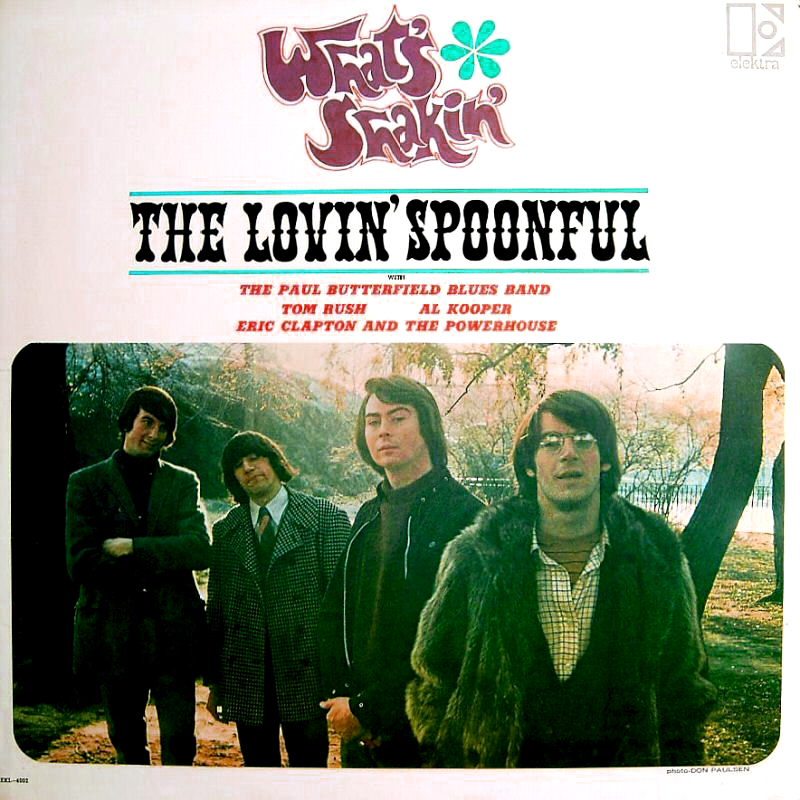
Title: What’s Shakin’
Year: 1966
Format: LP
Label: Elektra
When the Elektra label started to record electric rock music in the mid-1960s, it did so with some baby steps. Really, it wasn’t until the first Paul Butterfield Blues Band album (in 1965) that they did a full-length rockin’ electric platter, and even that LP was at least as rooted in blues as rock’n'roll.
It took Love’s debut album the following year to mark Elektra’s first all-out step into the rock’n'roll LP market (and, with the band’s “My Little Red Book,” into the Top Forty singles charts). And it would take the Doors’ best-selling debut album, and #1 single “Light My Fire,” to put Elektra rock on the top of the charts in 1967.
Along the way, however, the company accumulated a bunch of intriguing unreleased rock recordings by artists who never made an album for the label, as well as some interesting outtakes by artists who did. Rather than keep them locked up in a vault, Elektra generously made 14 of them available to the public with the 1966 compilation What’s Shakin’.
Every cut was by an artist of note — in fact one of the acts, the Lovin’ Spoonful, could have barely been hotter at the time of its release, though unfortunately for Elektra, their string of mid-’60s smashes was issued on another label. Also on board were Elektra’s hottest group of the time, the Paul Butterfield Blues Band, as well as a single track each by Tom Rush (then just beginning to move into folk-rock) and Al Kooper (then just beginning to make his reputation as part of the Blues Project).
Add three recordings by an ad hoc British supergroup with Eric Clapton, Jack Bruce, Stevie Winwood, and lead Manfred Mann singer Paul Jones, and you had an LP of truly interesting odds and ends, even if they didn’t match the best of what these musicians were putting onto their own albums.
Elektra founder and president Jac Holzman confirms that What’s Shakin’ was sparked in part by the recent success of the Elektra sampler Folk Song ’65. That record had included one song, “Born in Chicago,” from the sessions for the first Paul Butterfield album (a different version, incidentally, than the one that appears on the actual debut Butterfield LP).
Elektra was expecting sales of about 25,000 copies, but ended up selling 60,000, in large part due — as Holzman’s phone calls to stores confirmed — “Born in Chicago.” That was a huge success for what was at that point still a fairly small independent record label, and one that, as previously noted, had only barely begun to record electric rock.
What’s Shakin’ did not dilly-dally around — it was all electric rock, and if it wasn’t the sensational sales success that Folk Song ’65 was, as Holzman acknowledges, “it did fairly well. The recordings are from sessions that haven’t been completed.
In the Butterfield case, it was from the first iteration of [their first] album, which never got released. I had had a disappointment with the Lovin’ Spoonful, a disappointment on not getting Clapton. These were things that were sort of made available to me because they liked me, and [the Lovin' Spoonful's] John Sebastian felt he owed me. Which he really didn’t, but John’s a good guy.”
Admits Holzman, “This was an album that had no organic reason for being. Absolutely none. It was material that was available to us, which we tried to put a wrapper around that was reasonably transparent. I don’t think we tried to fool anybody. We were just taking advantage of what we could get.”
But although it sold respectably, he adds, “There was so much great stuff coming out in those days, and everybody could tell what the great stuff was. And nobody sounded like anybody else, for the most part — not true today. I think people were reserving their money for the really good things. And [What's Shakin'] was okay. It’s not stellar.”
The Paul Butterfield Blues Band were prominently featured with five tracks, all of which, as Holzman notes, date from around the time they recorded their debut album. The production of that record was quite troubled, with the first set of studio recordings getting scrapped.
A subsequent attempt at cutting a live album also failed before the group re-entered the studio to put down what became the actual The Paul Butterfield Blues Band LP. (The whole convoluted story is told in Holzman’s autobiography Follow the Music (co-written with Gavan Daws) and the liner notes to the Butterfield CD The Original Lost Elektra Sessions, which contains material from the initial, failed attempt at making a studio album.)
The Butterfield cuts on What’s Shakin’, however, hardly sound like inadequate rejects. Indeed they could have fit into The Paul Butterfield Blues Band LP comfortably, with the Butterfield original “Lovin’ Cup” and a cover of Little Walter’s “Off the Wall” being particularly outstanding. By the way, two of the five Butterfield songs on What’s Shakin’, “Off the Wall” and “One More Mile,” do not appear on The Original Lost Elektra Sessions or The Paul Butterfield Blues Band in any guise.
The four Lovin’ Spoonful tracks on What’s Shakin’ — never to be included, in this form or as re-recorded versions, on subsequent releases by the band — also took a circuitous route to commercial availability. The group had come close to signing with Elektra in early 1965, although they ultimately decided to go with Kama Sutra. The four cuts that made it onto What’s Shakin’ are, a little surprisingly, more roots rock’n'roll than folk-rock, including covers of the Coasters’ “Searchin’” and Chuck Berry’s “Almost Grown.”
Of the two John Sebastian originals, “Don’t Bank On It Baby” shows a similarly heavy R&B influence. Only the self-descriptive “Good Time Music” really flashed the original brand of good-time rock that was the Spoonful’s forte. (As a footnote, it subsequently scraped the bottom of the Top Hundred on a single by the Beau Brummels.)
As to why the Spoonful didn’t stick with Elektra, various of the principals offered various explanations when interviewed for this writer’s book Turn! Turn! Turn!: The Folk-Rock Revolution. Bassist Steve Boone: “Jac Holzman, obviously, was a friend of John’s and Zally’s [Spoonful guitarist Zal Yanovsky] and Erik’s [Spoonful producer Erik Jacobsen].
I had a lot of respect for the Elektra label, just because of the artists that I knew to be on it at the time. But we as a group, and our management and production, all agreed that going with Jac Holzman and Elektra was risky in that we wanted to be clearly identified as a rock band.
We wanted the benefits of being on Dick Clark, we wanted to be in Teen Beat magazine, we wanted to ride around in limousines and act like rock stars. We really felt that Elektra would be a label that would deliver the quality that we were looking for, [but] couldn’t deliver the oomph in the rock’n'roll department.”
John Sebastian: “If we had only gone with Jac, what a different world it would have been. I don’t know if the music would have been that different. I think that part of our decision was that we didn’t want to change horses in midstream. All of our little practice runs had been with Erik Jacobsen.”
Erik Jacobsen: “I think the reason we did the four songs for him was because we felt a little bit guilty. We had kind of hung [Holzman] out to dry just a little bit on that somehow, and allowed him to have those sides.”
Jac Holzman: “Nothing would have been different with the Lovin’ Spoonful [if they'd signed with Elektra], except insofar as [Paul] Rothchild might have produced. I’m not sure whether Rothchild [who would go on to produce Love and the Doors] would not have been a bit too strong for them. I don’t know whether Paul would have let John do what John did without there being some blood on the studio.”
What, then, would have been different? Holzman: “I ran into John Sebastian, he was performing at Central Park many, many years after I had left the business, probably the mid-’80s. I went backstage to see him, and he gave me a big hug, and said, ‘What a mistake we made. We would have sold no fewer records on Elektra, and we would have been paid.’” Jacobsen confirmed that at Kama Sutra, “We were taken to the cleaners, like very few people were in the subsequent era.”
As for the two artists represented by just one song apiece on What’s Shakin’, Holzman believes Tom Rush’s cover of Fats Domino’s “I’m in Love Again” is an outtake from the sessions for his 1966 album Take a Little Walk with Me. That seems logical as that record was split between one entire LP side of acoustic folk, and one LP side dominated by electric full-band covers of rock’n'roll oldies; “I’m in Love Again” could well have been recorded for consideration on the oldies side.
As for Al Kooper’s “Can’t Keep from Crying Sometimes,” it’s been speculated that this was also recorded around the time of the Take a Little Walk with Me sessions, as Kooper had taken a prominent role on the LP’s electric cuts as a pianist and guitarist. Kooper would record a tougher version of the same tune — an adaptation of a Blind Willie Johnson number — later in 1966 as part of the Blues Project, who made it the opening track of their second album, Projections.
The What’s Shakin’ version is actually itself something of a Blues Project recording, as it was cut by the trio of Kooper (on vocals, keyboards, and guitar) and Blues Project rhythm section Andy Kulberg (bass) and Roy Blumenfeld (drums), though the later Projections recording boasted a considerably fuller arrangement.
The most enigmatic recordings on What’s Shakin’ were the three tracks credited to Eric Clapton and the Powerhouse, subsequently revealed to be a studio-only supergroup of sorts.
With Eric Clapton (then in John Mayall’s Bluesbreakers and months away from joining Cream) on lead guitar and Stevie Winwood (then in the Spencer Davis Group) on vocals, the band also included bassist Jack Bruce (then of Manfred Mann), Manfred Mann lead singer Paul Jones (on harmonica), pianist Ben Palmer (who had played with Clapton in a band during a brief interval in 1965 when Eric left the Bluesbreakers, and would later roadie for Cream), and Spencer Davis Group drummer Pete York. For contractual reasons, Winwood was credited under the pseudonym of either Steve Anglo or Stevie D’Angelo on the original LP
It wasn’t hard for anyone with a decent knowledge of the British pop scene to recognize his voice, however, and in the October 29, 1966 issue of Melody Maker, Clapton admitted that “Steve Anglo” was indeed Stevie Winwood. (Winwood would also use the pseudonym of Steve Anglo on a November 1966 recording with John Mayall, “Long Night,” which was issued shortly afterward on the various-artists Raw Blues compilation.)
Probably recorded in March 1966, the three Powerhouse songs on What’s Shakin’ include Robert Johnson’s “Crossroads,” which Clapton and Bruce would bring to rock audiences as two-thirds of Cream, and the instrumental “Steppin’ Out,” which Clapton recorded on his sole album as part of the Bluesbreakers (and which Cream would record in concert and for the BBC). The third item, “I Want to Know” (credited to “MacLeod,” possibly a pseudonym for Paul Jones or the group, as Jones’s wife was British author Sheila MacLeod) would not resurface in Cream’s repertoire, although Ten Years After did it on their first album.
That album, funnily enough, included two songs done by other acts on What’s Shakin’ (“Spoonful,” which had been one of the Butterfield tracks, and “I Can’t Keep from Crying Sometimes”), making one wonder if Ten Years After had been influenced by the Elektra compilation. Incidentally, in a March 1968 interview (printed in 1992 in the Eric Clapton issue of Best of Guitar Player), Clapton said that an unreleased fourth track, identified only as a “slow blues,” was also recorded. “The slow blues was never issued, so they must have it on tape at Elektra somewhere,” he revealed. “It was pretty good, too.”
The Powerhouse cuts were recorded in London at the prompting of Joe Boyd, a young American who would soon go on to become a top producer, often in the British folk-rock field, for Fairport Convention, the Incredible String Band, Nick Drake, and others. “Elektra had an ‘electric blues project’ in preparation and I was opening a London office for them,” he told researcher Christopher Hjort when interviewed for Hjort’s upcoming book on John Mayall.
“I suggested that we include an English blues band in the project. Paul Jones came to see me at Elektra and I told him of my difficulty in finding an unsigned blues band for the project. He suggested putting together an all-star group, and we made out the lineup together in my office.”
This original proposed lineup was the same as that used on the eventual session, Boyd continued, “only with Ginger Baker on drums. But he was away on tour, so we used Pete York instead. Jones approached them, then I worked with Clapton, Winwood, and Jones to choose repertoire — a track to feature each one of them.”
This was, he added, his first recording session in the United Kingdom as a producer, “but Holzman showed up and insisted on taking the tapes to New York to mix, so I didn’t get credit.” Clapton and Bruce, of course, would within about three months be working together in Cream, a trio completed by the intended drummer for the Powerhouse project, Ginger Baker. Clapton would also play, though only briefly, with Winwood in another top-selling rock band, Blind Faith.
Hard as it might be to imagine today, Clapton and Winwood were not well known in the United States when What’s Shakin’ came out. Cream had only just formed and had yet to put out a record; Clapton had not toured in the United States; his pre-Cream band, John Mayall’s Bluesbreakers, were virtually unknown in America; and he’d left his pre-Mayall band, the Yardbirds, before they’d chalked up their first hit.
As for Winwood, while the Spencer Davis Group were already huge in Britain, they wouldn’t have their first significant Stateside hit until early 1967. Of course, had Clapton and Winwood already been international stars when What’s Shakin’ was compiled, they might not have even had the time or inclination to get together with other musicians for the Powerhouse session in the first place.
Instead, they supplied one piece of the puzzle for this intriguing grab bag of tracks by present and future ’60s stars, of which even many fans of the artists remain unaware. (Richie Unterberger)
Track Listing
- Good Time Music [Lovin' Spoonful]
- Almost Grown [Lovin' Spoonful]
- Spoonful [Paul Butterfield Blues Band]
- Off The Wall [Paul Butterfield Blues Band]
- Can’t Keep From Crying Sometimes [Al Kooper]
- I Want To Know [Eric Clapton & The Powerhouse]
- Crossroads [Eric Clapton & The Powerhouse]
- Lovin’ Cup [Paul Butterfield Blues Band]
- Good Morning Little Schoolgirl [Paul Butterfield Blues Band]
- Steppin’ Out [Eric Clapton & The Powerhouse]
- I’m In Love Again [Tom Rush]
- Don’t Bank On It Baby [Lovin' Spoonful]
- Searchin’ [Lovin' Spoonful]
- One More Mile [Paul Butterfield Blues Band]
Fear Itself – Fear Itself (1969)
Artist: Fear Itself
Title: Fear Itself
Year: 1968
Format: LP
Label: Dot
Fear Itself was a short-lived psychedelic blues-rock band formed by Ellen McIlwaine in the late 1960s in Atlanta, Georgia. The band released one self-titled album in 1969 on vinyl by Dot Records.
The band featured McIlwaine singing lead vocals as well as performing harp, rhythm guitar and organ. Chris Zaloom performed lead guitar, Steve Cook played bass guitar, and Bill McCord was on drums. (Steve Cook left Fear Itself after this album was recorded and Paul Album joined the group playing bass guitar.)
Inspired by Jimi Hendrix and Cream, the group’s sound was unique due in large part to the McIlwaine’s gospel-bluesy voice and lyrics. The group performed at Woodstock Festival in 1969, and eventually separated after the bass guitarist Paul Album was killed by a drunk driver. McIlwaine later moved to Canada and started a solo career. (Wikipedia)
Track Listing
- Crawlin’ Kingsnake
- Underground River
- Bow’d Up
- For Suki
- In My Time Of Dying
- The Letter
- Lazarus
- Mossy Dream
- Billy Gene
- Born Under A Bad Sign
Mount Rushmore – ’69 [Vinyl] (1969)
Title: ’69
Year: 1969
Format: LP
Label: Dot
Mount Rushmore seems to be taking themselves much more seriously on this album, but, as a result, the overall sound is much more mellow and light compared to the debut. There are some moments of heaviness, almost all of which is contained in the monstrously heavy and grungy “Toe Jam” (easily the highlight of the album, and much heavier than anything Blue Cheer could ever dream of).
The rest of the heaviness is scattered amongst a few heavy riffs. But the majority of the album is pretty much bland blues-rock/pop-rock with decent solos. There is one other song, though, that is noteworthy: “I’m Coming Home”. This song sounds like a long lost Led Zeppelin track.
The singer sounds exactly like a restrained Robert Plant, while the guitarist plays smooth electric blues licks that sound just as good as Jimmy Page (which isn’t really saying a lot, considering he’s mediocre).
This probably isn’t a coincidence, since Led Zeppelin debuted in early ’69, meaning this band was probably intentionally copying their style (which just goes to show how influential they were at the very start of their career). (Andrupchik RYM)
Track Listing
- It’s Just The Way I Feel
- 10:09 Blues
- Toe Jam
- V-8 Ford Blues
- Love Is The Reason
- I’m Coming Home
- King Of Earrings
- Somebody Else’s Games
Mount Rushmore – High On Mount Rushmore [Vinyl] (1968)
Title: High On Mount Rushmore
Year: 1968
Format: LP
Label: Dot
Mount Rushmore were a San Franciscan group consisting of Warren B. Phillips (lead vocals, 1966-68), Glen “Smitty” Smith (vocals, guitar), Mike “Bull” Bolan (lead guitar), Terry Kimball (bass) and Travis Fullerton (drums, percussion).
Great early hard rock with roots (and parts of the stem) in psychedelia. The sparseness of the sound coupled with brilliantly performed vocals makes for perhaps the finest american hard rock album of the late sixties.
It contains great rock tracks such as “I Don’t Believe In Statues”, and more experimental pieces like “Looking Back”, with its’ shifting meters and proto kraut parts. A “lost” classic. (Tovan RYM)
Track Listing
- Stone Free
- Without No Smog
- Ocean
- I Don’t Believe In Statues
- Looking Back
- (‘Cause) She’s So Good To Me
- Medley: Fannie Mae/Dope Song
The Yellow Payges – Vol. 1 (1968)
Title: Vol. 1
Year: 1968
Format: LP
Label: UNI
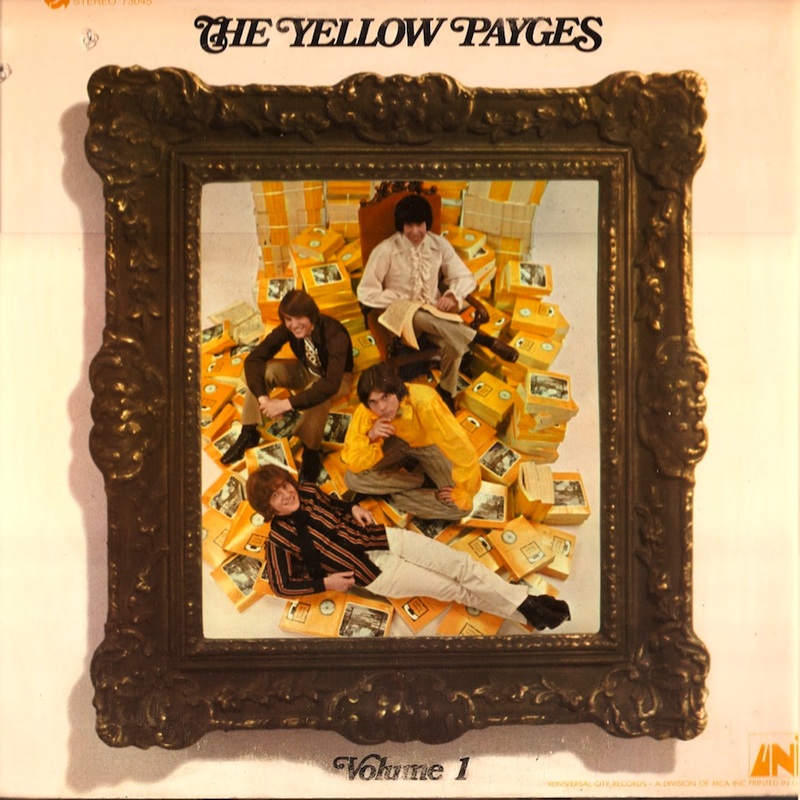
Garage rockers the Yellow Payges formed in Torrance, California in the fall of 1965 — while attending a performance by friends the Palace Guard at the Hollywood club the Hullabaloo, vocalist Dan Hortter took the stage to sing a rendition of “I’m a Man,” so impressive that club owner Gary Bookasta hired Hortter’s own band to back the Newbeats two weeks later. The problem was, Hortter’s previous band, the Driftones, had dissolved months earlier, but he quickly assembled a new Driftones’ lineup including guitarists John Knox and Larry Tyre, bassist Herby Ratzloff, and drummer Terry Rae, also a member of the Palace Guard. Rae resigned almost immediately after the Newbeats gig, with drummer Dan Gorman signing on in time for the group to change its name to the Yellow Payges.
They were soon playing the Hullabaloo on a steady basis, with Bookasta signing on as manager — in 1966, Knox, Tyre, and Ratzloff exited, with guitarists Bob Norsoph and Randy Carlisle, and bassist Mike Rummans signing on in their stead. When Norsoph and Carlisle quit soon after, Rummans moved to guitar, with Jim Lanham briefly assuming bass duties prior to the addition of bassist Teddy Rooney, son of Hollywood legend Mickey Rooney. In 1967, this Yellow Payges lineup issued their debut single, the Showplace label effort “Never See the Good in Me” — “Jezebel” followed later that year, and both records generated enough local buzz to earn the band a contract with major label UNI.
In addition to releasing their label debut “Our Time Is Running Out,” in late 1967, the Yellow Payges closed out the year as part of Dick Clark’s Happening ‘67, a package tour which traveled to 45 U.S. cities in 45 days. In mid-’68, both Rummans and Rooney exited, with Hortter and Gorman quickly recruiting guitarists Bill Ham and Bob Barnes, both products of Fort Worth, Texas (a geographic quirk resulting in some confusion as to the band’s actual hometown). On August 16, the Yellow Payges played their biggest-ever show, appearing at the Hollywood Bowl on a bill headlined by the Animals, the Rascals and Tommy James & the Shondells; they spent much of the year to follow supporting their singles “Childhood Friends” and “Crowd Pleaser” on tour with the Animals, later spending six months opening for the Beach Boys.
The band’s debut LP, Vol. 1, appeared on UNI in mid-’69, generating the singles “Never Put Away My Love for You,” and “Vanilla on My Mind”; “Follow the Bouncing Ball” appeared in 1970, and their cover of the warhorse “I’m a Man” (a nod to Hortter’s big break) fell just two slots shy of cracking the Billboard Hot 100. Somewhat ironically, it was a campaign with AT&T that spelled the Yellow Payges’ demise: hired by Wall Street advertising firm Cunningham & Walsh as part of a phone company-sponsored campaign designed to appeal to young audiences, the band was forced to appear in commercials in yellow satin ruffled shirts, effectively destroying their credibility and their momentum. After one final single, “Moonfire,” the Yellow Payges dissolved in late 1970 — Barnes later backed Kinky Friedman under the alias Roscoe West, and also collaborated with T-Bone Burnett. (Jason Ankeny, All Music Guide)
Track Listing
- The Two Of Us
- Little Woman
- Friends
- Boogie Woogie Baby
- Crowd Pleaser
- Moonfire
- Devil Woman
- Never Put Away My Love For You
- I’m A Man/Here ‘Tis
Lee Akers And The Electric Generation – Heavy, Heavy, Heavy (1969)
Title: Heavy, Heavy, Heavy
Year: 1969
Format: LP
Label: Crown
Low budget Rock/Blues effort by Lew Akers who was involved with various projects for the budget label Crown. A pretty decent offering considering the label was known for it’s exploitation of current hits by the major labels. For more info see previous post by The Underground Electrics. (Max Collodie)
Track Listing
- And When I Die
- Money Does It
- No Respect
- All I Ever Tried To Do Is Try
- Lean Back
- Blood Sweat And Tears
- Green Eyes
- Janie Blues
- The Other Side
- An Evening In The Country Carla
- Just Don’t Come Back
The Underground Electrics – Hey Jude (1969)
Title: Hey Jude
Year: 1969
Format: LP
Label: Crown
The Underground Electrics “Hey Jude” album is Lee Akers singing with back up instrumentation from the The Firebirds, (they’re the same band as the Electric Firebirds) who released two albums including “Light My Fire” on Crown Records in the late 60s, early 70s.
Lee Akers also sang on two albums for Crown called The Spinners “Spinning Wheel” and Lee Akers and the Electric Generation “Heavy Heavy Heavy”, while The Firebirds did an album under the name The 31 Flavors called “Hair” (see June 25, 2010 post) and like the Firebirds album, it is real heavy and Far Out!. All of these albums are great and must be heard!! (Fuzzy)
Track Listing
- Hey Jude
- Standing At The Crossroads
- Boogie Chillen
- The Syndicator
- No Love In My Heart
- Goodbye Baby
- Queen Bee
- Sunnyland
- Dark And Dreary
- Dust My Blues
Sir Douglas Quintet – +2 (Honkey Blues) (1968)
Title: +2 (Honkey Blues)
Year: 1968
Format: LP
Label: Smash
It is hard to believe that this is the first entry in the extensive Sir Douglas Quintet discography, as it seems like the kind of experimental venture an artist might throw out after a handful of successful albums have already been released. The eclectic nature of bandleader Doug Sahm is undisputed, but this has got to be his album with the most experimental jazz leanings, again not something one would expect.
The type of themes that Sahm would return to again and again in his songwriting are here, delivered by a grouping that lacks one of the essential spark plugs in the Sir Douglas Quintet engine, keyboard man Augie Meyers. There is presumed to be compensation in the form of a total of five horn players, including Bay Area session whiz Mel Martin, but someone decided to record them with enough reverb to submerge a whale.
A total of seven songs, none of them really extended enough to account for paucity of titles, get a loping, jamming treatment that gets the message across, although a little vaguely at times. Certainly a promising, original album well above the level of most rock-bands-with-horns experiments of this era, but not as inspiring as this band’s music would soon become. (AMG)
Track Listing
- Are Inlaws Really Outlaws?
- Sell A Song
- Song Of Everything
- Can You Dig My Vibrations
- I’m Glad For Your Sake
- Whole Lotta Peace Of Mind
- You Never Get Too Big
- Linda Lou [bonus]
- Soulful Woman [bonus]
- Too Many Docile Minds [bonus]
Disclaimer: The link below may point to content that is copyrighted. redtelephone66 only provides this link with the understanding that you are responsible for the content you download. redtelephone66 does not engage in music piracy, nor do we do host, fileshare, or otherwise trade in copyrighted works.

The Mainline – Canada, Our Home And Native Land [Vinyl] (1971)
Title: Canada, Our Home And Native Land
Year: 1971
Format: LP
Label: GRT
Courtesy Of Ross
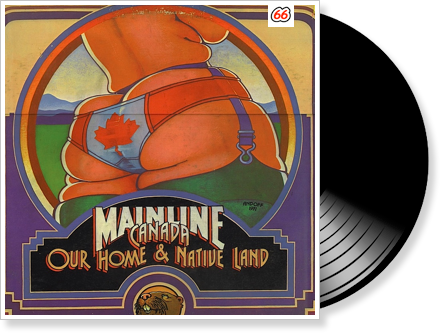
Mainline consisted of Bob Adams (harp), Mike Harrison (bass), Mike McKenna (guitar, vocals), Tony Nolasco (drums, vocals), Ted Purdy (acoustic guitar, vocals). For more info please refer to the October 25, 2010 post of their “Bump ‘N’ Grind Revue” Lp.
Track Listing
- Blind Girl
- Get Down To
- Pedalictus Rag
- One Time Loser
- You’re My Heart’s Desire
- Motorcycle
- I Am Normal
- Brain Damage
- Honkis de Konkis
- Going To Toronto
- Nova Scotia Breakdown
Disclaimer: The link below may point to content that is copyrighted. redtelephone66 only provides this link with the understanding that you are responsible for the content you download. redtelephone66 does not engage in music piracy, nor do we do host, fileshare, or otherwise trade in copyrighted works.