
The 31st Of February – The 31st Of February (1969)
Title: The 31st Of February
Year: 1969
Format: LP
Label: Vanguard
The 31st Of February was a rock and roll band formed by Jacksonville, Florida natives Scott Boyer, David Brown and Butch Trucks.
All three were alumni of Englewood High School in Jacksonville, though they did not come together musically until Brown and Trucks found themselves living on the same floor of a dormitory at Florida state University in the fall of 1965.
Having heard the folk-rock of groups like The Byrds and The Lovin’ Spoonful, saxophonist Brown bought an electric bass and started to jam with drummer Trucks, an alumnus of The Vikings, The Echoes and the Jacksonville Symphonette.
Guitarist and vocalist Boyer, making his living as a folk singer, was contacted by Brown who offered his and Trucks’ services if Boyer would trade his acoustic guitar for an electric guitar. Boyer agreed and the three formed a group, The Bitter Ind. (short for Independents).
Playing fraternity parties, growing their hair long and ceasing to attend their classes (in Brown’s and Trucks’ cases), the group left Tallahassee after the end of the school year and tried their hand at performing in Daytona Beach.
After being turned down repeatedly by club owners, the group found a bit of luck, landing a one-night performance at the Club Martinique. Shortly into their set, two members of the Allman Joys, a group that frequently appeared at the club, walked in and sat down. After the group finished, the two members introduced themselves and lavished praise on the group.
They were the namesakes of the Allman Joys, Duane and Gregg Allman. When the Bitter Ind. relayed their story of their inability to get steady employment, the Allmans offered them free lodging.[2] In time, the Bitter Ind. returned to Jacksonville discouraged, their meeting with the brothers Allman the only high point of their journey.
Shortly after returning to Jacksonville, however, Trucks received a call from Duane Allman, stating that the Allman Joys were playing at the Beachcomber, a Jacksonville club, and that they needed a drummer. Trucks agreed to sit in for the night.
After the show, Duane Allman suggested to Trucks to ask the club manager to let the Bitter Ind. audition. The manager agreed, loved the group’s sound and let them stay on through mid-1967.
After their engagement ended, the group, no doubt under threat of legal action from the New York nightclub The Bitter End, decided to change their name. After briefly using the moniker “The Tiffany System”, the group found themselves in Miami, Florida, signed to folk giant Vanguard Records as The 31st of February.
Their eponymous debut album was released in early 1968, a heady mix of folk-rock and psychedelic pop. After its failure to get noticed, the group added a lead guitarist and began to rework their sound.
Almost immediately, the group again ran into Duane and Gregg Allman, who had just broken up their post-Allman Joys group The Hour Glass. Electing to join forces, the newly-hired guitarist was fired and the remaining five-piece began performing throughout the Southeast.
In September 1968, they began recording material for their second album, including nascent versions of “Melissa” (which would come out on the Allman Brothers Band’s Eat A peach album in 1972) and “Nobody Knows You When You’re Down And Out” (which Duane Allman would later cut with Derek and the Dominos).
Though the material would not come out until four years later, they serve as an important bridge towards the sound that The Allman Brothers Band would be producing within twelve months.
Whilst in the midst of recording and touring, Gregg Allman elected to move out to southern California in order to let his brother and the remaining members of the Hour Glass be freed from their contract with Liberty Records.
Though Gregg offered the others positions in his backing band, nothing came of it and in a matter of months, Butch Trucks would join Duane and Gregg Allman in The Allman Brothers Band. (Howard Hales Broom)
Track Listing
- Sandcastles
- Porcelain Mirrors
- Broken Day
- Wrong
- The Greener Isle
- Cod’ine
- A Different Kind Of Head
- Pedestals
- Free
- A Nickel’s Worth Of Benny’s Help
- Pick A Gripe
- Cries Of Treason
Various Artists – Early Chicago Volume 1 (1971)
Title: Early Chicago Volume 1
Year: 1971
Format: LP
Label: Happy Tiger
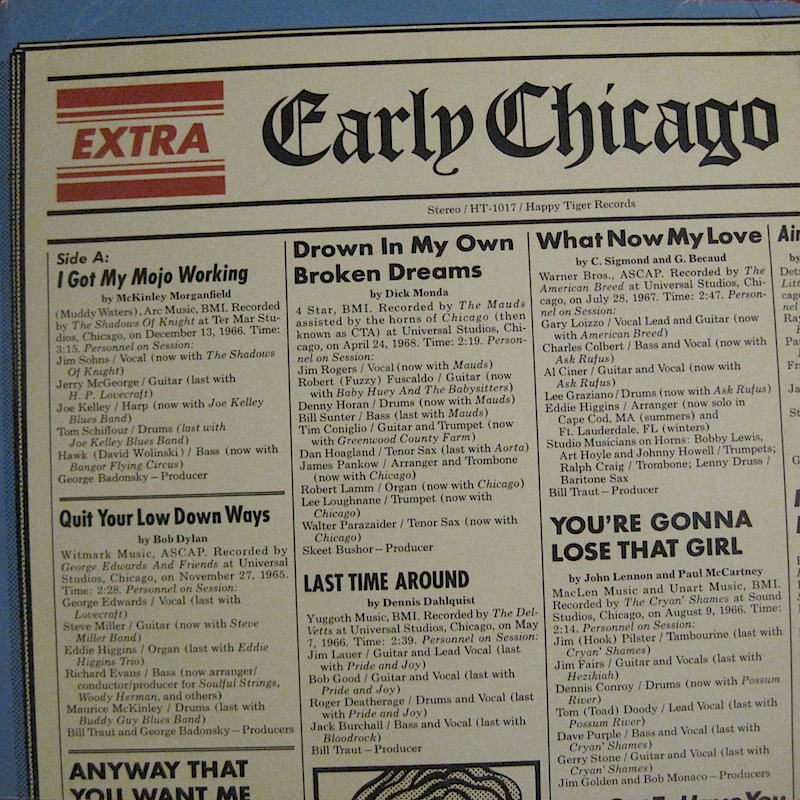
A fantastic compilation released in 1971 on the Happy Tiger label by Dunwich Productions featuring early sides by the Shadows Of Knight, The Cryan’ Shames, The American Breed, The Flock, H.P. Lovecraft, The Maudes (with horns by CTA), The Trolls, The Del-Vetts, George Edwards And Friends, The Rovin’ Kind, Saturday’s Children and The Little Boy Blues.
Usually when early recordings are unearthed during or after the success of a particular group, it’s to take advantage of that success and usually the material is inferior. This is one of those rare cases where the material is actually better or as good as that particular band’s best output. From an historic perspective, an excellent look into the Chicago Rock scene of the mid to late sixties. (Jack Schett)
Track Listing
- I Got My Mojo Working [The Shadows Of Knight]
- Drown In My Own Broken Dreams [The Mauds assisted by the horns of Chicago then known as CTA]
- Quit Your Lowdown Ways [George Edwards And Friends]
- What Now My Love [The American Breed]
- The Last Time Around [The Del-Vetts]
- You’re Gonna Lose That Girl [The Cryan' Shames]
- Magical Wings [The Flock]
- Man With Money [Saturday's Children]
- I’ve Got To Have You [The Trolls]
- Anyway That You Want Me [H. P. Lovecraft]
- Ain’t Too Proud To Beg [The Little Boy Blues]
- I Didn’t Want To Have To Do It [The Rovin' Kind]
The Mauds – Hold On (1967)
Artist: The Mauds
Title: Hold On
Year: 1967
Format: LP
Label: Mercury
Compared to other mid-1960s Chicago-based outfits like The American Breed, The New Colony Six, Rotary Connection, Shadows of the Knight, etc., The Mauds have simply gotten lost in the shuffle. Part of it may have been due to the fact these guys pursued a fairly commercial brand of pop/blue-eyed soul which didn’t sit all that well with critics. Who knows …
Originally formed in 1965 singer/frontman Jimy Rogers, The Mauds started out as a covers band, playing parties, dances and Chicago clubs. Following a series of personnel changes, by 1966 the line up consisted of Rogers, rhythm guitarist Timmy Coniglio, lead guitarist Robert Fuzzy Fuscaldo, bassist Billy Winter, and drummer Phil Weinberg. Initially signed to Bill Traut’s Chicago based-Dunwich label, the band debuted with the 1967 single ‘Hold On’ b/w ‘C’mon and Move’ (Dunwich catalog number 160).
The single generated considerable local attention with Mercury Records subsequently purchasing national distribution rights. Reissued under Mercury catalog number 72694 and backed by Mercury’s promotional power, the reissued single hit # 114 on the pop charts. The single was followed by ‘When Something Is Wrong (with My Baby’ b/w ‘You Make Me Feel So Bad’ (Mercury catalog number 72720). As was standard marketing policy, Mercury subsequently released a supporting album
Produced by George Badonsky and Bill Traut, 1967′s The Mauds Hold On offered up a mix of the earlier singles, pop and soul covers, and a pair of Fuscaldo-penned originals. Exemplified by tracks like ‘Harlem Shuffle’, ‘Knock On Wood’ and ‘You Must Believe Me’ to my ears the results were energetic, if frequently less than awe-inspiring. With the band normally sticking close to the original arrangements anyone familiar with the original versions was left to wonder why they bothered …
Even worse, a couple of their song choices were just plain bad. Propelled by a fey performance from Rogers ‘When Something Is Wrong (with My Baby)’ was a clunker through and through; they managed to reduce ‘Mercy, Mercy, Mercy’ to cocktail jazz, and they somehow managed to turn Isaac Hayes and David Porter’s ‘Hold On’ into something dull and forgettable.
On the other hand Rogers had a likeable voice; the band’s playing was decent (though the horn arrangements were occasionally quite clunky), and the originals were actually quite good. ‘C’mon and Move’ may have been the funkiest track on the album, while ‘You Made Me Feel So Bad’ was the best rocker. Initially a major disappointment, though it’s grown on me the more I’ve played it. (Bad Cat)
Track Listing
- Harlem Shuffle
- Knock On Wood
- When Something Is Wrong With My Baby
- Look At Granny Run
- Mercy Mercy Mercy
- Hold On
- You Must Believe Me
- You Don’t Know What I Like
- C’mon And Move
- Ha, Ha, Ha
- You Made Me Feel So Bad
Rock Island – Rock Island (1970)
Title: Rock Island
Year: 1970
Format: LP
Label: Project 3
Steeped in the blues tradition, this new group, the first venture of this sort for Project 3, features good driving instrumentals around harmonizing vocals. “When I Was A Boy” is a folk tune leading into good instrumental jamming. “Hard” And Never Easy” is an electric tune with a acoustic chorus. And “Blues” is just that with two extra endings for the listener to choose from. Rock Island has made an excellent showing on it’s first album. (Billboard Magazine)
Track Listing
- Blue, Blue Lady
- Runnin’ Through My Mind
- When I Was A Boy
- I Keep On Tryin’
- Hard And Never Easy
- She Has Left Me
- Won’t You Stay Another Day
- I Remember
- Babe I’m Gonna Leave You
- Blues
- Blues II
- Blues III
Gator Creek – Gator Creek (1970)
Title: Gator Creek
Year: 1970
Format: LP
Label: Mercury
Given the eight members of this short-lived studio entity had more than their share of chops, I guess the best way to describe Gator Creek would be as an early attempt to put together a super group. The funny thing is that today the band is virtually unknown – try finding a single write up on their album, let alone any kind of biographical material on the band … even the members’ own sites (e.g. Mike Deasy’s website) only pay passing mention of the group.
The Gator Creek lineup was made up of a series of L.A.-based studio musicians – sax play Allen Beutler, keyboardist Dee Barton, guitarist Mike Deasy, singer Kathy Deasy, singer/guitarist Kenny Loggins, bassist Ray Neapolitan, keyboardist Mike O’Martin (aka Michael Omartian), and drummer Gene Pello. Collectively they had played in numerous bands (see above for a partial listing) and as hired guns, played on literally hundreds of session and albums.
Those credentials make it easy to see why Mercury would have been interested in financing an album. Co-produced by Barton and Bob Todd, 1970′s cleverly titled “Gator Creek” served as a showcase for the various members’ talents which gave the LP a versatile, if somewhat disjointed feel. Interestingly given he was responsible for penning almost half of the material, keyboardist Barton was probably the least impressive member of the group.
As a lead singer he didn’t have much of a voice and tracks like the swamp rocker ‘Betty Jean’s Mama’ and the country-flavored ‘Home’ weren’t particularly memorable. As a husband and wife team the Deasys acquitted themselves better; Mike’s stellar guitar on display throughout (nice feedback drenched opening to ‘Dirty Boogie’), while their cover of Jackson’s ‘These Days’ displayed some surprisingly impressive harmony vocals (and would have made a nice single). Kathy’s performance on ‘Mud Island’ may have been the most radio-ready song on the set.
Represented by two of his own compositions, Loggins was probably the most mainstream and commercial presence. He certainly had the best voice and ‘Danny’s Song’ became a staple in his Loggins and Messina and solo careers.
As mentioned, the ten tracks bounced all over the musical spectrum, with quite a bit of boogie woogie found throughout the grooves (‘Don’t Try To Lay No Boogie Woogie On the King of Rock and Roll’, ‘Dirty Boogie’ and ‘Holy Moly Rolly Polly’). Hardly the year’s most impressive release, but not without some charm. (Bad Cat)
Track Listing
- Don’t Try To Lay No Boogie Woogie On The King Of Rock And Roll
- Danny’s Song
- These Days
- Dirty Boogie (instrumental)
- Betty Jean’s Mama
- Holy Moly Rolly Polly
- Long-Tail Cat
- Mud Island
- Take A Look
- Home
Morning Dew – Morning Dew [Vinyl] (1970)
Title: Morning Dew
Year: 1970
Format: LP
Label: Roulette
Midwest legends who cut a handful of great garage 45s before this swan song hippie rock LP, which unfortunately was issued way too late to make any impact. Rated highly by many, it’s a solid trip through Airplane/Cream /Butterfly dimensions mixing early heavy moves with strong folkrock/psych material.
Lack of macho vocals is a plus, and opening “Crusader’s Smile” is a classic. Reminds me of the Mainstream label sound, though this is more consistent. A good LP all over, but perhaps not enough of a mindblower to warrant the big price tag. True originals have “Bell Sound” stamped in the trail-off. (Patrick Lundborg)
“Good but overrated album that sounds fantastic on first listen but comes down to earth once you get used to it. Mostly it’s pretty mainstream, with solid vocals and performances and a few really great songs on side one. All of it is decent, but it lacks the kind of depth or originality that would give it classic status.” (Aaron Milenski)
Track Listing
- Crusader’s Smile
- Upon Living
- Young Man
- Then Came The Light
- Cherry Street
- Gypsy
- Something You Say
- Country Boy Blue
- Save Me
- Epic: Part One – The Mann
- Epic Part Two: – Death Is A Dream
Jesse Davis – Jesse Davis (1970)
Title: Jesse Davis
Year: 1970
Format: LP
Label: Atco
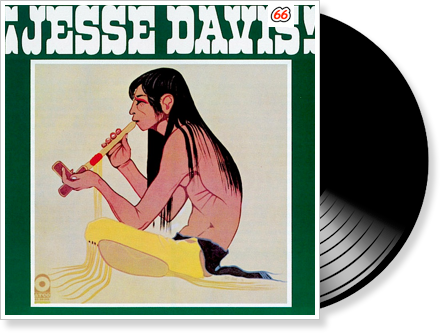
Jesse Davis, full blooded Kiowa Indian and Oklahoma native, was a frequent session guitarist back in the late 60′s and early to mid 70′s. He later fell prey to drug addiction and died in 1988 at age 43. But what better way than music to leave a part of yourself behind? Davis’ debut solo album is a really fun, rollicking rock album full of horns, piano, blues solos and guest appearances.
Should any questions of legitimacy arise, note that Jesse ‘Ed’ Davis played with Taj Mahal, John Lennon, Willie Nelson, Steve Miller among others and Eric Clapton and Gram Parsons make appearances here on Davis’ self-titled debut. Davis also produced Gene Clark’s (of The Byrds) album “White Light,” and appeared in the Rolling Stones Rock and Roll Circus alongside Taj Mahal.
“Reno Street Incident” starts this one off with a nice and slow Creedence-inspired tune with some nice backing piano and a tasteful solo from Jesse. Next is “Tulsa County,” one of my favorites here. It’s also got a lot of Creedence inspired melodies which sound great. “Washita Love Child” is a really bouncing track with an awesome chorus and great playing all around.
The centerpiece of the album is the lengthy “Every Night is Saturday Night” which screams “party” at every turn. After a generally fast paced 1st half, the album turns the dial down just a bit for the second half but does everything right on the Costello-ish “Golden Sun Goddess.”
The one track I have any problem with is Rock N Roll Gypsies. It starts off slow, sounding a little bit like Skynyrd’s “Tuesday’s Gone” but ultimately feels out of place, adding too much to the slower second half. The icing on this cake for me was the cover of one of my favorite songs, Van Morrison’s “Crazy Love.” The group really gives it a good treatment and it deserves a listen.
The only real problems I have with this one are the down-the-hill/up-the-hill song arrangement and the slight lack of originality. Overall, this is a windows down, sun setting, summer time rock album. The first half especially! It’s a pretty rare and quality listen and merits some exposure. (superbradman RYM)
Track Listing
- Reno Street Incident
- Tulsa County
- Washita Love Child
- Every Night Is A Saturday Night
- You Belladonna You
- Rock ‘N’ Roll Gypsies
- Golden Sun Goddess
- Crazy Love
Buzzy Linhart – Buzzy [The Black Album] (1972)
Title: Buzzy
Year: 1971
Format: LP
Label: Kama Sutra
There are two other Buzzy Linhart albums entitled Buzzy, one released in 1969 on Philips (had this one posted on the old blog, will re-up at a later date) and this third solo release on Buddah records in 1972. There’s a jazzy “Eye 1-2-C-U Shuffle,” which could be the Electric Flag with Linhart on vocals (ok, if you see fit to tell us that now).
The band — featuring Danny Trifan on bass, guest star Moogy Klingman on organ, future Steely Dan/Doobie Brothers session man supreme Jeff “Skunk” Baxter on acoustic and electric guitars, Ten Wheel Drive’s Luther Rix, and mixing by Todd Rundgren creates what may be the most intimate of Linhart albums released on a major label. There’s a great cover of Elton John and Bernie Taupin’s “Take Me to the Pilot” with the equally great line “he’s a virgin” with Buzzy quipping “aren’t we all?.”
Interesting that Uni Records pushed much Elton John product out in this early-’70s period when Buddah had three Linhart discs in release (one on a subsidiary called Eleuthera Records, a band project called Music, with a majority of the songs written by Buzzy).
On February 28, 2002, AMG spoke with the singer/songwriter’s son, Xeno Linhart (note that the publishing company on some of the songs is Xeno Music, with Ascap as the Performing Rights Organization). Xeno claimed that “Apparently, shortly after recording The Time to Live Is Now, there was a drummer swap. Luther Rix and Kevin Ellman swapped bands so Luther and Bette Midler could be together, and bringing in an Indian drummer into the Trio to do the ragas seemed right.
But Kevin left soon after to go with Moogy Klingman and become Utopia. All this in just a few months, and then there are the next sets of players. But the order of recording is not really the same as the order of release. There really are two albums called Buzzy. The 18-minute version of “Sing Joy” [is] on Buzzy Phillips 1969, later on Best of Buzzy Linhart (1972) and the more memorable 8:30 version [appears] on Buzzy Kama Sutra/Buddah 1972 The Black Album, as it is called for its mostly black cover (by photographer Ira Wexler).
The first Buzzy is quite unique in its arrangements. Best of Buzzy (1972) on KamaSutra/Buddah is a repackaging of the Buzzy (Phillips) and other material. So, the two “Sing Joy” (tracks) show up in a few places. It is worth some study itself, as it was the first raga Buzzy wrote (1964), and then re-wrote a few times. It is also a major component of the 30-minute long live raga jam by Seventh Sons, “4 A.M. at Franks” (also released as “Raga,” both on ESP Disks).
We have restored and remastered the cut for inclusion on a collection of improvised one-take recordings to be called ‘Avant Buzz.’ So, there is a lot of Buzzy’s material with the date 1972, but it was just a timing issue, and probably a mistake by record companies to flood the market with so much of his material all at once and not making it clear that some was recorded years earlier.”
On Barry Gordy’s “You Got What It Takes” a hit for both Marv Johnson and the Dave Clark Five in the ’60s, Linhart gives it a musician’s treatment. Nothing on this album seems to be crafted with the charts in mind, though on “Rollin’ On” Buzzy lifts melody and lines from Bacharach/David by fusing “What the World Needs Now” into his song.
L. Luther Rix’s “Boogaloother” is a delight with passages straight from the Ten Wheel Drive songbook. “Sing Joy” changes the mood, evolving from the percussive sounds into a rocking “Tutti Frutti” tracked live at Studio A of New York’s Record Plant.
The Black Album may be the least commercial of Buzzy’s efforts, but it is solid musicianship and contains sounds that drew from, as well as inspired, past and future works of Ten Wheel Drive, Bette Midler, Utopia, Jimi Hendrix, and Steely Dan, and it is all quite staggering. (Allmusic Guide)
Track Listing
- Tornado
- Rollin’ On
- You Got What It Takes
- Boogaloother Or “Captain Hornbone’s Last Desparate Truck”
- Sing Joy /Tutti Frutti
- Take Me To The Pilot
- Eye 1-2-C-U Shuffle
- Tell Me True
- Don’t You Pay Me No Mind
Donovan – Liquid Sunshine Donovan (Compilation)
Title: Liquid Sunshine Donovan
Year:
Format: LP
Label: Epic (Unreleased)
An unreleased compilation album that showcases Don’s more psychedelic sides: “Outside” (side one) is a glittering necklace of his pop-psych jewels, while the flipside “Inside” features his more introspective, although equally psychedelic, songs arranged in a seamless suite. L.S.D. (get it?) sums up the era nicely, including cover artwork that is very much a product of its time, and it’s a shame it never saw release. There are even some added sonics to book-end the album, including a short collage fade-out to side two. A must-hear for any fan of sixties psych – Hail Atlantis! (Internet Source)
Track Listing
- Outside: Season Of The Witch/Sunshine Superman/Fat Angel/The Trip/Hurdy Gurdy Man/Atlantis
- Inside: Sunny Goodge Street/Peregrine/Tangier/Ferris Wheel/Three Kingfishers/Guinevere
Ruby Jones – Ruby Jones [Vinyl] (1971)
Title: Ruby Jones
Year: 1971
Format: LP
Label: Curtom
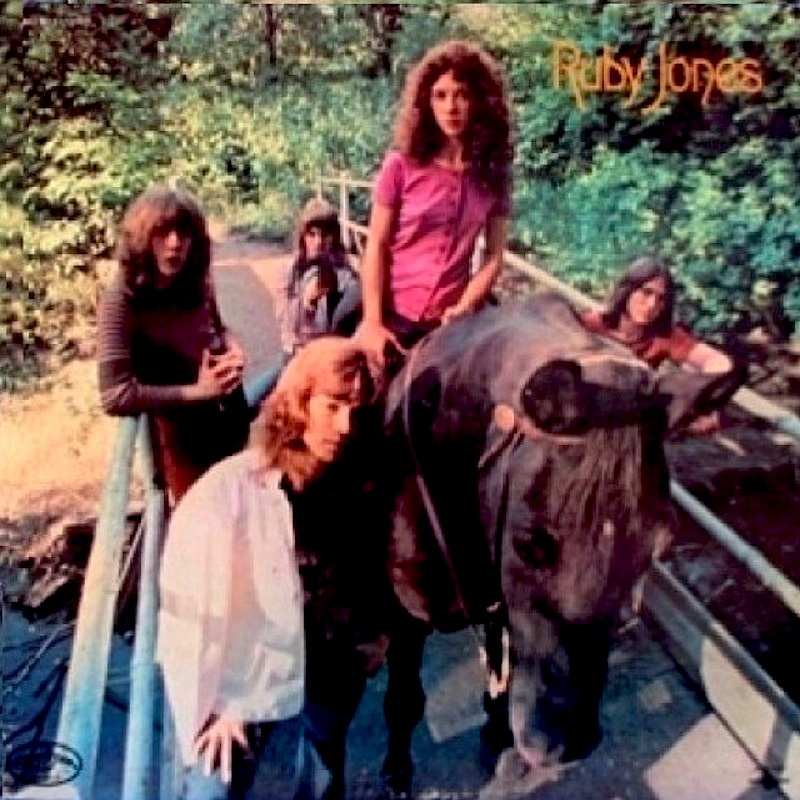
Singer Ruby Starr was best-known as a backup singer for ’70s macho man rockers Black Oak Arkansas, but also issued several recordings as a solo artist as well. Born Constance Henrietta Mierzwiak in Toledo, OH, in 1949, the future rock singer got her start at the age of nine (performing renditions of Brenda Lee songs) before changing her stage name to Connie Little and forming the Phil Spector-esque Connie & the Blu-Beats.
Following stints in such obscure outfits as the Downtowners and the Blue Grange Ramblers (aka BGR), the latter of which mutated into the outfit Ruby Jones (a name that the singer was going by at the time). Signed to Curtis Mayfield’s Curtom label, the recording of Ruby Jones’ 1971 self-titled was even supervised by Mayfield.
Shortly after the album’s release, Black Oak Arkansas frontman Jim Dandy spotted Starr singing in an Evansville, IN, club and persuaded her to join his band, as she assumed her best-known stage name Ruby Starr.Starr toured with the band for several years (appearing on the albums Street Party and Balls of Fire, as well as their lone hit single “Jim Dandy”) before leaving the group to form the Ruby Jones Band in 1976, and issuing Scene Stealer the same year.
By the dawn of the ’80s, Jones/Starr had formed Grey Star, issuing a pair of recordings — 1981′s self-titled debut and 1983′s Telephone Sex — before forming the group Henrietta Kahn in the late ’80s. In the ’90s, Starr was diagnosed with cancer, eventually passing away at home in Toledo in January of 1995.
After her passing, several archival releases that featured Starr were issued, including the live Black Oak Arkansas recording, King Biscuit Flower Hour Presents, and a reissue of Ruby Jones’ debut album, retitled as Stone Junkie. (Greg Prato)
Track Listing
- 99,000 Times
- Looking Out At Tomorrow
- 46th Street
- Have No Witness
- Freely Away
- Oh Baby
- Tightrope
- Bicycle Built For Everyone
- Stone Junkie
- You Better Run