
Buskers – Buskers (1970)
Title: Buskers
Year: 1970
Format: LP
Label: RCA Victor
Another Simon Napier-Bell project for RCA Victor (see the Fresh “Out Of Borstal post of April 8, 2010). “Busking – to play without written arrangements often done on streets to make money from passers by.” (Hmm, sounds like Wild Man Fischer was a Busker).
Buskers in London often double daytime busking with nighttime gigs in bands and orchestras.
Some busk to work their way through music college-others have busked their whole lives. They do everything from tap-dancing and playing the spoons while while tied in a sack to playing jazz and blues in ten or twelve piece bands.
Centres of busking are Leicester Square, Piccadilly and Oxford Street, but in the summer many buskers go off to the south of France, Paris, Denmark, Sweden or the coastal resorts of Britain for a “summer season.” Amongst famous artists who started out as buskers are Peter Sarstedt, Don Partridge, Donovan, Chad & Jeremy. (Album Liner Notes)
Track Listing
- Intro: My Old Man/My Daddy Is A Millionaire
- Nina
- I Can’t Go On Living Without You
- I Belong To Glasgow
- Sylvester’s Last Voyage
- Bond Street Blues Medley: She’s Got It/Blue Suede Shoes
- Music, Music, Music
- Je Suis Tous Les Fenetres
- Cover My Bones
- Joey Friendship
- Buskers’ Interview
- Ballin’ The Jack
- If I Ruled The World
Brethren – Brethren (1970)
Artist: Brethren
Title: Brethren
Year: 1970
Format: LP
Label: Tiffany
Here’s what we know about this short-lived ’70s New York-based entity
1.) The line up consisted of keyboardist Mike Garson, guitarist Tom Cosgrove, drummer Rick Marotta and bassist Stu Woods. 2.) They were one of the original (aka few) acts signed to Scepter’s short-lived Tiffany subsidiary. 3.) Their debut album was recorded in Hollywood’s Gold Star Studios.
1970′s “Brethren” teamed the band with producer Jay Senter. With three of the four members contributing material (Cosgrove was the mainstay composer), the album featured a mix of what a friend has labeled “white boy blues” (“Hitchin’ To Memphis” and “Everybody In The Congregation”) and country-rock numbers (a nice cover of James Taylor’s “Don’t Talk To Me Now” and “Mississippi Freighter”).
Cosgrove had a nice raspy voice, well suited to the up tempo material. He was also a capable guitarist (check out his sterling performance on the funky “Outside Love” and the meltdown instrumental “Success Brand Oil”). While much of the set recalled something out of the early ’70s Bobby Whitlock, or Delaney and Bonnie catalogs, nothing here was particularly original or commercial.
To our ears, the Gospel-influenced rocker “Provided For” provided the album’s highlight. The album’s also interesting for it’s bizarre mix of guests, The Blossoms (providing backing vocals), Dr. John and Poco’s Rusty Young. (Bad Cat)
Track Listing
- Midnight Train
- Don’t Talk Now
- Mississippi Freighter
- Success Brand Oil
- Hitchin’ To Memphis
- Everybody In The Congregation
- Provided For
- Outside Love
- Just To Be There
Brethren – Moment Of Truth (1971)
Artist: Brethren
Title: Moment Of Truth
Year: 1971
Format: LP
Label: Tiffany
“Moment Of Truth” is the second album released by Brethren, and moves easily between country-rock on the pop side of the Band and soul-rock similar to the Rascals, but the stress is generally light and lively, as Tom Cosgrove’s vocals provide most of the interest. Marretha Stewart & the Girls add depth with their soul background vocals.
The tracks on side one contain three covers including an eight minute plus version of Dr. John’s “Loop Garoo”, and a remake of Moogy Klingman’s “The Sun And The Moon”. Side two is all originals featuring some fine Cosgrove originals including “Lady On The Terrace” and “Rainy Day Lady”. Mike Garson chips in with the soulful “History Repeats Itself”.
Most notable about Brethren, besides the fact they were an excellent band, is that the four members went on to become in demand back-up musicians. Tom Cosgrove, (vocalist and guitarist) was in demand by many, including Al Kooper and Todd Rundgren.
Rick Marotta (drums), backed dozens of artists including John Lennon, while bass player Stu Woods went on to back up Jim Croce & Janis Ian, and keyboard player Mike Garson had quite a run with David Bowie among others. (Billboard Magazine)
Track Listing
- Loop Garoo
- Wesley
- The Sun And The Moon
- Freedom Blues
- Lady On The Terrace
- Move On
- Rainy Day Lady
- History Repeats Itself
- Blaze
Candle – Candle (1972)
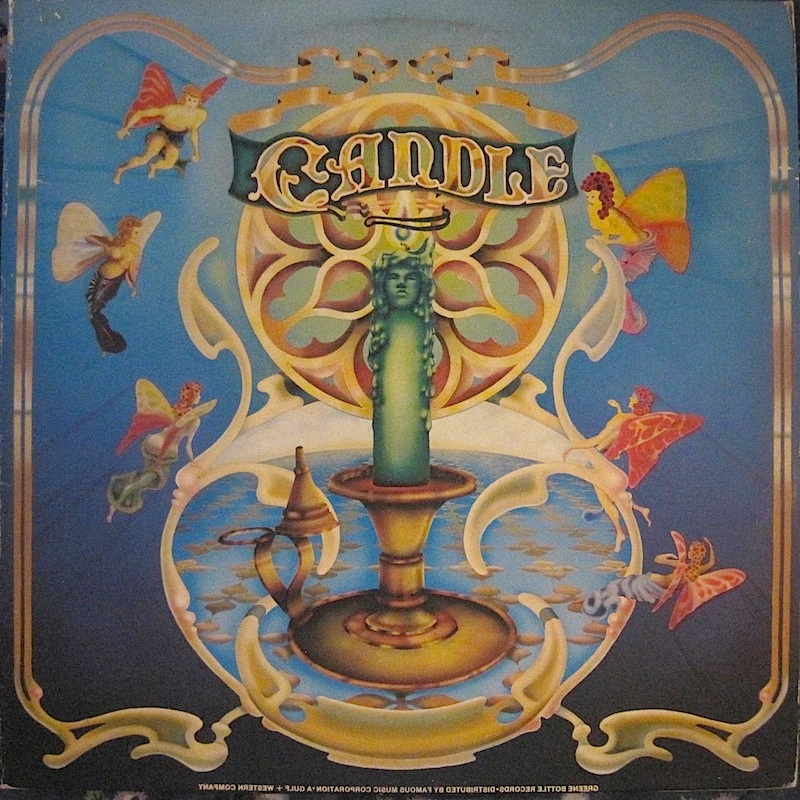
Artist: Candle
Title: Candle
Year: 1972
Format: LP
Label: Green Bottle
Candle is Jeffrey David Hooven: piano, acoustic guitar, vocal; Robert Verne: acoustic guitar, vocal; Davey Wilson: bass, vocal; John Skelton: flute, vocal; L. J.Wolken: accordion; Don Peake: electric guitar; Duane Bryant: drums; Richard Roberts: conga; Andy Narell: steel drum, organ, piano; Doug “Flower” Kraatz: violin, viola; Kaili Vernoff: morale. Obscure acoustic/eclectic ensemble with gentle songwriting, psych/prog overtones, country hippie vibe….. rare….
This album is a first on two counts, it marks the recording debut of Candle and it’s the initial release of Charlie Greene’s “Green Bottle” label. The total feel of the album can be summed up in one wordpleasant. There is nothing harsh or grating about Candle’s music, their forte being multi textured ballads, poignant little vignettes highlighted by emotion-filled vocals and richly constructed backings. Especially captivating is “Sleepy Lylah” (Billboard Magazine)
Track Listing
- You Belong
- You Really Don’t Know How To Love Me
- She Only Wants To Be A Lady
- Country Magic
- Gracious Living
- Every Night The Sun Goes Down (Without You)
- Sleepy Lylah
- I Wish It Would Rain
The Deadly Nightshade – F&W (1976)
Artist: The Deadly Nightshade
Title: F&W
Year: 1976
Format: LP
Label: Phantom
The title of the second album, F&W, stands for “Funky & Western”. It’s a play on “C&W”, Country & Western… a side of The Deadly Nightshade that Phantom/RCA definitely wanted to downplay on the second album.
It seemed (and still does seem) strange, since RCA had a huge country music division in Nashville. I guess the key word is “division”. The way the mainstream music industry then divided up music was that artists were either one thing or another.
Our cross-genre identity, where we wrote (or picked, in the case of covers) songs in several styles—limiting ourselves only by what we/audiences liked, and by whether or not each song’s style was a good fit for us so we played it well– worked great for us. But it didn’t work at all for the mainstream marketing machine, because an album like that didn’t fit the pre-categorized bins at Sam Goody.
And when it came down to a choice between our crunchy country/bluegrass side and our rock/power pop side, Phantom/RCA wanted the latter. The reason, as it was explained to us, is that country music was a sort of cult music with minimal crossover possibilities. An album perceived as country wouldn’t get played on rock radio or sell to rock/pop buyers, whereas a rock/pop album could cross over to the country charts.i.e. Phantom/RCA essentially saw rock/pop sort of like “O positive” blood, the universal donor for everyone. Country was more like A blood—a big category, but one with no way out.
How set in stone was this perception? Well, during a later tour that The Deadly Nightshade opened for Billy Joel, to support “F&W”, we did a gig at the Nashville Civic Center. The thousands of people were definitely there to see Billy, not us.
It was the sort of classic situation where the most an unknown opening act can hope for is that the main act’s loyal fans will sit on their hands, rather than throw rotten tomatoes. But our set went so well that we got an encore, lit matches, even some pretty wild dancing in front of the stage– the whole thing.
Now RCA’s Nashville marketing guys had been very skeptical about The Deadly Nightshade before the concert. In fact when we first hit town, they’d taken us out to lunch at a female strip club, to see if they could gross us out. But immediately after the concert, they called RCA’s national office in NY and said they wanted to put more money into promoting The Deadly Nightshade as a C&W act. Note: that was their own money, not the NY office’s money.
RCA said no. i.e. it was pretty clear that if they couldn’t market us as a rock/pop act, they didn’t want us at all.
Frankly, The Deadly Nightshade’s success was not based on trying to fit ourselves into some pre-existing category. We did badly at that. Rather, our success had been based on taking the pulse of the times, then making up our own new category that fit what people seemed to want/need/love—and fit our own strong points, of course. So we still hoped to sneak out a weird fusion album. But we realized that, for marketing purposes, we needed to label the weird fusion.
So “Funky & Western” was our soundbite for a made-up musical style (and an album) that encompasses both a fiddle/washboard song and a cover of the old Motown hit “Dancing in the Streets”. We hoped that the word play– “funky” almost rhymes with “country” (close enough for a rap artist, anyway)—would make the soundbite sound familiar enough to make the weird mix of styles understandable.
To be honest, the inclusion of the disco song (”Mary Hartman, Mary Hartman”) made the album as a whole a bit hard to understand even for us. But we had to include “Mary Hartman” because it was a semi-hit. And it was our own idea to do the song, so we can’t pin that bit of accidental commerciality on the record company. It’s all explained below.
Anyway, the second album was released late, about a year and a half after the first album, mainly because we and RCA/Phantom had a hard time settling on a producer.
The first one we agreed on was Richard Greene, Seatrain’s violin player, who we’d long idolized. We also loved that Richard seemed to favor our most eclectic newly-written songs, particularly one washboard number (called “I Know What I Like”) that we mainly wrote to give me a chance to sing as low as possible; the result was much like Kermit the Frog, had he been a baritone-type bullfrog rather than a tenor.
But after several months, it seemed like Richard had too many Seatrain commitments. Phantom/RCA wasn’t as pleased as we were with choices like the frog song, anyway.
Next was Paul Rothschild, who’d produced The Doors and was then starting to work with Bonnie Raitt (another of our idols, and, btw, as wonderful a person as she is a singer and bottleneck guitar player). Paul signed on, and was supposed to do our album after he completed Bonnie’s “Home Plate”. We were psyched. But ‘Home Plate” ran very late, and after another several months, Phantom/RCA got terminally antsy.
Then came a series of other possibilities, including one fellow who insisted on having studio hotshots play for us. (The explanation that particularly endeared him to us: “They’ll sound just like you, only better.”) We and our label finally agreed on Joel Diamond and Charlie Calello.
Joel, who was the name producer, showed up at the studio sometimes, to be Joel Diamond. But otherwise, I don’t think we registered much. (His discography includes two albums, both called “The Deadly Nightshade”; one is on Atlantic, one’s on his own record company Silver Blue. We never recorded for either company.) Charlie, who was primarily an arranger– much of it for Frankie Valli and the Four Seasons, for whom he’d also played bass briefly– did the actual producing work.
The studio experience was initially much more positive than the first album. For one thing, though Phantom did insist on instrumentally supplementing the three of us with studio players, Charlie found us three regular players—drummer Allan Schwartzberg, pianist Jon Stroll, and extra electric rhythm guitar player Lance Quinn—who played with us on every cut, rather than album one’s rotating superstar cast of thousands.
Obviously they were not women. We didn’t feel up to fighting that fight again. But they were nice guys, who, before playing, actually listened to the three of us play each song through once, to try to get our feel, instead of jumping in after the second bar and taking the song over.
So laying down the basic tracks went unbelievably fast. We nailed them all (except for one late add, a cover of “Dancing In the Streets’) in two days.
Unfortunately, that encouraged the record company to change our release date from October to September. Admittedly, September is a much better sales month, because of the new school season. So it made marketing sense. But to make the deadline, we’d have to complete the whole rest of the album—one more basic track, all instrumental overdubs, all vocals, mixing, and mastering—in ten days. The two-day basics made a 12-day album seem feasible.
We did make the deadline. But it was, in my opinion, at the expense of many vocals. The harmony parts are as good or better than on the first album. But in terms of vocal quality, our signature blend doesn’t sound as distinctive, or as carefully done, as on the first album.
The difference: On the second album, if someone’s voice was slightly out of tune or scraggly, instead of singing till we got it right, we used a time-saving trick of Charlie’s: We not only doubled and then tripled ourselves, but often also doubled each other’s parts. (I.e. if Anne’s part sometimes sounds like Anne plus Helen and me, it probably is.) When such tripled tracks are blended together, imperfections smooth right out, so the trick works. Still, it is just a trick, not getting it right.
By the twelfth night, everyone was pretty happy, but so exhausted that all those who had lives, including Anne, went home early. Our engineer Kevin stayed with Helen and me to re-mix the previously recorded disco semi-hit “Mary Hartman”, in order to make it sound marginally more like the rest of the album. We finished at 3:00 a.m. and drove out to the 24-hour Clairmont Diner (now, sadly, defunct) in New Jersey.
“Hey, do you know who these women are?” a totally giddy Kevin enthused to our waitress. “They’re two-thirds of The Deadly Nightshade, and they just finished an album. ”The waitress looked us up and down and said, “That’s nothing. Frankie Valli comes here all the time.” [PRB]
Track Listing
- Comin’ Thru
- Show Me The Way Back Home
- I’m Feelin’ Fine
- One Day At A Time
- Murphy’s Bar
- Little Old Lady From Pasadena
- Dancing In The Streets
- Mary Hartman, Mary Hartman
- No Chicken Today
- Johnny The Rock And Roll Star
- Ain’t I A Women
The Deadly Nightshade – The Deadly Nightshade (1975)
Artist: The Deadly Nightshade
Title: The Deadly Nightshade
Year: 1975
Format: LP
Label: Phantom
On our first album, The Deadly Nightshade, released in 1975, the producer was Felix Cavaliere, who had been the keyboard player and creative leader of The Rascals. They’d been one of our favorite groups from the days of their energetic, passionate first album (before the mellow later hits), when they were still called The Young Rascals, and Felix’s trademark was dramatic slides up and down his Hammond B3 organ, with his elbow.
We were thrilled at the prospect of having Felix’s elbow on our album. And we also felt that as a producer, he’d understand our own live energy, and be able to translate that into an exciting recording.
Felix did play on the album. But he was past his elbow days and Hammond B3 melodrama, into more tasteful Fender Rhodes jazzy/Latinesque stylings. (Think “Groovin’” rather than “Ain’t Gonna Eat Out My Heart Anymore”.)
The Deadly Nightshade had not, very deliberately, progressed beyond melodrama. Still, we felt that Felix could capture our kamikaze live sound and spirit in the studio. Unfortunately, however, between Phantom/RCA and us– pulling in opposite directions and with very different concepts of what The Deadly Nightshade’s recordings should be– he was in an impossible position.
We did try to compromise on the issues. It was clearly a given, for instance, that there would be many studio musicians playing on our album, and some—drums replacing my tap boots stomping on the backbeat or downbeat; real horns supplementing or replacing our kazoos; keyboards added in places—seemed reasonable ideas.
But since a big part of what The Deadly Nightshade was about was inspiring other women to play in bands, and proving women could cut it, we wanted as many of the studio musicians as possible, preferably all of them, to be female.
It was a simple concept that no one got, and it caused constant conflict. With the hottest studio guys in town eager to work with
Felix, and RCA happy to pay for them, it seemed incomprehensible to them that we wanted to hire lesser known women.
Since the players we found were both excellent and appropriate for our musical style, we found it equally incomprehensible that they persisted in acting like we were prioritizing gender over musicianship.
As it worked out, we used everybody on some song or other. But the grrrls were generally relegated to the songs that the powers that be considered lightweight. The boyz seemed mainly interested in impressing each other. Nobody was happy.
The most astonishing war story came out of a weekend when we went up to Massachusetts to do a couple of gigs. In the cats’ absence, the mice came out to play. On one country song we’d recorded earlier, the jazz drummer Susan Evans had played. We loved the tracks.
Susan had gotten a hard-hitting, rowdy bar band feel that few jazz drummers can manage. But our production team decided that one of the album’s engineers, a guy who had drummed for the Blues Magoos six or seven years before (but hadn’t played since), could do better. So he played over Susan’s tracks, erasing them.
His drumming was out of sync in roughly a zillion places, naturally; laying rhythm tracks after the fact is difficult even for players who aren’t rusty. So imagine our delight when we got back from our road trip. We ended up using the single scratch track onto which the guys had mixed all of Susan’s tracks. Actually, even with the customary individual EQing of each drum rendered impossible, she sounds damned good.
All in all The Deadly Nightshade finished up the album feeling like The Dead Nightshade. The songs are our originals/our choices. The vocals are all ours. And we are playing on all the cuts, buried under there somewhere. [PRB]
Track Listing
- High Flying Woman
- Nose Job
- Something Blue
- Losin’ At Love
- Dance, Mr. Big, Dance
- Keep On The Sunnyside
- Sweet, Sweet Music Shuffle
- I Sent My Soul To The Laundromat
- Someone Down In Nashville
- Blue Mountain Hornpipe
- Onions
The Oxpetals – The Oxpetals (1970)
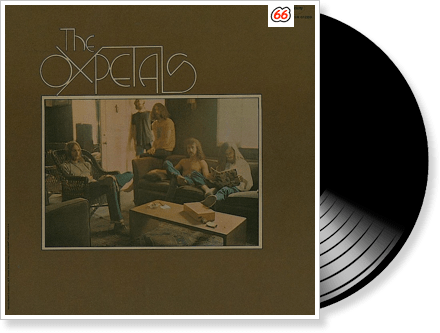
Title: The Oxpetals
Year: 1970
Format: LP
Label: Mercury
The Oxpetals consisted of Benjamin Herndon (vocals-guitar), Steven Pague (guitar-vocals), Guy Phillips (bass), Robert Webber (keyboards) and Daniel “Ace” Allison (drums).
Laid-back with pleasing harmonies, this is uplifting soft rock that incorporates boogie, folk and country influences. Likely to be labeled “hippie-rock” but that’s not to denigrate it, (Shyney)
Track Listing
- Don’t Cry Mother
- I Still Remember
- Doin’ It
- What Can You Say
- The Lazy Station
- March 22
- Declaration Of Oneness
- Down From The Mountain
- Silent Partner
- Stephanie
- You Can’t Hide From The Rude Owl
- Glory To The Skies
Tim Davis – Pipe Dream (1972)
Artist: Tim Davis
Title: Pipe Dream
Year: 1972
Format: LP
Label: Metromedia
Contributed by David B.
After glancing at the far-out cover, I knew I had to have this Tim Davis album. It had slipped my mind that this mysterious Mr. Davis was the drummer for Steve Miller Band’s first five albums and contributed “congas” to Jefferson Airplane’s “Crown Of Creation” album amongst other things.
“Pipe Dream” is Tim’s solo debut on Metromedia Records. Very high quality San Francisco blues rock with leftover psych remnants. Steve Miller, Tracy Nelson and several other SMB regulars guest on this, so the set does sound a lot like a lost Steve Miller Band record. But is that a bad thing? Nope. (SleepObsessed RYM)
Track Listing
- On The Rocks
- Don’t Mention The Lady”s Name
- Nothing Is The Same
- Boogie Woogie F.C.B.
- To Sailors’ Sons
- Love Has Come
- I’ve Always Tried To Please You
- Buzzy Brown
- Sunday
- Beatle Blues
- Rich Kid Blues
Turley Richards – Expressions (1971)
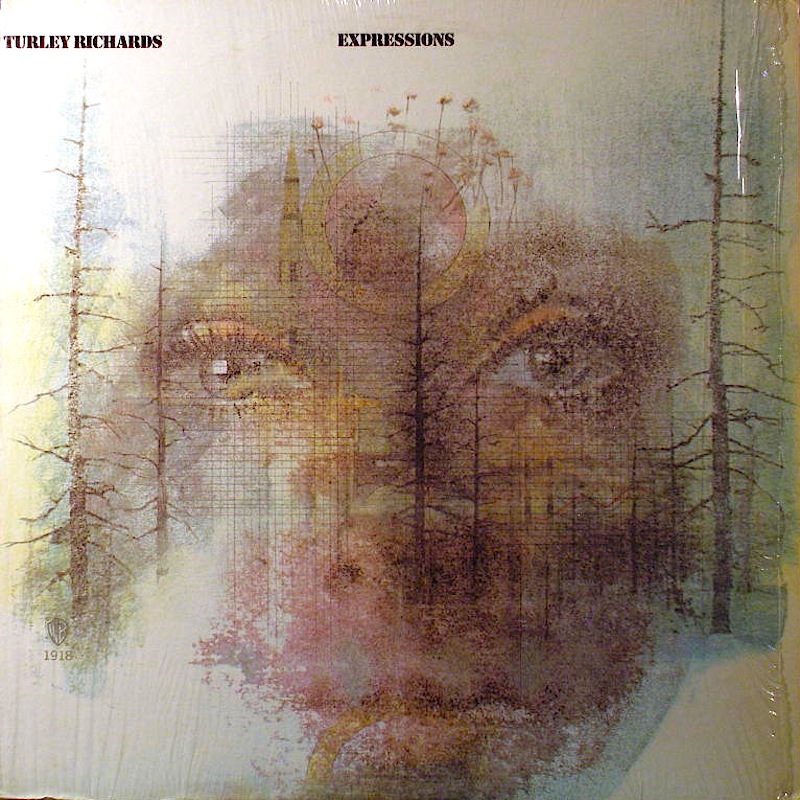
Title: Expressions
Year: 1971
Format: LP
Label: Warner Brothers
“Expressions” is one of Turley Richards’ early recordings. It captures the incredible energy he has as a writer and singer, and it is a reminder of an era when people, both artists and audiences, believed that music was an important part of our lives.
Those who have followed Turley’s career know that several other albums, especially “From Darkness To Light” may be more complex and illustrative of his incredible talents, but this album perhaps best introduces a listener to this unique musical force.
“Expressions” captures the artist at a time when he was beginning to be comfortable with national attention, but before the weariness that often comes from “show business pressures” crept into some of his material.
Let’s hope some genius in the many executive suites that are familiar with Turley will let loose some of his other recordings, perhaps this is one of the beginning signs that record companies, no doubt running scared because of the computer communication revolution, will review their libraries and finally give proper attention to those artists that care enough about their music. (Paul Steinmetz)
Track Listing
- Beautiful Country
- Child Of Mine
- Stoned On Love
- Place For My Mind
- Nightmare
- The Last Day
- Train Back To Mama (Broken Dreams)
- It’s All Over Now Baby Blue
- Virginia Woman
- My World Is Empty Without You
Wild Thing – Partyin’ (1969)
Artist: Wild Thing
Title: Partyin’
Year: 1969
Format: LP
Label: Elektra
Wild Thing (one reviewer at RYM calls them Steppenwolf Jr.) were a conceptional biker group conceived by Jac Holtzman, head of Elektra Records. The group consisted of Poncho Vidal (guitar), Patrick Mitchell (bass-vocal), Jesse P. Brock (organ-vocals) and Dennis Ianntelli (drums).
Their album “Partyin’” contains cover versions of songs from the mid to late sixties including such hits as “Born To Be Wild”, “In A Gadda-Da- Vida”, “Good Lovin’” and “Wild Thing”. The “Born To Be Wild” biker exploitation angle was likely perceived to cash in on the success of film”Easy Rider” released the same year.
WOW!, Elektra label, now were really talking muso-bizzness. Exploito-Elektra hmmm?….. maybe less of a wow? 1968. Ezy Rider was out there, leader of the pack and all who jumped on its bandwagon were happy to be followers, chasing the $s. And I suppose thats what “Partyin’” is: a reactive album rather than a proactive one. cos reactions often generate the cash register.
The band Wild Thing simply set about recording 14 covers simply. and simply got the product in the can. BUT were they, are they any good?, for those who prefer originals, stick to the originals and steer well clear of this, HOWEVER, this will appeal to ALL of us who so loved our local bands playing our local scene. The boys know their limits but do play to the edge of their talent.
EXPLOITO albums do bring something to the table that big names don’t (i.e. straight shooting from the hip), nothing too arty, simply get in, do the business and keep all on show within a tight-nit-fit. As the album unfolds, Jesse’s organ and Dennis’ drums do kick up some ass and the husky vocalist does hit the notes. The bass lines glue the sound together and on some tracks Poncho gets to shine.
However, to enjoy this album one has to suspend disbelief and not compare any of these versions with the real thing. As the album develops it is apparent that the target audience is perceived by Elektra to be an eclectic wide one.
The title “Partyin‘” makes sure theres a fair degree of blue-eyed soul in the mix, (half of the album), ensuring that the groovy dancers can do their thing, while the other half who prefer to sit things out, can revel in the heavier numbers on show.
Poncho’s guitar becomes prominent during “Mercy”, which has me loving the band, as they are obviously having a whale of a time. Some may find “Mercy” rather pedestrian..me I found it strangely the STAND OUT track? “My Girl” is one where the party goers can snuggle up a bit, and exchange phone and zip codes. The three closers sum up the band, “Revolution” allows Poncho to really blast out his lines with gusto as our fearless foursome go for an extended smorgasbord swirl of noise.
The boys check their watches and kick in with a rave up of “Sooky-Sooky” as they really try to come on over as We are hip! And so the generous 14 tracks on show end up with Wild Thing’s version of “Wild Thing“, which is slow enough to allow our party goers to really pair off and head for the exits enabling them to take in their next sunrise.
So what’s on show is a little of this and a lot of that and like Tom Waits said of music like this, Its shopping music, nothing too interruptive! , that said, after my listen I sure do miss parties like the one on show here. Interruptive? nay, simply nostalgic. summed up by the albums art-work do you not see yourself there? (REVIEWED BY AYE AFLOAT)
Track Listing
- Born To Be Wild
- Hold On, I’m Coming
- Magic Carpet Ride
- In The Midnight Hour
- Good Lovin’
- Mustang Sall
- Revolution
- In A Gadda-Da-Vida
- My Girl
- Sooky-Sooky
- Mercy, Mercy, Mercy
- Born On The Bayou
- Knock On Wood
- Wild Thing