
Fargo – I See It Now (1969)
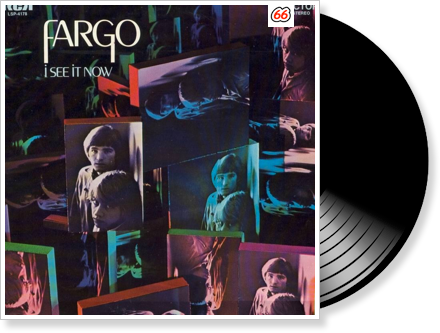
Title: I See It Now
Year: 1969
Format: LP
Label: RCA Victor
Salt Lake City-based psych-pop duo Fargo teamed Tony Decker and Dean Wilden. After debuting in 1968 with the Capitol single “Robins, Robins,” the pair signed with RCA in 1969 when their LP “I See It Now” was released.
Produced by Martin Cooper and arranged by Al Capps, who was best known for his work with the Nitty Gritty Dirt Band, among others, their album met with virtually no commercial recognition (probably due to poor promotion), and soon after Fargo dissolved.
“In the words of Frank Zappa: “It can’t happen here”, a lyric lifted from a piece on his 1966 album, Freak Out, he was just merely questioning whether or not a music scene could have existed in other places of the U.S. during the 60′s besides Los Angeles. How about Salt Lake City, Utah?
As much as Salt Lake City, Utah would seem like the most unlikely hot bed for any music scene to occur, yes it did happen there………
Fargo were a duo who released one album entitled, I See It Now, for RCA Victor in 1969. The album is pleasant psychedelic pop, with some great vocal harmonies, and the musicianship, along with the orchestral backing in spots is quite strong.
The down side of the album, though, is that there aren’t really any real stand out tracks, and can take some time to grow on you. However, once you listen to the album and it gets inside of your brain, then you’re hooked.
With that said, the album may not be a classic or masterpiece, but all in all is a very wise purchase not just for the psych collector in mind, but it is also not a musical disappointment either.
With the price online being no more than just a mere $15.00-$30.00, the album is also a wise investment that could appreciate in value one day as it draws more attention to a larger audience.
Not too much is known about Fargo, other than the group consisted of the duo, Tony Decker and Dean Wilden. The album did not really sell by any stretch at the time, due to lack of promotion from RCA records. Fargo dissolved thereafter.” (RecordFanatic)
Track Listing
- ‘Round About Way Of Describing Our Situation
- Long Goodbye
- Sound Of It
- Places Everyone
- Castles In Wales
- Talks We Used To Have
- When The Dew Drops Change Into Teardrops
- Promises Of Love
- You Need Me
- Cross With No Name
- I See It Now
The British Casuals – Hour World (1969)
Artist: The British Casuals
Title: Hour World
Year: 1969
Format: LP
Label: Mainstream
Unquestionably the most disappointing rock release on this highly collectable label. The (British) Casuals produced ultra-commercial male vocal pop with horns and orchestration.
The “British” was added to their name for releases on the Mainstream label in the U.S. to differentiate them from the American band, Ronnie and The Casuals. They formed in the UK in the early 60’s, and transfered to Italy in the mid 60’s, returning to Britain after their single “Jesamine” became a hit. (tymeshifter RYM)
Originally formed by John Tebb (piano and vocals) and Howard Newcombe (guitar), they added Don Fortune (drums) and Zenon Kawolski (bass), and became The Casuals in 1961. Upon turning professional in 1962 Fortune and Kawolski left, to be replaced by Mick Brey and Ian Good.
In 1965 they won the TV talent show Opportunity Knocks three times, leading to a recording contract with Fontana Records who issued their debut single “If You Walk Out”, which was unsuccessful. In 1966 Alan “Plug” Taylor (bass) joined, and the band moved to Italy, where they signed with CBS in Milan to record Italian language covers of British hit singles.
These included a #1 Italian single covering the Bee Gees’ “Massachusetts”. Good left in mid 1967, and was not replaced, but when Brey left later that year, Bob O’Brien joined on drums.
In 1968, whilst still in Italy, The Casuals switched to Decca Records, who released the single “Jesamine” which charted, so the band came back from Italy to promote the record, which reached #2 on the UK Singles Chart late in 1968.
“Jesamine” was a cover version of The Bystanders’ “When Jesamine Goes” issued in February 1968, and was co-written by Marty Wilde and Ronnie Scott (the Bystanders’ manager, not the famous jazz musician), under the pseudonym Frere Manston and Jack Gellar.The follow-up single, “Toy” (written by Chris Andrews) also made the Top 40, peaking at #30.
They were also successful in Germany, where “Jesamine” hit #9, and “Toy” went to #27, but their first and only album, Hour World, was issued too late to capitalise on these successful singles. Chris Evans stood in for Newcombe when he was ill, and when Taylor and O’Brien left in 1970, Evans became a permanent member, along with Lloyd Courtney. None of the following four singles managed to chart, and the group was dropped by Decca in 1971.
They signed to Parlophone in 1972 and released “Tara Tiger Girl”, but the single went nowhere, nor did a single “American Jam” for which the band was renamed ‘American Jam Band’, although, as both singles had the same B-side, the link was obvious. They left Parlophone for Dawn Records in 1974, but after their final single, “Good Times”, flopped, they disbanded in 1976. (Wikipedia)
Track Listing
- Jesamine
- Toyland
- Never My Love
- Fool’s Paradise
- Now You Can Be
- Daddy’s Song
- Hello It’s M
- Someday Man
- Touched
- Sunflower Eyes
- Hey-Hey-Hey
Forever & Ever – The First Look At….. (1967)
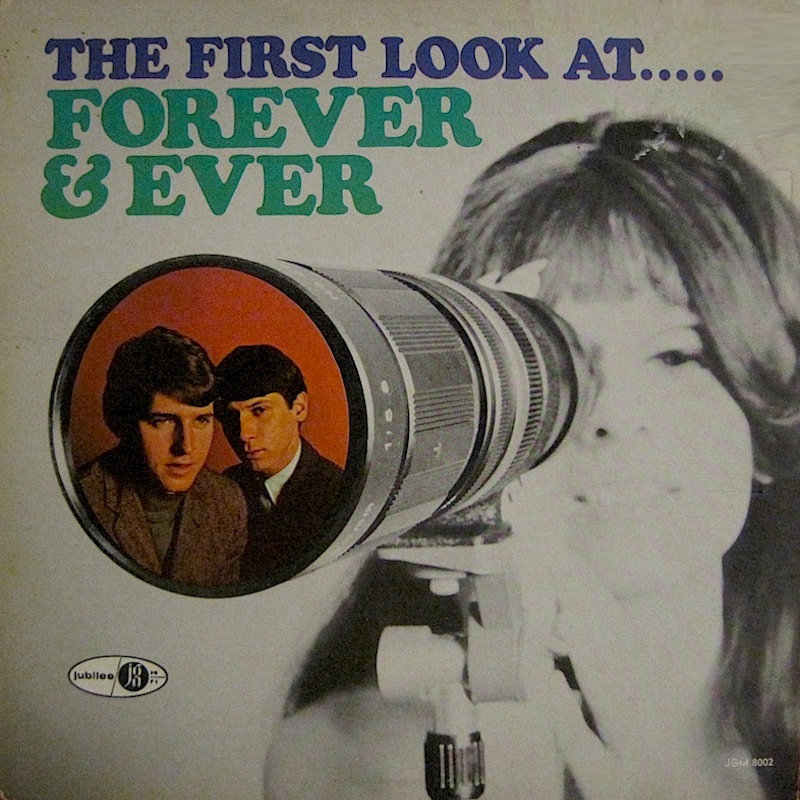
Title: The First Look At….
Year: 1967
Format: LP
Label: Jubilee
A poetry of words and music had not beeline of the legacies of rock ‘n roll’s influence on the pop music scene until the recent development of folk rock. When performers came from the field of “pure” folk music and found an eager and hit-making audience among much of the beat generation, it was as predictable as the ending of a western whose hero stands tall on a white horse that a fusion of folk and rock would materialize.
It is my belief that what could have been an artistic holocaust has proven to be extremely beneficial to both musical forms. Folk has rewarded rock with intelligence, insight and melodic interest, while many fascinating rock concepts have come along to underscore the many emotional levels on which fine folk material can be written. Folk music has helped rock ‘n roll come of age. Rock, in turn has provided folk material with an orchestration it has long been in need of.
A fortunate sign that we have by no means heard the last of talented folk-rock performers appears in the arrival of a new duo, FOREVER and EVER. Like their fellow talents in this bag, they are 20th Century minstrels, for Bob Corbin and David Hanner write and render their own material and are thus masters of their own fate in the world of entertainment.
Once “Lost Lambs,” a straight rock group that tried to buck the hard rock market over a two year period, Corbin and Hanner ventured into the folk-rock area in 1966, pooling their versatile talents as singers, musicians and writers to develop vocal arrangements of songs whose poignancy lend such haunting quality to this album.
These songs entail an entire complement of varied folk-rock themes, which, as students of the idiom recognize, involve impressions of a highly personal and imagery-loaded nature. There is, however, less propaganda or, as the euphemists might put it, “protest or message” song material from the pens of Corbin & Hanner than one has been conditioned to expect from this field. Nevertheless, their songs reflect the feelings of talents who are sensitive to man’s relationships with man and certainly, woman.
Happily, the boys do not take everything seriously. There is a charming number here, “Early Morning Bath,” which bathtub tenors should take delight in.
Whether one is inclined toward folk or rock he is likely to have the impression that FOREVER and EVER know what they are writing and singing about. They’ve got a sound and outlook that seems destined to be an important part of a great pop music force, the wide-wide world of folk-rock. (IRV LICHTMAN, Editor In Chief, Cash Box Magazine)
Track Listing
- Friday Woman
- Saints And Sinners
- I Love
- Travelin’ Man
- Little Sister
- And I Love Them
- The Beautiful Night
- I’m A Loner
- Peggy
- Early Morning Bath
Robert John – Compositions (1977)
Artist: Robert John
Title: Compositions
Year: 1977
Format: LP
Label: Guinness
For a guy who’s been active in music since the late-1950s, there’s precious little information available on Robert John Gallo (aka Bob Gallo). I can only admire him for protecting his privacy. As far as I can tell, 1977′s Compositions was his fourth solo release. It followed two albums released for his own Mandala label (1972′s A New Place To Live and Painted Poetry and 1977′s A Place To Live for Guinness.
The album seems to have been kind of a one man show with John responsible for producing and writing all of the material. Musically it’s hard to describe this one. The first couple of times I heard it I walked away thinking I’d been conned into buying a collection of MOR lounge act moves and that’s the predominant genre across these twelve tracks.
But the collection was quirky enough for me to keep coming back to it. (I stumbled across a great eleven word review of the album that captured it perfectly … “Can’t quite pinpoint it but there’s something really f***ed in here.”
The opener “Sweet Elephant” started out sounding like a slice of Liberace-styled keyboard flourishes, before shifting gears into something approaching a rock song structure, complete with martial drumming. Pretty, but forgettable.
John’s big band cover of the classic “Tequila” was surprisingly funky (nice guitar) and may have been the standout track. Sounding like a cross between a comedy skit and a dry run complete complete with humming conductor and miscellaneous sound effects, “I’m Going To Make You Love Me” was simply weird.
The up tempo “The Butterfly” offered up another weird mix of rock and big band sounds… quite disconcerting. – Featuring a nice acoustic guitar (and some hackneyed orchestration) “The Sea” was a pretty, but forgettable ballad.
“Umbrella Song” was another track that tried to blend rock instrumentation (fuzz guitar and mellotron) with a big band horns… call it a qualified success. – And from here on it was basically more of the same. I’d love to tell you “Open The Lid”, “I’m Down Again” and “Never Look Back” were awe-inspiring compositions, but they simply weren’t.
Occasional nice slices of fuzz guitar, but that was about it… The one exception was “Summer Skies”. Not that it was a particular amazing performance, but as the lone vocal performance it kind of stood out. It certainly won’t show up on anyone’s top ten list, but had a certain quirky charm that might appeal to a few folks out there. (Bad Cat)
Track Listing
- Sweet Elephant
- Tequila
- I’m Going To Make You Love Me
- The Butterfly
- The Sea
- Umbrella Song
- Open The Lid
- I’m Down Again
- Summer Skies
- Never Look Back
- It Hurts To Fall In Love
- Sailing
Hamilton Streetcar – Hamilton Streetcar (1969)
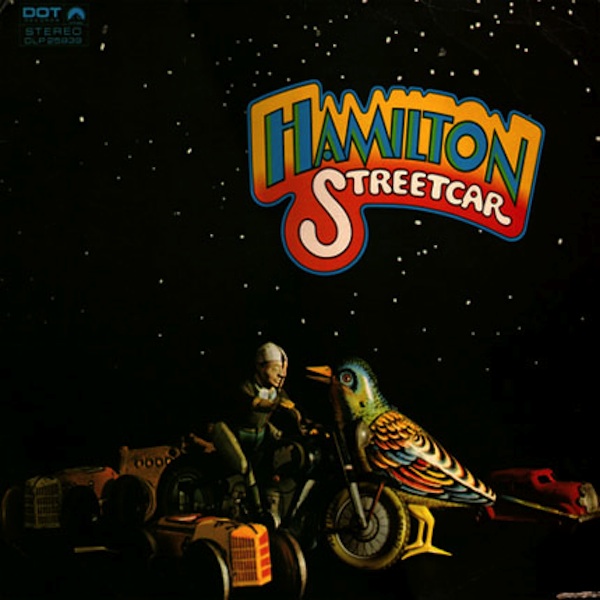
Title: Hamilton Streetcar
Year: 1969
Format: LP
Label: Dot
1969’s “Hamilton Streetcar” found the survivors of the original group working with producer Richard Delvy. The impact on creativity was obvious. Whereas Plummer had previously written all of the band’s material (he’d reportedly written some 50 tracks for their catalog), on the album his contributions were limited handling lead vocals and penning the pop-flavored ‘Silver Wings’. That left the newly recruited Clifford to pick up the creative slack (rounded out by numerous cover tunes).
Structurally the set was certainly odd, largely forsaking conventional three minute song structures in favor of a pair of side long, multi-part suites that frequently interweaved main themes with shorter refrains (examples included Clifford’s ‘Welcome into Your World’ and a cover of Tim Buckley’s ‘Pleasant Street’). Heavily orchestrated tracks like their cover of Lee Michael’s ‘Streetcar’, Boylan’s ‘Brother Speed’ (which the original band line up actually included in their live repertoire) and ‘I See I Am’ featured an engaging mixture of lounge act, MOR pop, with occasional psych moves.
The song quality bounced all over the place (Plummer himself has slammed the LP – see below), but several of the tracks were simply great – ‘Wouldn’t It Be Nice (To Have Wings and Fly)’ and Plummer’s ‘Silver Wings’ were personal favorites. Not a perfect comparison, but songs like ‘Now I Taste the Tears’ and the instrumental ‘Entre Acte’ sounded a bit like Curt Boetcher and Gary Usher’s work with Sagittarius. It certainly wouldn’t appeal to everyone, but folks into sunshine pop, or Boylan’s work with Appletree Theatre would probably find a great deal to like. Definitely different, the set has grown on me each time around … (Bad Cat)
Track Listing
- Overture
- Streetcar
- Brother Speed
- I See I Am
- Where Do I Go
- Now I Taste The Tears
- Welcome Into Your World
- Entre Acte
- Wouldn’t It Be Nice (To Have Wings And Fly)
- Silver Wings
- Honey And Wine
- Pleasant Street
- Wasn’t It You
Summerhill – Summerhill (1969)
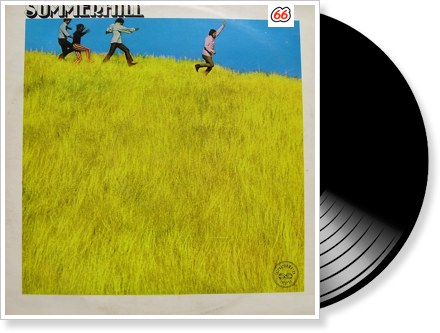
Title: Summerhill
Year: 1969
Format: LP
Label: Tetragrammaton
This album goes for the kitchen sink approach, kind of like the Sundowners and Condello albums. It mixes over-orchestrated popsike with semi-heavy rock and sparkling guitar rock. The combination of styles is a bit off-putting, and by the time you get used to it you’ll realize that only two or three songs really rise above, though those (especially the killer guitar pop tune “It’s Gonna Rain”) are very good indeed. I don’t expect anyone to like the whole thing, but if you prefer a spotty album with a few great songs to a consistent one with no standouts, this is worth picking up. (Acid Archives)
Track Listing
- Soft Voice
- Friday Morning’s Paper
- Bring Me Around
- The Last Day
- Follow Us
- The Bird
- My Way (Hard For You)
- What Can I Say
- It’s Gonna Rain
- Summer Days
T.S. Bonniwell – Close (1969)
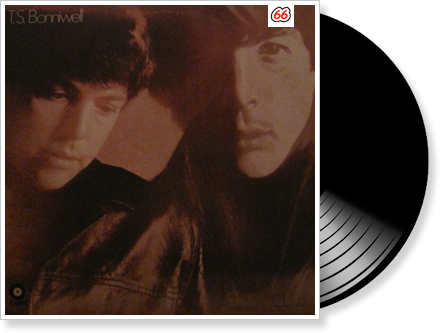
Title: Close
Year: 1969
Format: LP
Label: Capitol
T.S. Bonniwell is the billing that Sean Bonniwell used for his only solo album, Close, released on Capitol in 1969. This might be a bit confusing to Music Machine fans, who are familiar with the name Sean Bonniwell rather than the handle T.S. Bonniwell. For it was as Sean Bonniwell that he was the singer-songwriter and chief visionary of the Music Machine, one of the finest garage-psychedelic bands of the 1960s.
The Music Machine’s achievements and records are described more fully in their own entry. In brief, though, it can be noted that Bonniwell was by far the most important member of that group, penning their torturous but catchy riff-driven songs of psychological ecstasy and confusion, even if just one of them (“Talk Talk”) became a hit. Bonniwell was also their lead singer, usually using a gripping, throaty tone that could reach hair-raising intensity, though occasionally he could switch into a surprisingly smooth if moody croon.
The original Music Machine lineup broke up as they were getting their second album together, and much of the second album and some of their final singles are primarily the work of Bonniwell, with assistance from some other musicians. Bonniwell sold the rights to the name of the Music Machine to get out of his contract with Warner Brothers. He soon recorded his solo album, with Vic Briggs (who’d been guitarist in the late-1960s version of the Animals) producing.
The record, while it has its good points, was quite a shock given the grinding organ-and-fuzz-guitar-helmed rock Bonniwell had usually churned out with the Music Machine. Close, by contrast, was tremulous singer-songwriter pop that verged on MOR territory at times. Bonniwell forsook his raunchy vocal persona almost totally in favor of his sensitive, clear croon, perhaps in a partial retreat to his pre-Music Machine folkie days, when he’d been in the Wayfarers. Influences from lounge pop, bossa nova, and flamenco were evident in a set decorated by subdued orchestration.
For open-minded listeners, Close does have some positive attributes, particularly in the introverted-to-the-point-of-reclusion lyrics and its sad but sweet melodies. Often Bonniwell sounds like a man whose roaring fire has dwindled down to a candle in the wind, such is the fragile and burned-out nature of songs like “Black Snow” and “Sleep.” In an interview with the magazine Ugly Things, Bonniwell described it as “kind of like, if Neil Diamond did an imitation of Johnny Mathis.” (How about Tim Buckley?)
There were only 5,000 copies printed and it was only issued in California, and as it’s never been reissued on CD (Hey Richie yes it is please visit Sean’s site http://www.bonniwellmusicmachine.com/ and order a copy!!!) it’s quite rare and difficult to hear. Bonniwell was not happy with the record, and left the music business after its release. Decades later he wrote his autobiography, Talk Talk, retitled Beyond the Garage when it was revised. (Richie Unterberger, All Music Guide)
Track Listing
- Where Am I To Go
- Love Is Such A Simple Word
- Who Remembers
- Something To Me
- Black Snow
- She Is
- Temporary Knife
- Continue
- Where It belongs
- But Not With My Heart
- Sleep
Rain – Rain (1972)
Title: Rain
Year: 1972
Format: LP
Label: Project 3
Another impressive Project 3 label recording. The production on this is soft and slick, but exactly what these songs needed, and not a detractor. There are hints of the Zombies and Beatles in the songwriting, yet with a more progressive feel. Keyboards dominate many of the melodies, and add great texture. The real highlights are the songwriting and vocals, which display great talent. Most of the lp’s are said to have pressing flaws. A once obscure record that has been recently gaining momentum. (Jack Dominilla)
Track Listing
- Can You Help Me Sing My Song
- To A Dreamer
- Mother’s Evil Child
- Love Me Still
- All Your Days Are Long
- Let Our Hopes Run Our Dreams
- Song To Barbara
- You Take Me Higher
- He Could Have Known
- As I Played My Song (For You)
- Springtime [bonus non lp]
The Bubble Gum Machine – The Bubble Gum Machine (1967)
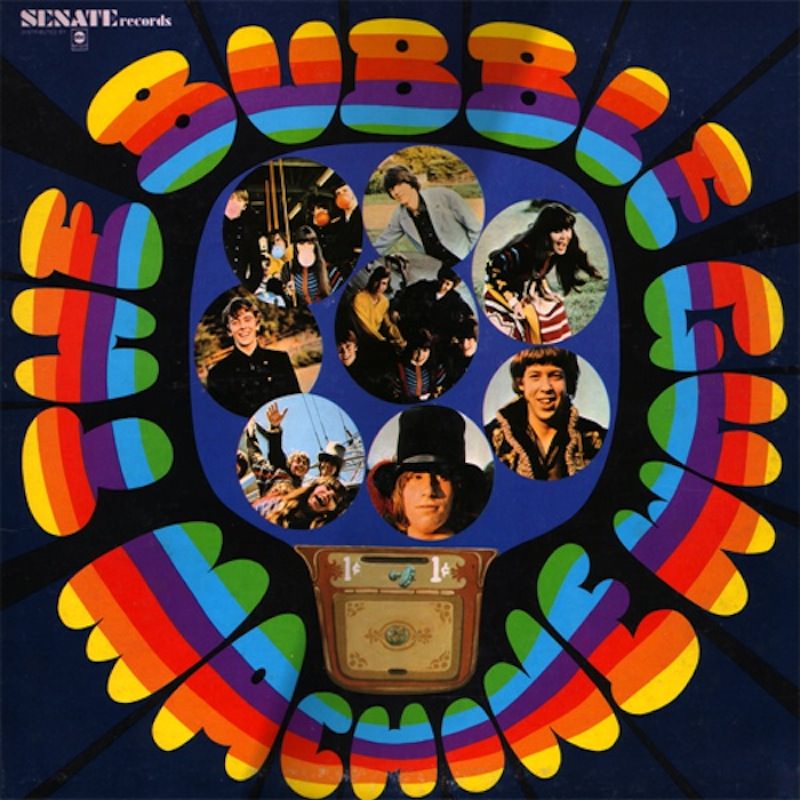
Title: The Bubble Gum Machine
Year: 1969
Format: LP
Label: Senate
Here’s another one I haven’t been able to learn much about. A five piece (judging by the cover and first name liner note credits), they seem to have been a studio project for producer/writer Wes Farrell. Released by the ABC affiliated Senate label, their self-titled 1967 album featured a decent mix of Farrell-penned originals (“Wha’Cha Gonna Do For Me Now” and “I Wonder”) and popular covers (Beatles, Buffalo Springfield, The Bee Gees, whose “To Love Somebody” was mis-credited to Robert Gibb – think they meant Robin Gibb.
To be honest, “The Bubble Gum Machine” isn’t going to drastically change your life. The uncreditted male vocalist had a decent enough voice, while their attractive female singer (‘Vicki’ – no last names shown on the credits) had a voice than bore a passing resemblance to Cass Elliott. Unfortunately, as far as mid-1960s music goes, nothing here is particularly original or inspiring. ‘Bout the best you can say is that “The Love of a Woman” has a certain top-40 charm and they would have made a great bar cover band. (Bad Cat)
Track Listing
- Wha’Cha Gonna Do For Me Now
- To Love Somebody
- A Song That Never Comes
- For What It’s Worth
- The Love Of A Woman
- I Wouldn’t Be Lonely Anymore
- You Make Everything Right
- I Wonder
- No Love To Be Found
- Sgt. Pepper’s Lonely Hearts Club Band
The Appletree Theatre – Playback (1969)
Title: Playback
Year: 1969
Format: LP
Label: Verve Forecast
The Appletree Theatre was a studio group of American musicians who released the album Playback in 1967.
The project was set up by brothers Terry and John Boylan, with leading jazz session musicians including Larry Coryell and Eric Gale. The album was essentially a loosely-woven concept album, comprising a collage of interlaced vocal narratives, sound effects, song fragments, and quality pop songs such as “Hightower Square” and “I Wonder If Louise Is Home”. John Lennon referred to it as one of his favourite albums.
In the wake of the set’s commercial failure Terry went solo, releasing three albums as a singer/songwriter, while John reappeared as a member of the short-lived Hamilton Streetcar before turning his attention to production with the Eagles, Linda Ronstadt, and others. (Wikipedia)
Track Listing
- THE ALL TOGETHER OVERTURE: …in the beginning… HIGHTOWER SQUARE (the start of it all)
- ACT I: lullaby
- SATURDAY MORNING (about a Saturday morning)
- NEVERTHELESS IT WAS ITALY (a déjá vu in a pizza parlor, and a bit of merry olde England)
- ACT II: I WONDER IF LOUISE IS HOME (a bit of tragic relief)
- chez Louise
- E-TRAIN (the jello song)
- meanwhile… BROTHER SPEED (vocal with didactic chorus)
- YOU’RE THE BIGGEST THING IN MY LIFE (being, as it is, a pause in the proceedings)
- ACT III: DON’T BLAME IT ON YOUR WIFE (the fellini song, an ode or an elegy depending on tomorrow)
- THE SORRY STATE OF STAYING AWAKE (an old banjo tune we rearranged)
- EPILOGUE: BAREFOOT BOY (a bit of Johnny Appleseed)
- LOTUS FLOWER (Michael, John and Boona)
- WHAT A WAY TO GO (yes)