
Gil Mellé – The Andromeda Strain O.S.T. (1970)
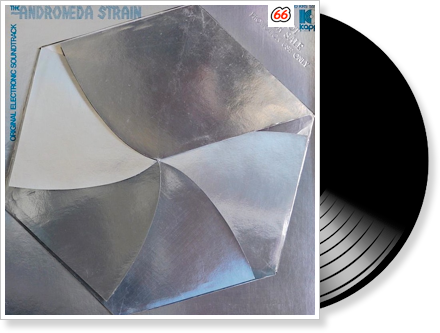
Title: The Andromeda Strain O.S.T.
Year: 1970
Format: LP
Label: Kapp
In 1970, during the editing of his now classic movie The Andromeda Strain, the director, Robert Wise, approached me with a view to have the soundtrack album marketed in a special manner. I was then in charge of Order Service for MCA Records; that is, record manufacture.
He asked if it was possible to have the record pressed in a hexagonal shape as the extra terrestrial viral strain called Andromeda in the film was hexagonal. I said anything was possible, but that it would cost an estimated $20,000. While this was then a high figure for record production, it was minimal to the movie business and was agreed.
The executives at Kapp Records were only too happy to go along with the scheme as it relieved them of the production costs. (The soon to be defunct Kapp Records was one of several labels under the MCA umbrella at the time.) I discussed the matter with the president of Monarch Records, who pressed all MCA record requirements for the West Coast at that time.
My idea was to have the music recorded in 10 Au format but put on a 12 Au matrix and manufactured as a 12 Au record. A steel hexagonal mold would then be made and this would be used in a press to trim the excess material from the 12 Au record to make a hexagonal shape, leaving the 10 inches of recorded material intact. This became the production method.
Kapp had agreed to a production run of 10,000 records. The pressing process encountered some problems: the unrecorded surface of the record had to be roughed so that it could be gripped for the cutting. This left unsightly corners on the finished record, therefore a more careful method of roughing only those edges that would not form the corners of the finished record had to be devised. Also, for a run of 10,000, the edges of the mold had to be sharpened frequently so as to leave a clean edge on the record.
The packaging into the record jackets also required extra time compared with normal jacketing. However, the total cost, including a spare mold, came to somewhat less than the quoted figure of $20,000. MCA were fortunate in having a very creative design team for their record jacket production. John LeProvost and Virginia Clark wanted to reflect the fact that it was music from a movie, thus they came up with the idea that the jacket should emulate a camera lens surrounding the actual record, but nevertheless pasted on a 12 Au square board.
The original 10,000 records sold out fairly rapidly. Gil Melle, the composer of the music, urged a second pressing, but the Kapp management did not want to go to the expense of reproducing the original format. It was therefore decided to repress the 10 Au recording on a 12 Au standard record and package it in a standard jacket. This did not sell so well, and MCA soon lost interest in the record.
Hope that’s of some interest to the ANDROMEDA STRAIN fans out there. Looking forward to the continuation of the vinyl piece. (filmfactsman RYM)
Track Listing
- Wildfire
- Hex
- Andromeda
- Desert Trip
- The Piedmont Elegy
- Op
- Xenogenesis
- Strobe Crystal Green
Disclaimer: The link below may point to content that is copyrighted. redtelephone66 only provides this link with the understanding that you are responsible for the content you download. redtelephone66 does not engage in music piracy, nor do we do host, fileshare, or otherwise trade in copyrighted works.

My brother had this one. It had a plastic bag for an inner sleeve with a sticker on it warning you not to play in on automatic turntables, as it would destroy your needle.
hello leonard…
an interesting back story on this recording, or at least the making of the tangible end product. very creative concept and packaging. can’t say i’ve ever heard the soundtrack, although i do remember the film title. is yours a vinyl rip from the hexagonal first pressing?
Never mind the packaging – the music is fantastic – great squelchy analogue synths, mysterioso swooshes – and it made me do a little research on the composer, who turns out to have been a fascinating guy -
Gil Melle was one of the most fascinating and underappreciated figures in post-bop jazz. A prodigy as both a musician and painter, he was a pioneer of jazz/classical fusion and electronic music. Compositions like “The Gears”, “Mindscape” and “Funk for Star People”, while never destined to become standards, typified the advances he made in American musical conception. Melle died suddenly at his home in Malibu, California, on October 28, 2004, at the age of 72.
Melle was born in New York City on December 31, 1931, and abandoned by his parents while still a toddler. He was raised by friends and showed early promise as an artist, winning several major painting competitions before high school. He took up the saxophone around the age of 14 and was playing professionally in Greenwich Village within two years.
In 1950, at nineteen, Melle became the first white musician signed to Blue Note, and also designed several album covers for the label. He also took the climactic step of introducing Alfred Lion to his friend, recording engineer Rudy Van Gelder, whose methods became an essential element in the Blue Note sound. From the get-go Melle’s music was well advanced beyond modern jazz of the time, reflecting early developments in the classical/jazz fusion he later dubbed “Primitive Modern”. His 1956 album Patterns in Jazz was one of the label’s most modernistic releases for years to come. Later that year he signed to Prestige, for whom he recorded three albums in one year before leaving the jazz scene in favor of studio work.
In the early 1960s Melle began working as a film and television composer in Los Angeles, writing music for Rod Serling’s “Night Gallery”, “The Andromeda Strain”, and over 125 other movies and TV shows along with more standard orchestral works. Many of his scores were entirely electronic, completely innovative at the time. Melle also pioneered many developments in electronic music, including early analog synthesizers and drum machines. His band The Electronauts was the first all-electronic ensemble to perform at Monterey. Melle only recorded sporadically from the late 1960s until his death, preferring in the end to concentrate on painting and digital art.
Hello,
WOW, this was in fact a very interesting one.
Especially about the production of this piece of “pop culture”, or let me say “pop art”.
I was very surprised that the release from ADD N TO (X) which had actually the same design, havn’t been the “first born”.
At least the idea of having one quite original idea of packing from this over-the-top-art-band, came to an end.
But to be true: I still love them the same.
For those who are interested:
http://www.discogs.com/Add-N-To-X-Little-Black-Rocks-In-The-Sun/release/36473
Kind regards
Andreas Krings, Munich/Germany