

White Lightnin’ – File Under Rock (1969)
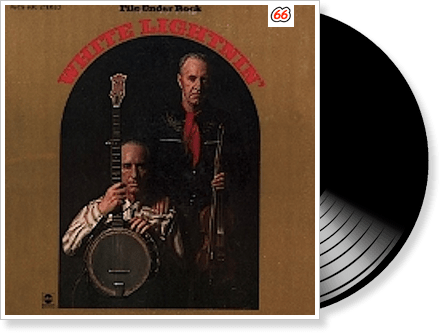
Title: File Under Rock
Year: 1969
Format: LP
Label: ABC
Post courtesy of MrWebster
White Lightnin’ consisted of two old-timey musicians from North Carolina, Obray Ramsey (banjo) and Byard Ray (fiddle), backed by some of New York’s top session musicians. Ramsey had recorded several albums at this point, which featured him singing with only banjo backing. Here, he and Ray (his cousin) were backed up with a full ensemble, complete with fuzz guitar and the jazzy bass playing of Chuck Rainey.
Exactly how this collaboration came about is still a mystery. There are moments where it works, but, more often than not, it sounds like an ill fit. The closing, 7-minute “Amazing Grace” which sounds like Ramsey and Ray mistakenly walked into a black church, is probably the biggest “what were they thinking?” moment here.
Although it is commonplace today to bring together musicians of different genres for experiments such as these, at the time it was not so. While Billboard gave the album a positive review, many bluegrass and old-time purists, understandably, gave it the raspberry. The curious title of the album only served to alienate the traditionalists and confuse buyers.
The album “File Under Rock” features personnel identical to that of Len Novy’s “No Explanations” (see July 29, 2010 post with the addition of Ramsey, who does not appear on that album.) Like “No Explanations”, “File Under Rock” was produced by Arthur Gorson (Tom Rush, Ars Nova) at Century Sound, NYC (liner notes state that it was recorded live in the studio”).
Other musicians include guitarists Sam Brown, Len Novy and Ralph Casale, bassist Chuck Rainey, drummer Herb Lovelle, David Frishberg on piano and Jimmy Owens on trumpet and flugelhorn. The choir vocalizations are courtesy of one “Wonderous Joy Clouds”. The album was released by ABC in August 1969 to no response.
Obray Ramsey and Byard Ray also are seen and heard in the film Zachariah and one cut appears on that film’s soundtrack.
A year later, with Gorson still at the helm and some of the same personnel in tow, they cut one album for Polyor, “Fresh Air”, which featured Eric Andersen and Judy Collins as guests. It sounds a little less dated than it predecessor and the production shows a little more restraint.
A little trivia for you: Obray Ramsey was Mel Lyman’s mentor on the banjo, and he also was the subject of Matthews’ Southern Comfort’s “Ballad of Obray Ramsey”, issued as the b-side to their renedition of “Woodstock” in 1970. (MrWebster)
Track Listing
- Pretty Sparrow
- All The Good Times Are Past And Gone
- Saro
- Pretty Polly
- The Unclouded Day
- New River Train
- Down In The Willow Garden
- Crazy Arms
- Amazing Grace
From the back cover of Obray Ramsey’s 1957 LP Blue Ridge Banjo, notes by Kenneth S. Goldstein:
In recent years, we have heard all to often about the ‘dying’ of folk
culture in the Southern mountains. Many of the collectors who ventured into this area to record the songlore of the region in the 1930s and ’40s, shed sorry tears for the passing of a beautiful and rich tradition, each proclaiming his own collection to be the “last leaves” of this once-proud heritage. So, fewer and fewer adventuresome souls have involved themselves in recording the still-living tradition of the area. Those who have, however, have been amply rewarded by finding that, even though mountain life
has been completely revolutionized in the past few decades, tradition dies hard, and numerous singers may still be heard and recorded. To be sure, there are new sounds and new songs, but this material is, in many ways, as vibrant and vital as it was in the days of Cecil Sharp’s pioneering collecting forays.
Obray Ramsey, whose sprightly banjo songs and instrumentals make up this LP, is living proof that this tradition still exists. And there are many more young, middle-aged and old folksingers like him, who have retained the best songs of their hardy mountain ancestors, perhaps changing some of them to suit their own artistic and performing abilities, but still retaining the best elements of old-style singing and playing.
Ramsey was born on the banks of the three Laurels at the edge of the Smokey Mountains in western North Carolina. His father’s people came from the highlands of Scotland, and his mother’s ancestors were Cherokee Indians.
Most of his songs were learned from his mother and grandmother, both fine singers with extensive repertoires. For most of his life he has sung his songs unaccompanied, though he had learned to play the guitar when still a young boy. After he married and settled down as a successful farmer near Marshall, North Carolina, he met Bascom Lamar Lunsford, folksinger, collector, and organizer of the Mountain Dance and Folk Festival held annually in Asheville, North Carolina. Lunsford recognized his fine singing talents and encouraged him to take up the 5-string banjo, which he believed would be perfectly suited to Obray’s style of singing. To show his faith in this belief, Lunsford gave Ramsey his first banjo in 1953. Now, Obray Ramsey is one of the finest banjo-pickers in the Southern Mountains. His style is a perfect compromise between old picking styles and currently popular modern styles.
Bio I found on Byard Ray a while back, sorry, can’t recall the source, and google has come up dry. (weird)
A lifetime musician, this North Carolina fiddler and banjo player received a National Endowment for the Arts grant and did a smattering of recordings in the late ’70s and early ’80s. Then Byard Ray pretty much slipped out of both the sights and minds of old time music enthusiasts, not even earning a nod of recognition from collectors who know the name of similar artists from the ’20s who made one or two records. Ray began playing fiddle when he was
seven, his greatest inspirations were players born in the mid- to late 19th century, such as J. Dedrick Harris, Ashbury McDevitt, and Ray’s great uncle, Mitchell Wallin. His natural talent on the instrument was kept a secret from everyone but his brother, Otis, because the youngsters had been strictly forbidden to touch the instrument out of fear that they would wreck it.
Finally the truth came out when the two brothers were hanging around one day with a visiting fiddler, who thought he would do the little boy a favor and give him his first fiddle lesson. Despite Ray’s account of the tale, in which the fiddler threatens to kill his mother if she “whups” the boy for touching the fiddle without permission, fiddling seems to have been a family tradition with players such as great grandfather Morris Gosnell, his mother Rilla May Wallin, and his father William Morris Ray. And those are just the relatives whose names he could remember.
Ray grew up in a tradition of music, stories, and ballads being passed along orally among family members and friends in the community. He also adapted to modern times and the more urban environments that developed, in which the instruction of this type of cultural material began to be focused around university settings. By the ’80s, Ray had become a fiddle and banjo teacher at a variety of colleges, including Berea College in Kentucky and Warren Wilson College in the mountains of North Carolina. Students at such
institutions actually encouraged Ray to record his first solo project,
Traditional Music of Southern Appalachia, pressed on vinyl by Durham’s Sounds Good Studio, complete with an outlandish psychedelic cover. This was not his first recording by any means. He participated in two albums done during the folk revival of the ’60s, focusing on numbers done by Ray in tandem with another musical family member, his cousin Obray Ramsey, a banjoist. But although the two were used to playing as a duo, producer John
Simon lured them to New York City, where they performed along with a studio band featuring a strange range of players, including the sometimes avant-garde classical guitarist Sam Brown, studio pro and funkmeister Chuck Rainey, drummer Herb Lovelle, the amusing pianist Dave Frishberg, and even a black gospel group, the Wondrous Joy Clouds. The result of this collaboration certainly sound intriguing, if anyone can find a copy of the record. It was entitled File Under Rock, and the ad hoc group was given the
name White Lightnin’, at that time a slang term for a type of LSD, as well as the traditional name for home-brewed liquor from the mountains. A second album, entitled Fresh Air, was also released, meaning someone must have been happy with the initial results. The latter recording is notable for an interesting Bob Dylan cover version of “I’ll Be Your Baby Tonight,” featuring the old time musicians performing with softer folkies Judy Collins
and Eric Anderson. Slightly more accessible through the archival world of late-night television is the drug-soaked hippie western Zachariah, another strange project Ray and Obray got into via a connection of the White Lightnin’ project. It is safe to say that this film represents the largest audience exposure Ray’s music ever received, even if it was a film that sank like a stone(d). He also recorded for several labels with the Laurel River Valley Boys, also featuring Ervin Lewis and John Ray.
In the early ’70s, he formed a string band named the Appalachian Folk, and created an album based on the group’s repertory. Membership included Lou Therrell on banjo, Vivian Hartsoe on guitar, and Arlene Kesterson on bass. His daughter, Lena Jean Ray, is also an accomplished singer of mountain ballads and traditional material. His granddaughter, Donna Norton, after
initially rebelling from hearing so much of this type of music around the house, became interested in it after all when she went away to college in New York City and found out how much her fellow students liked Appalachian music. She began performing in a duo with Lena Jean shortly thereafter.
Billboard 16 Aug 1969 – album spotlight review. (no album title listed?)
WHITE LIGHTNIN’-ABC ABCS 690 (S) This is a fascinating album. Byard Ray and Obray Ramsey, mountain fiddler and banjoist, respectively, are joined by some excellent New York musicians and go to town on such tunes as “All The Good Times Are Past And Gone,” “Pretty Sparrow,” “Amazing Grace.” Jimmy Owens, Len novy, Ralph Casale, Sam Brown, Wondrous Clouds Of Joy are some of the people who contribute to the sides. Arthur H. Gorson produced. An exciting, creative package.
Until today, I’d only heard of White Lightnin’ in conjunction with the movie Zachariah (another fun soundtrack, eh?). I’m looking forward to expanding my musical horizons with this. Thanks again!
This is one of my all-time favorite albums. I don’t remember how I heard about it in 1969, but I bought it really not knowing what to expect. I was blown away. Still am, today. It is too bad it was never transferred to disk. I wonder if Dave Frishberg even remembers this. Their version of Amazing Grace was worth the price of the record alone (which I think was $3.99).
I was living in Oakland in the late 60′s and a radio jock played Amazing Grace from this album. I went straight out to Berkeley and bought it, probably from Tower Records. I still have it. I haven’t looked at my vinyls in many years but most of them are pristine, so I hope this one is also. Everything is in storage in the US while I spend some time in Saudi Arabia.