

Mark Eric – A Midsummer’s Day Dream (1969)
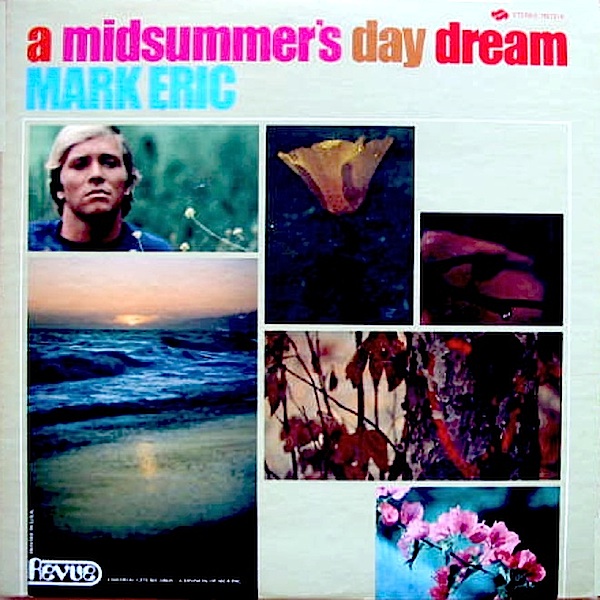
Title: A Midsummer’s Day Dream
Year: 1969
Format: LP
Label: Revue
L.A. native Mark Eric was leading the Southern California dream life in his teens — surfing by day and writing songs about girls by night — before his musical talents drew him to Hollywood. He was 16 when he met Russ Regan, then at Warner Bros., but his first break came while waiting in the lobby of label honcho Lou Adler’s office. There he met Bob Raucher, an engineer at local KHJ radio station (who wondered why Eric wasn’t in high school). Raucher took a liking to the suntanned surfer/songwriter, and, under his “personal management,” Eric was soon recording at Gold Star studios in Hollywood.
One of his songs was later recorded by the Four Freshmen, who were by then on Liberty. Subsequent sessions by Eric, backed with studio musicians, led to another meeting with Regan, now heading up UNI (owned by MCA), who signed the promising soft pop singer to the label.
Eric only recorded one album, A Midsummer’s Day Dream, which was released in 1969 on UNI’s R&B subsidiary, Revue Records is treasured by collectors as one of the more perfect blends of soft pop and surf pop, with appropriately accenting vibraphones and French horns, pseudo-studio jazzy/soft pop melodies, “bah bah bah” harmonies, and moody string arrangements reminiscent of Curt Boettcher’s productions of Sagittarius and the Millennium. Eric’s charming, somewhat imperfect falsetto (in a somewhat obvious homage to Brian Wilson) hints at a subterranean layer of loneliness throughout.
His self-penned, broken-hearted Beach Boys-style ballads (think Pet Sounds/Friends) are, in fact, the perfect vehicle for his faltering upper-register voice. Highlights include “California Home” (about a homesick airplane flight away from L.A.); an end-of-summer lament, “Where Do the Girls of the Summer Go”; and “Don’t Cry Over Me,” with its gorgeous blend of harmonic filigree and sophisticated studio sheen. .
Eric eventually left music behind and began working as an actor in Hollywood, appearing on numerous TV sitcoms and several commercials. One of his songs, “Fly Me a Place for the Summer,” was later recorded by the Mike Curb Congregation for an airline commercial. (Bryan Thomas, All Music Guide)
Track Listing
- California Home
- Move With The Dawn
- Laura’s Changing
- Where Do The Girls Of The Summer Go
- I’d Like To Talk To You
- Take Me With You
- Night Of The Lions
- Don’t Cry Over Me
- We Live So Fast
- Sad Is The Way That I Feel
- Just Passing By
- Lynn’s Baby
Disclaimer: The link below may point to content that is copyrighted. redtelephone66 only provides this link with the understanding that you are responsible for the content you download. redtelephone66 does not engage in music piracy, nor do we do host, fileshare, or otherwise trade in copyrighted works.



Awesome!! I love “Night of the Lions” on the ANGELS DIE HARD soundtrack LP so good to know he recorded an entire LP. Look forward to checking this out!
This is one of the greatest albums of all time!
Is this a vinyl rip? It sounds remarkably like the cd reissue from a few years back…
Hello Jawchop,
It’s a cd rip minus the bonus tracks.
excellent post man
after listening to the dl – I can see what jawchop means – there’s been remixing here and although the instruments are more pronounced I think I like the LP better – everything is more blended – plus Eric’s voice sounds different – here there’s a little bit of a donald duck sound – like it quacks somehow – remixers have to be very careful -digital sound is better then it used to be – but it’s like an overpowered car – the starts and stops tend to be accentuated – unless you really have a fine control of what you’re doing